
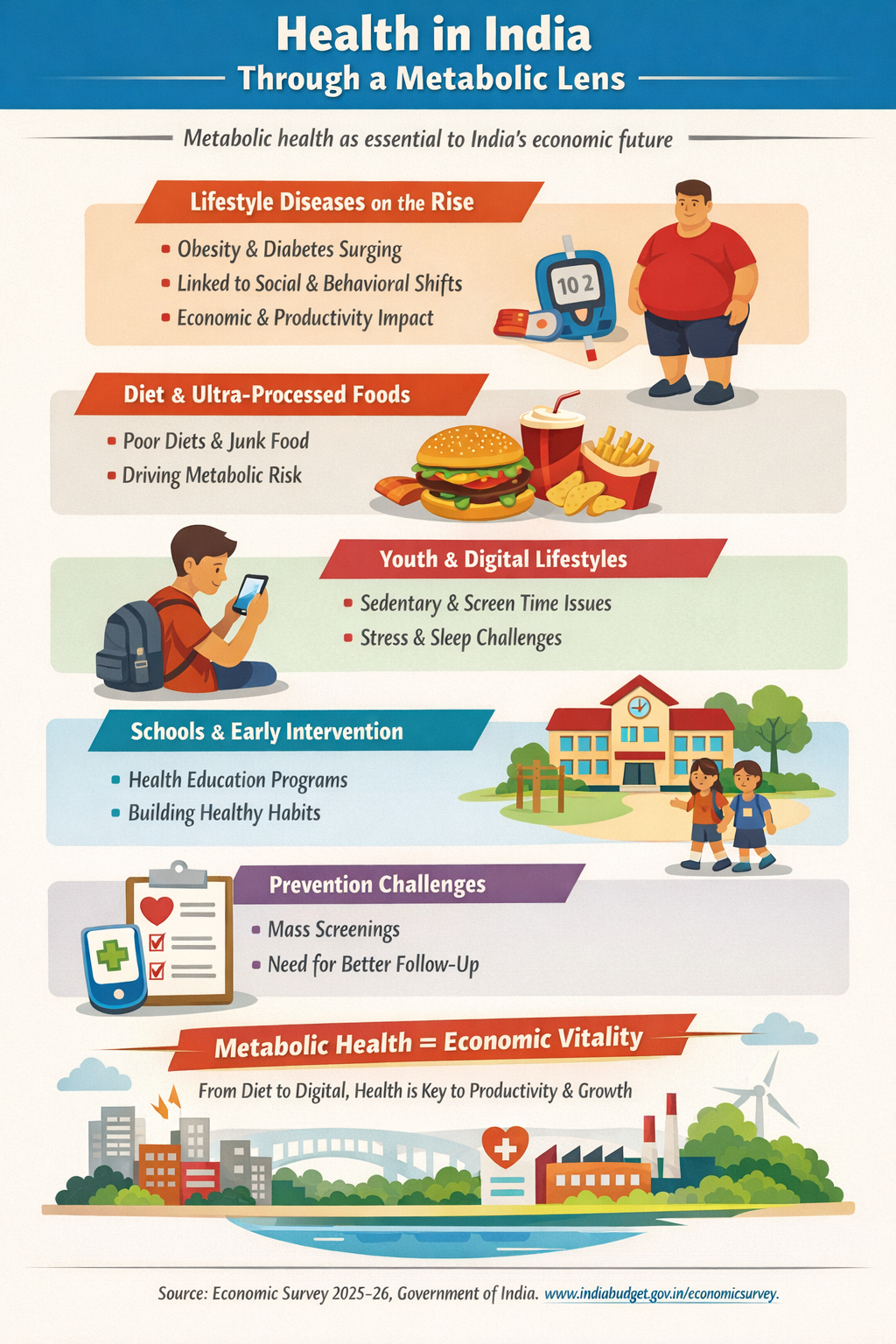
This article is framed by public health trends highlighted in the Economic Survey 2025–26 (Government of India) and referenced against the official document hosted at https://www.indiabudget.gov.in/economicsurvey/. (India Budget)
Reframing Health for the 21st Century: Metabolic Risk, Systems Change, and India’s Economic Future
Health is no longer simply a personal or clinical issue — it is now deeply economic, social, and structural. That’s the powerful insight emerging from the Education & Health chapter of India’s Economic Survey 2025–26, a flagship analytical document authored by the Ministry of Finance ahead of the Union Budget. (India Budget)
While the Survey acknowledges progress in traditional health outcomes, it spotlights metabolic health as a defining challenge of our era — with implications far beyond hospitals and clinics.
1. The New Face of Public Health: Lifestyle Diseases Are Front-and-Centre
For the first time, India’s premier economic analysis frames obesity, diabetes, and other non-communicable diseases (NCDs) as threats not just to individual wellbeing but to economic productivity and human capital. (Business Standard)
These conditions are:
-
Rising rapidly across age groups,
-
Deeply linked to social and behavioural shifts,
-
And now recognised as systemic — not just clinical — risks. (The Week)
For Metabolic Matrix, this validates a core thesis: metabolic dysfunction is an economic risk factor, not merely a healthcare demand.
2. Diet Quality and Ultra-Processed Foods: Structural Drivers of Metabolic Risk
The Survey highlights that India’s dietary profile has shifted — with increased consumption of calorie-dense, nutrient-poor foods contributing to escalating obesity and metabolic stress. (The Economic Times)
This is not merely about individual choice. It’s a food environment issue — tied to availability, marketing, and cultural norms around ultra-processed foods. Metabolic Matrix’s emphasis on food system transformation aligns directly with this structural framing.
3. Youth, Digital Culture, and Health Behaviour
India’s rapid digital adoption is a double-edged sword. While digital technologies support education and innovation, the Survey flags digital addiction and sedentary lifestyles as emerging public health challenges — with implications for sleep, stress regulation, and lifelong metabolic risk. (The Week)
For anyone aligning health with productivity and wellbeing, this reinforces an essential point:
Digital behaviour shaping is metabolic shaping.
4. Schools and Early Intervention as Metabolic Lever Points
The Economic Survey explicitly identifies schools as platforms for health promotion — from dietary literacy and physical activity to community and family engagement. (The Economic Times)
This supports Metabolic Matrix’s strategic framework that metabolic resilience is cultivated early — in learning ecosystems, family environments, and social norms, not just clinics.
5. Prevention-First Orientation, But Fragmented Systems
Mass screenings for hypertension and diabetes have been rolled out at scale, demonstrating India’s capacity for public health reach. (The Week)
However, the Survey intimates that detection alone — while important — is not sufficient. The real challenge lies in connecting detection with robust preventive systems, behaviour design, and environmental change. That’s the space where metabolic transformation policy must invest.
Metabolic Health as Economic Infrastructure
Perhaps the most profound shift in the Survey is its framing of health as human capital — a foundational asset for sustained economic growth and productivity. (India Budget)
This perspective dovetails with Metabolic Matrix’s narrative:
Metabolic health is not a cost — it’s a capability.
From schools to workplaces, from food environments to digital ecosystems, metabolic health intersects economic performance, cognitive potential, and societal wellbeing.
Looking Ahead
The Economic Survey of 2025–26 confirms that metabolic risk factors — obesity, dietary quality, behavioural patterns, and lifestyle diseases — are now core societal determinants of future economic success. (Business Standard)
For Metabolic Matrix, this creates a compelling opportunity: to shape policy, design interventions, and guide narratives that place metabolic wellbeing at the centre of human and economic development.
Source: Economic Survey 2025–26, Government of India — accessible at https://www.indiabudget.gov.in/economicsurvey/. (India Budget)