
Ultra-Processed Foods and the Hidden Plastic Crisis: A Metabolic Perspective
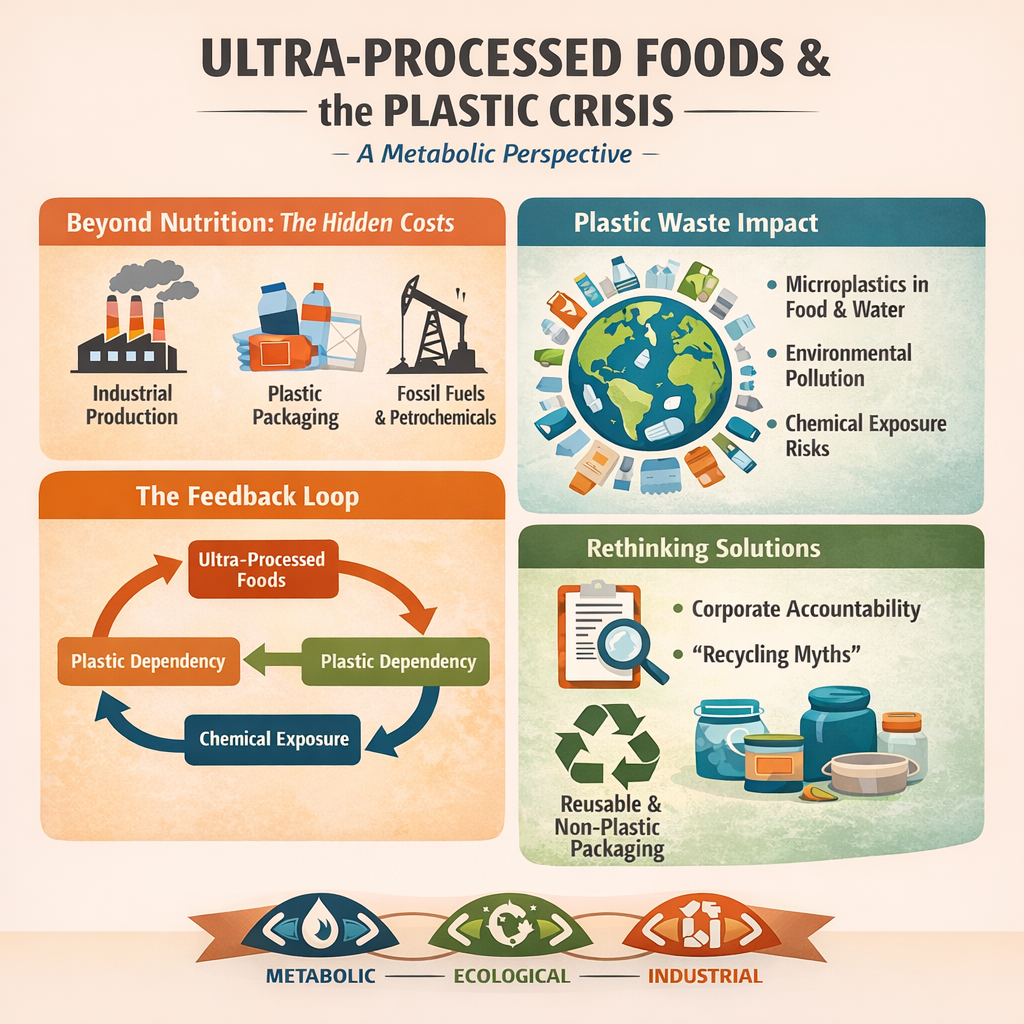
A newly published Nature Food commentary brings an urgent and often overlooked connection into focus: ultra-processed foods (UPFs) are not just a metabolic or nutritional issue—they are a major driver of the global plastics crisis.
For those working within the Metabolic Matrix framework, this paper is particularly compelling. It reinforces a core principle: metabolism does not exist in isolation—it is embedded within ecological, industrial, and political systems.
Beyond Nutrients: Seeing the Full System
Most discussions about ultra-processed foods center on their internal composition—high levels of sugar, salt, unhealthy fats, and synthetic additives. But this paper asks us to widen the lens.
UPFs are not just foods. They are industrial products co-produced with petrochemical systems.
Plastic packaging is not incidental—it is foundational.
Without cheap, lightweight, and highly engineered plastics, UPFs could not exist in their current globally dominant form.
This reframes the issue entirely:
-
UPFs are not only metabolically disruptive
-
They are ecologically extractive and structurally dependent on fossil fuels
The Invisible Infrastructure of Consumption
Plastic packaging has become so normalized that it is largely invisible. Yet it shapes behavior at scale:
-
Enables global distribution and long shelf lives
-
Supports hyper-palatable, ready-to-consume products
-
Reinforces “throwaway” consumption patterns
Flexible plastics—multi-layered, non-recyclable materials used for snacks and convenience foods—are particularly important here. They allow for precise atmospheric control, preserving taste and texture while enabling mass distribution.
From a systems perspective, this is profound:
the metabolic experience of the consumer is directly engineered through packaging technology.
A Dual Crisis: Human Health and Planetary Health
The paper situates plastics within the broader framework of planetary health. The implications are staggering:
-
Plastics are now found in food, human tissue, and ecosystems
-
Microplastics disrupt soil, marine life, and microbial systems
-
Plastic production contributes significantly to greenhouse gas emissions
-
Chemical exposure (e.g., endocrine disruptors) is rising through food packaging interactions
There is also emerging evidence that UPFs may increase chemical migration from packaging into food, due to their fat content and long storage times.
This creates a feedback loop:
Industrial food → plastic dependency → chemical exposure → metabolic disruption
The Illusion of Solutions
Corporate responses have largely focused on “recyclability” and circular economy narratives. But the data tells a different story:
-
Only ~9% of plastic is actually recycled globally
-
Flexible plastics (common in UPFs) are largely non-recyclable
-
“Advanced” or chemical recycling remains technically and economically unviable at scale
In other words, the current system is not being redesigned—it is being managed at the margins.
Why This Matters for the Metabolic Matrix
This paper aligns strongly with the Metabolic Matrix’s integrative philosophy:
-
Metabolic health cannot be separated from environmental context
-
Industrial food systems are co-dependent with extractive material systems
-
Interventions must move beyond individual behavior toward systemic redesign
When we talk about metabolic dysfunction, we are not only talking about insulin resistance or inflammation—we are also talking about:
-
Supply chains
-
Packaging systems
-
Corporate incentives
-
Policy frameworks
Toward a New Research and Action Agenda
The authors call for a deeper interdisciplinary approach, including:
-
Greater transparency from food corporations
-
Critical evaluation of “circular economy” claims
-
Policy mechanisms such as extended producer responsibility
-
Exploration of alternative models (reuse systems, non-disposable packaging)
From a Metabolic Matrix standpoint, this is an invitation to expand our work:
from metabolism to meta-systems.
Final Thought
Ultra-processed foods are often framed as a nutritional problem. This paper makes it clear they are something much larger:
They are a convergence point of metabolic, ecological, and industrial dysfunction.
Addressing them requires more than dietary advice—it demands systemic transformation across food, materials, and economic structures.
Ralston, R., Sievert, K., Anastasiou, K. et al. Ultra-processed foods are a key driver of the global plastics pollution crisis. Nat Food (2026). https://doi.org/10.1038/s43016-026-01341-0