
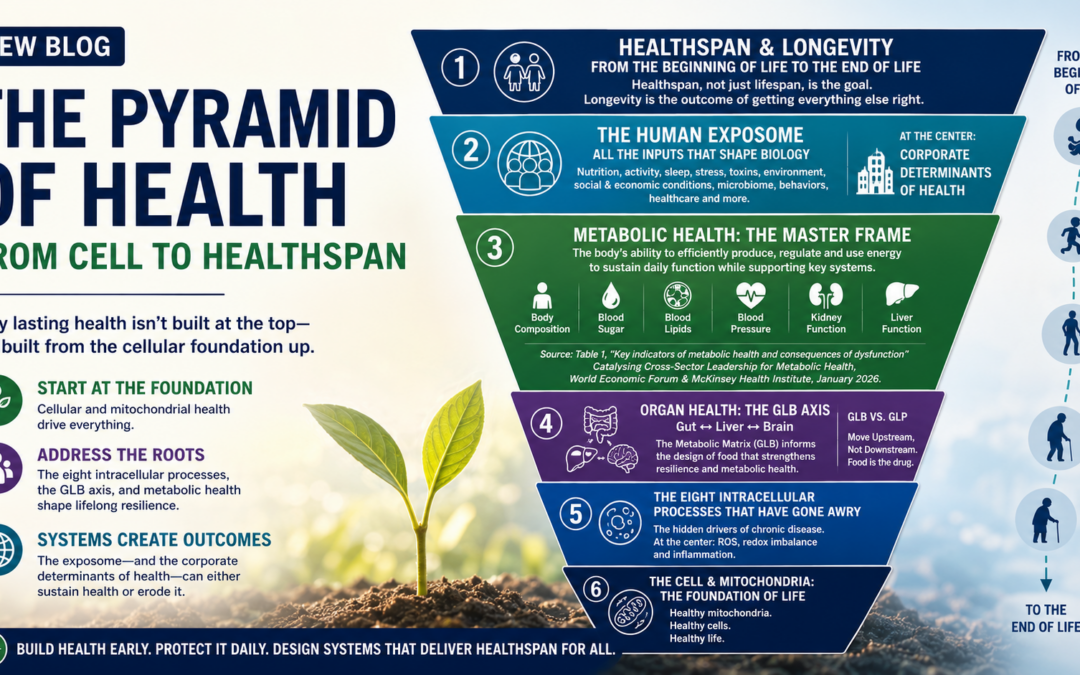
The Pyramid of Health: Why Healthspan Begins at the Cellular Level
The global health conversation is shifting. For decades, the dominant goal was to extend lifespan: helping people live longer. More recently, the focus has moved toward healthspan: helping people live better for longer, with fewer years lost to chronic disease, disability, and dependency.
That shift is welcome. But it still does not go deep enough.
If we want to understand what truly drives health across the lifespan, we need to move beneath diseases, beneath organs, and beneath lifestyle categories. We need to begin where life itself begins: the cell.
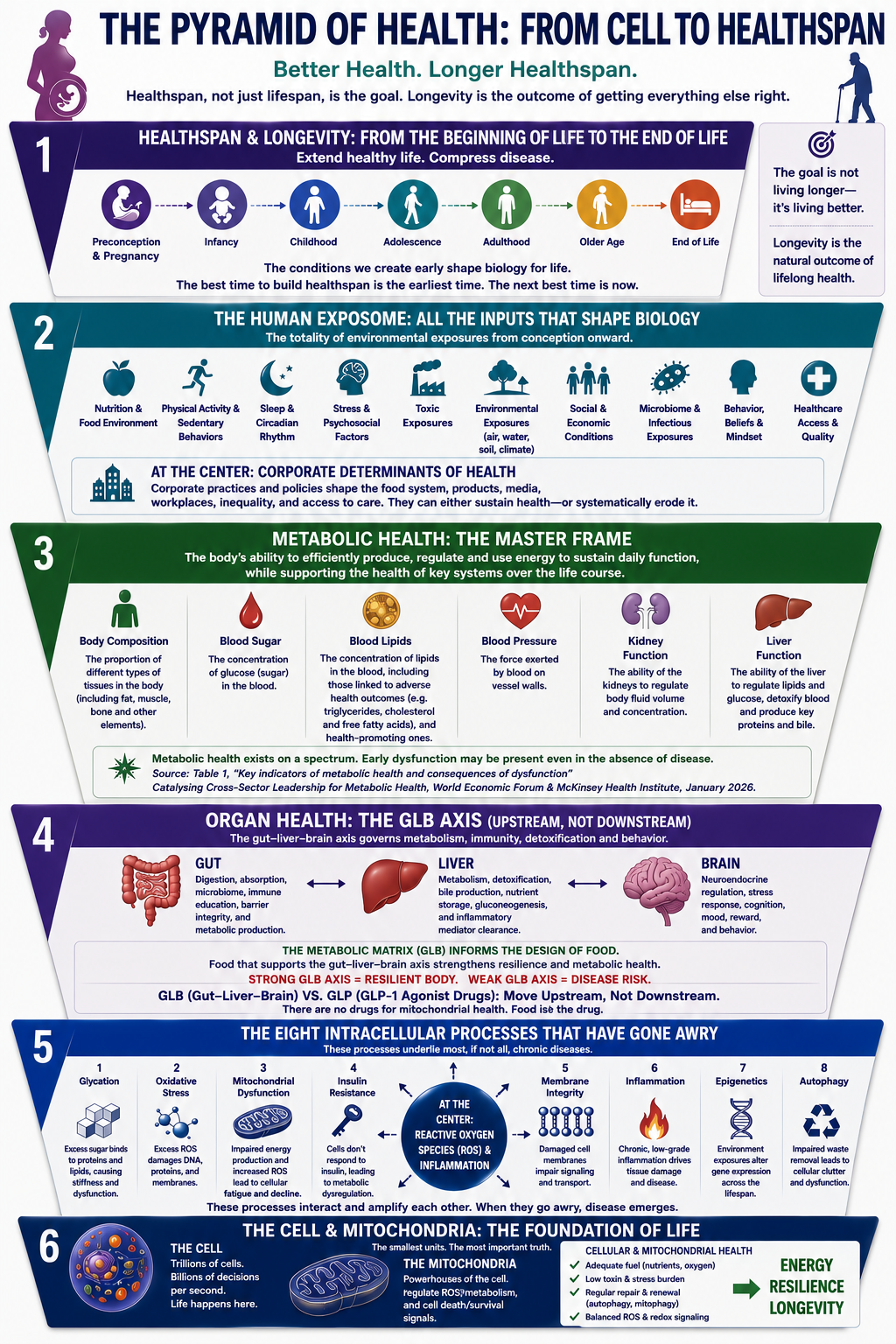
At the foundation of human health are cellular and mitochondrial function. Above that sit the intracellular processes that determine whether cells remain resilient or move toward dysfunction. Above that are organ systems, metabolic health, the exposome, and finally the visible outcomes we call healthspan, longevity, or chronic disease.
This is the Pyramid of Health: an upside-down framework that asks us to start not with disease, but with the biological foundation that makes health possible.
Healthspan, Not Just Lifespan
The goal is not simply to live longer. The goal is to live better.
A longer life is not necessarily a healthier life. Around the world, people are living longer while spending more years with cardiometabolic disease, obesity, diabetes, cognitive decline, fatty liver disease, kidney disease, cancer, and frailty. The challenge is not only mortality. It is the compression of morbidity: reducing the number of years lived in poor health.
This is why healthspan must become the central goal.
Healthspan is not built at the end of life. It is shaped from the beginning of life to the end of life. The biological conditions that influence lifelong resilience begin before birth and continue through infancy, childhood, adolescence, adulthood, older age, and the final stage of life.
The best time to build healthspan is the earliest possible moment. The next best time is now.
The Human Exposome: The Inputs That Shape Biology
Every person lives inside a dynamic field of exposures. These exposures begin at conception and continue throughout life. Together, they form the human exposome: the totality of environmental, social, behavioral, biological, and psychological inputs that shape human biology.
These inputs include nutrition and the food environment, physical activity and sedentary behavior, sleep and circadian rhythm, stress and psychosocial factors, toxic exposures, air, water, soil and climate conditions, social and economic conditions, microbiome and infectious exposures, beliefs and behavior, and access to quality healthcare.
This is where personal choice and systems design intersect. Daily behaviors matter deeply, but they are shaped by environments, incentives, access, culture, and markets.
At the center of the exposome sit the corporate determinants of health. Corporate practices and policies shape food systems, products, advertising, workplaces, media environments, inequality, and access to care. They can sustain health, or they can systematically erode it.
This is where cross-sector leadership becomes essential. Health is not produced by healthcare alone. It is produced by the systems in which people live, work, eat, move, learn, and age.
Metabolic Health: The Master Frame
The World Economic Forum and McKinsey Health Institute Brief, Catalysing Cross-Sector Leadership for Metabolic Health, defines metabolic health as the body’s ability to efficiently produce, regulate, and use energy to sustain daily function while supporting key systems across the life course, including cardiovascular, renal, and hepatic systems. The briefing emphasizes that metabolic health exists on a spectrum, and early dysfunction may be present even before disease is diagnosed.
This is why metabolic health is such a powerful master frame. It connects daily life to cellular function, and cellular function to chronic disease risk.
The WEF and McKinsey briefing identifies six key indicators of metabolic health:
Body composition refers to the proportion of different tissues in the body, including fat, muscle, bone, and other elements. Visceral fat around the organs can release inflammatory chemicals that impair insulin signaling, contributing to chronic inflammation and insulin resistance.
Blood sugar refers to glucose concentration in the blood. Elevated glucose levels increase diabetes risk and can promote insulin resistance through mechanisms including chronic inflammation.
Blood lipids include triglycerides, cholesterol, free fatty acids, and health-promoting lipids. Excess triglycerides and adverse cholesterol can accumulate in arteries, increasing the risk of heart attack and stroke, while other lipids are closely associated with insulin resistance and chronic inflammation.
Blood pressure is the force exerted by blood on vessel walls. High blood pressure increases the risk of heart disease, stroke, and chronic kidney disease.
Kidney function reflects the ability of the kidneys to regulate body fluid volume and concentration. Excess blood lipids and persistent hypertension are associated with impaired kidney function over time, while insulin resistance often develops in parallel with chronic kidney disease.
Liver function refers to the liver’s ability to regulate lipids and glucose, detoxify blood, and produce key proteins and bile. Insulin resistance, obesity, and type 2 diabetes are often seen alongside metabolic dysfunction-associated steatotic liver disease, which is strongly associated with chronic inflammation, cardiovascular disease, and chronic kidney disease.
Together, these indicators provide a practical and measurable bridge between individual biology, clinical risk, population health, and economic resilience.
The same briefing notes that improving metabolic health at population level could add 469 million healthy life years and boost global GDP by $5.65 trillion annually by 2050. That is why metabolic health is not just a clinical issue. It is a societal, economic, and strategic priority.
The GLB Axis: Gut, Liver, Brain
Within the Pyramid of Health, organ health sits beneath the metabolic health frame because organs mediate the relationship between cellular function and whole-body physiology.
The conventional framing of cardiometabolic health often centers on the heart. The heart matters enormously, but the upstream architecture begins earlier. The gut–liver–brain axis, or GLB axis, is foundational.
The gut governs digestion, absorption, microbiome signaling, immune education, barrier integrity, and metabolite production.
The liver governs metabolism, detoxification, bile production, nutrient storage, gluconeogenesis, lipid handling, and inflammatory mediator clearance.
The brain governs neuroendocrine regulation, stress response, cognition, appetite, mood, reward, behavior, and decision-making.
Together, the GLB axis helps determine metabolic resilience. A strong GLB axis supports whole-body health. A weak GLB axis increases disease risk.
This is also where the Metabolic Matrix becomes especially important. The Metabolic Matrix can help inform the design of food that supports the gut–liver–brain axis rather than simply chasing isolated nutrients or downstream disease markers. Food is not only fuel. Food is information. Food interacts with microbiology, metabolism, inflammation, mitochondrial function, neuroendocrine signaling, and behavior.
This is the upstream opportunity.
GLB stands in contrast to the current public fascination with GLP-1 agonist drugs. GLP-1 therapies have changed the metabolic health conversation, but they are not sufficient to deliver population-wide metabolic health. The WEF and McKinsey briefing makes this point directly: GLP-1s alone will not be enough because metabolic health is shaped by social, psychological, environmental, biological, and genetic factors, requiring a holistic, multi-sectoral approach.
The message is not anti-drug. It is upstream.
GLP-1 therapies may have a role. But the deeper opportunity is to design food, environments, systems, and cultures that support metabolic health before disease requires pharmacological rescue.
There are no drugs that directly fix the entire foundation of mitochondrial and cellular health. Food, movement, sleep, stress regulation, social conditions, environmental quality, and systemic design remain central.
The Eight Intracellular Processes That Have Gone Awry
Beneath organ health are the intracellular processes that determine whether cells remain functional, adaptive, and resilient.
In the framework drawn from Robert Lustig’s discussion of the “diseases that aren’t diseases,” there are eight key intracellular processes that underlie modern chronic disease when they go awry:
- Glycation
- Oxidative stress
- Mitochondrial dysfunction
- Insulin resistance
- Membrane integrity
- Inflammation
- Epigenetics
- Autophagy
These are not conventional diseases with simple diagnostic codes. They are deeper cellular pathologies. When they work properly, they contribute to longevity and good health. When they malfunction, they contribute to the chronic diseases that dominate modern healthcare.
At the center of these processes are reactive oxygen species, oxidative stress, redox imbalance, and inflammation. ROS are not inherently bad; they are part of normal cellular signaling. Inflammation is not inherently bad; it is essential for defense and repair. But when these systems become chronic, excessive, or dysregulated, they damage DNA, proteins, lipids, membranes, mitochondria, tissues, and organs.
This is the invisible architecture of chronic disease.
The Cell and Mitochondria: The Foundation of Life
At the base of the pyramid are the cell and the mitochondria.
The cell is the smallest unit of life. Every organ, system, behavior, and disease process ultimately rests on cellular function.
Within the cell, mitochondria are central. They produce ATP, regulate energy flow, participate in redox signaling, influence cell survival and death, and help determine whether tissues can adapt to stress or deteriorate under load.
Healthy mitochondria power healthy cells. Healthy cells build healthy organs. Healthy organs support metabolic health. Metabolic health supports healthspan.
This is why the foundation matters.
When mitochondria are overburdened by nutrient excess, toxins, oxidative stress, inflammation, poor sleep, chronic stress, or inadequate repair, the entire system becomes less resilient. The result may appear years later as insulin resistance, fatty liver disease, hypertension, cognitive decline, kidney disease, cancer, cardiovascular disease, or frailty. But the dysfunction began earlier, deeper, and smaller.
It began in the cell.
Why This Matters for Business and Policy
The Pyramid of Health reframes the work ahead for business, governments, healthcare systems, food companies, insurers, employers, civil society, and investors.
The WEF and McKinsey brief “Catalysing Cross-Sector Leadership for Metabolic Health” argues that advancing metabolic health requires systemic change across institutions, with each sector playing a distinct but interconnected role. It calls for collaboration, collective action, and a level playing field so that no organization is placed at a competitive disadvantage.
That is exactly the point.
We cannot treat our way out of a biologically degraded environment. We cannot medicate our way out of food systems that drive dysfunction. We cannot ask individuals to make perfect choices inside systems engineered against metabolic resilience.
The private sector is not peripheral to this challenge. It is central. Food manufacturers, healthcare providers, pharmaceutical companies, insurers, consumer health companies, employers, urban planners, educators, and technology platforms all shape the metabolic environment.
The question is not whether business affects health. It does.
The question is whether business will help build the foundations of health or continue profiting from their erosion.
The Key Takeaway
Start at the foundation of cellular health.
Healthspan is not created at the top of the pyramid. It is produced from the bottom up.
Cellular and mitochondrial health shape intracellular function. Intracellular function shapes organ health. Organ health shapes metabolic health. Metabolic health reflects and responds to the exposome. And the total system determines whether longer life becomes better life — or merely more years lived with disease.
The future of longevity is not only about late-life intervention. It is about lifelong biological resilience.
The best health systems, food systems, companies, and societies will be those that understand this simple truth:
Build the foundation early. Protect it daily. Design systems that make health the easier, default, and more desirable path.