
The WHA Liver Disease Resolution: A Landmark Moment — and a Call to Go Further
The adoption of the World Health Assembly resolution on steatotic liver disease marks a significant turning point in global health policy. For the first time, liver disease is being positioned not as a narrow hepatology concern, but as a central part of the global noncommunicable disease response.
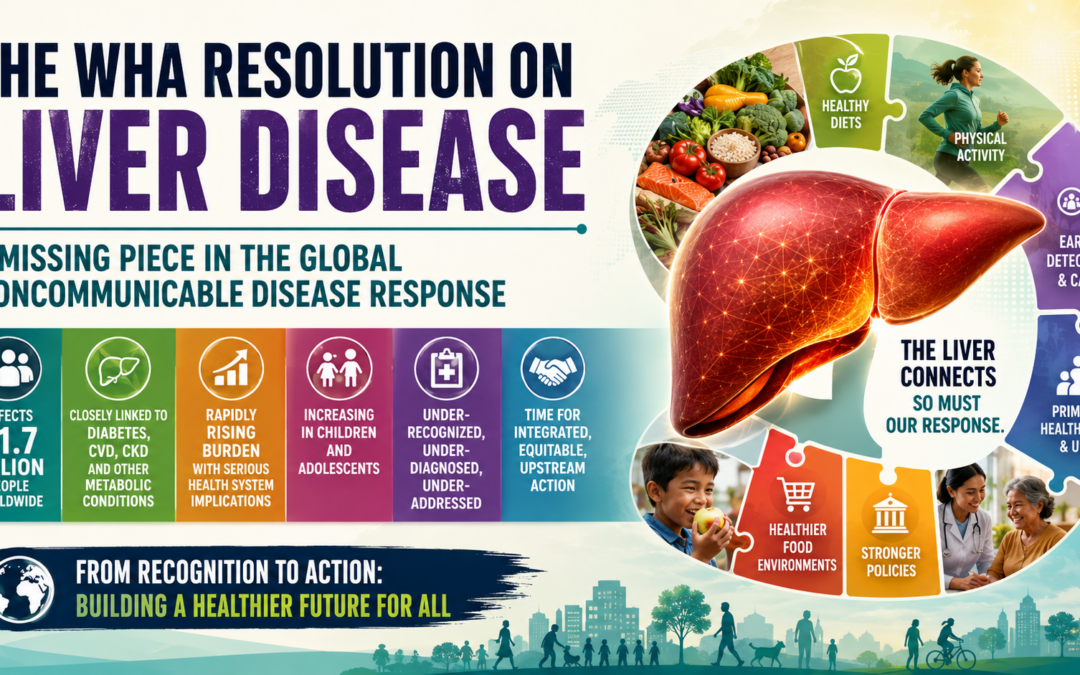
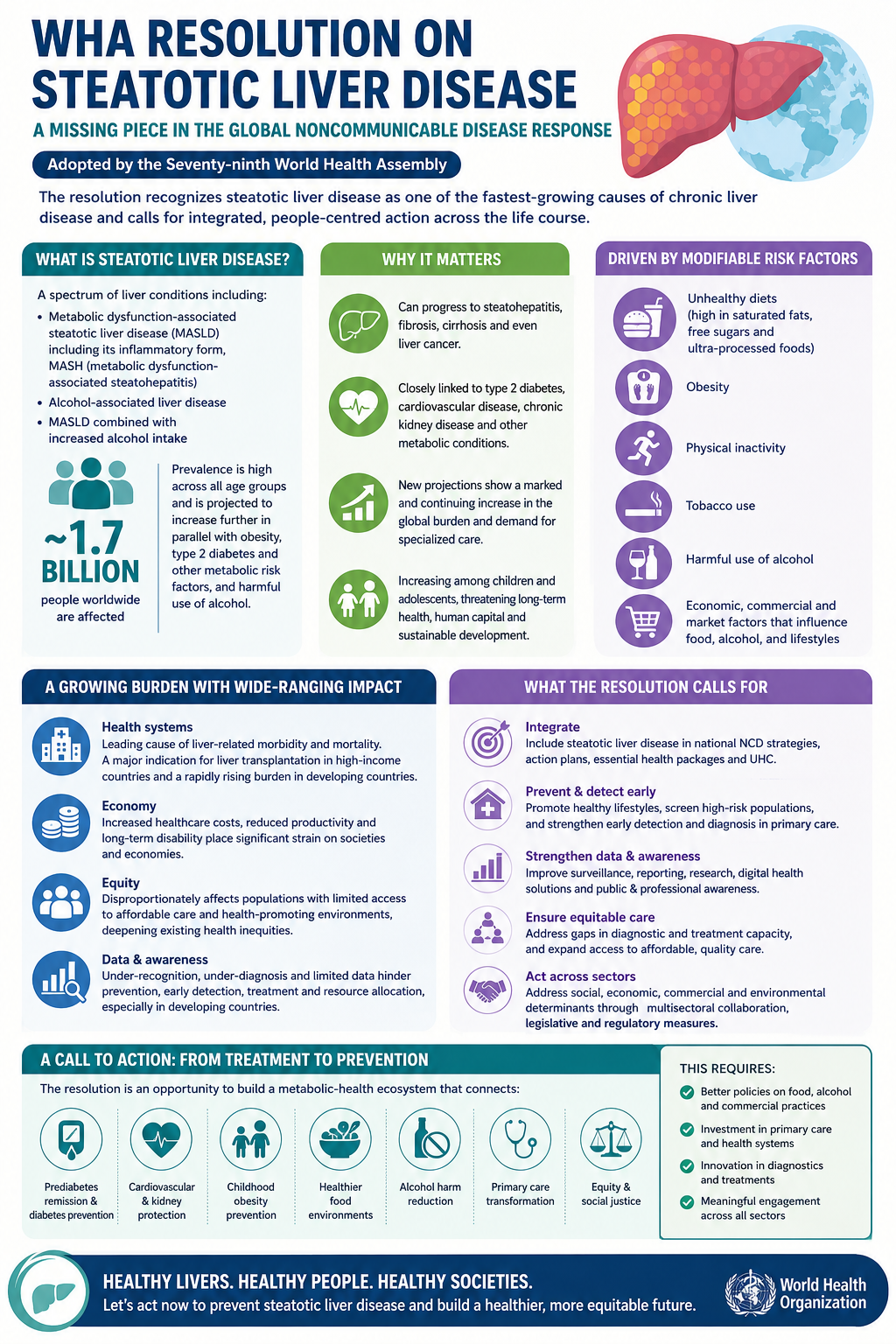
The resolution, titled “Steatotic liver disease: a missing piece in the global noncommunicable disease response,” recognizes that steatotic liver disease is one of the fastest-growing causes of chronic liver disease worldwide, affecting approximately 1.7 billion people and rising in parallel with obesity, type 2 diabetes, metabolic risk factors, and harmful alcohol use.
This is a landmark moment. It gives governments, health systems, clinicians, civil society, and industry a clearer mandate: liver health must now be integrated into national NCD strategies, primary healthcare, universal health coverage, surveillance systems, prevention efforts, and early detection pathways.
But the resolution also raises a critical question: will the world treat liver disease only after it appears, or will it confront the upstream conditions that are driving it?
Liver disease is a metabolic warning signal
Steatotic liver disease is not an isolated condition. It is deeply connected with the wider epidemic of metabolic dysfunction.
The WHA resolution explicitly recognizes the close association between steatotic liver disease and type 2 diabetes, cardiovascular disease, chronic kidney disease, obesity, unhealthy diets, physical inactivity, tobacco use, and harmful alcohol use. This matters because the liver is one of the earliest organs to reveal the damage caused by disrupted metabolic health.
Excess liver fat is not merely a liver problem. It is a signal of ectopic fat deposition, insulin resistance, inflammatory stress, and increased cardiometabolic risk. In many people, it appears years before the formal diagnosis of type 2 diabetes, cardiovascular disease, or advanced kidney disease.
That is why this resolution should be viewed not only as a liver-health milestone, but as a major opportunity for diabetes prevention, prediabetes remission, and metabolic risk reduction.
Metabolic dysfunction-associated steatotic liver disease and prediabetes share a common pathophysiological terrain: ectopic fat deposition, hepatic insulin resistance, impaired glucose regulation, and early stress on pancreatic beta-cell function. If liver fat is identified and reduced early, there is an opportunity to intervene before many people cross the metabolic tipping point into type 2 diabetes.
That insight is crucial. If care is organized around the shared biology of metabolic dysfunction, health systems can move beyond the fragmented management of separate diagnoses and toward an integrated model that addresses liver disease, prediabetes, diabetes, cardiovascular risk, and kidney disease together.
The resolution creates a policy scaffold
The WHA resolution encourages Member States to integrate steatotic liver disease into national NCD strategies, action plans, and monitoring frameworks. It calls for health promotion, prevention, screening, early detection, diagnosis, and management to be incorporated into essential healthcare packages, with a focus on primary healthcare, equity, and universal health coverage.
It also calls for strengthened surveillance, national reporting, public and professional awareness, investment cases, research, digital health solutions, and affordable diagnostic and therapeutic tools.
These are important building blocks. They can help bring liver disease out of the shadows and into routine public health planning. In many countries, steatotic liver disease remains under-recognized, under-diagnosed, and poorly captured in national data systems. The resolution directly acknowledges that this lack of awareness and limited data hinder timely prevention, early detection, treatment, and resource allocation.
In practical terms, the resolution gives countries permission — and encouragement — to do several things that are long overdue:
- Screen earlier for liver fat and fibrosis in high-risk populations.
- Integrate liver health into diabetes, obesity, cardiovascular, and kidney disease pathways.
- Train primary care teams to recognize metabolic liver disease.
- Include liver disease in NCD surveillance and investment planning.
- Treat liver health as part of prevention, not merely specialist care.
That is progress. But it is not enough.
The policy white space: food environments and commercial determinants
The most important gap in the resolution is not what it says, but what it does not say clearly enough.
The text recognizes unhealthy diets, excessive saturated fats, free sugars, harmful alcohol use, physical inactivity, and the impact of economic, commercial, and market factors on health. It also calls for multisectoral policy action and legislative and regulatory measures to promote healthy diets.
However, it stops short of explicitly naming several of the most powerful drivers of diet-related metabolic disease: ultra-processed foods, sugar-sweetened beverages, refined carbohydrate-heavy product portfolios, marketing to children, pricing incentives, retail environments, product formulation, and corporate accountability.
That omission matters.
Without a stronger focus on food systems and commercial determinants of health, there is a risk that governments will medicalize and manage the downstream consequences of metabolic dysfunction while leaving the upstream drivers largely intact.
This is where the next phase of advocacy must focus: connecting diabetes prevention, steatotic liver disease, nutrition policy, and commercial determinants of health — including the responsibility of the food and beverage sector in addressing rising rates of metabolic disease.
From treatment pathways to metabolic-health ecosystems
The liver disease resolution should not become another disease silo. Its greatest value lies in helping the global health community think more coherently about metabolic health.
A more ambitious response would link liver health with:
- prediabetes remission,
- type 2 diabetes prevention,
- childhood obesity prevention,
- cardiovascular risk reduction,
- kidney protection,
- healthier food environments,
- alcohol harm reduction,
- primary care transformation,
- and commercial accountability.
This requires moving from a late-stage disease-management model to a metabolic-health ecosystem.
That ecosystem must include clinical tools, such as early detection of liver fat and fibrosis, but it must also include nutrition policy, school food reform, front-of-pack labelling, restrictions on marketing unhealthy foods to children, sugar-sweetened beverage taxation, reformulation targets, procurement standards, and incentives that make healthier foods more accessible and affordable.
Pharmacological innovation will also have a role. GLP-1 receptor agonists and related therapies are changing the treatment landscape for obesity, diabetes, and metabolic liver disease. But they cannot be the whole answer. Medication may help reduce risk in individuals, but it cannot substitute for population-level prevention.
A coherent strategy must combine clinical intervention with upstream reform.
Why this matters for children and future generations
One of the most concerning elements in the resolution is its recognition that steatotic liver disease is increasing among children and adolescents, particularly in association with childhood obesity, unhealthy dietary patterns, and physical inactivity.
This should be a wake-up call.
A child with excess liver fat is not simply at risk of future liver disease. They may already be on a trajectory toward insulin resistance, type 2 diabetes, cardiovascular disease, reduced quality of life, and preventable health-system dependency.
The resolution correctly frames this as a threat to health, human capital, and sustainable development, especially in resource-constrained settings. But if childhood liver disease is rising because children are growing up in environments saturated with cheap, aggressively marketed, nutrient-poor, ultra-processed products, then prevention must reach beyond clinics.
We cannot screen our way out of this problem. We cannot prescribe our way out of it. We must change the environments that are producing metabolic dysfunction in the first place.
What should happen next?
The WHA resolution is a policy scaffold. The next task is to fill it with stronger, more explicit commitments.
Before the next World Health Assembly cycle, governments, professional societies, civil society, liver-health experts, diabetes organizations, public-health advocates, and food-system reform coalitions should work together on a clear agenda.
First, liver health should be embedded into national NCD plans as part of integrated cardiometabolic care. That means linking liver disease screening with obesity, prediabetes, type 2 diabetes, cardiovascular disease, and chronic kidney disease pathways.
Second, primary care should become the front line for early identification and intervention. Liver health should not be detected only when advanced fibrosis, cirrhosis, or liver cancer has already developed.
Third, national surveillance systems should track steatotic liver disease alongside diabetes, obesity, cardiovascular disease, and other NCD indicators.
Fourth, food environments must be treated as central to prevention. Future policy language should explicitly address ultra-processed foods, sugar-sweetened beverages, marketing to children, product formulation, pricing, retail availability, and corporate accountability.
Finally, liver health should become part of a broader public narrative: supporting the liver means supporting metabolic resilience, diabetes prevention, cardiovascular health, kidney protection, healthy ageing, and healthier communities.
A historic step — but not the final destination
The WHA resolution on steatotic liver disease is historic because it recognizes liver disease as a missing piece in the global NCD response. It brings long-overdue attention to a condition affecting hundreds of millions of people and connects it to obesity, diabetes, cardiovascular disease, kidney disease, unhealthy diets, alcohol harm, and health inequity.
But recognition is only the first step.
The world now has an opportunity to act earlier, think more systemically, and confront the commercial and environmental conditions that drive metabolic disease. If the resolution leads only to more screening and downstream treatment, it will fall short of its potential. If it leads to integrated metabolic-health strategies and stronger food-system reform, it could become a turning point.
The liver is telling us something. It is time for public health policy to listen.
Protecting the liver means protecting the metabolic future
This is exactly why the Metabolic Matrix places Protect the Liver as a core pillar of metabolic health.
The liver is not simply another organ affected by metabolic dysfunction. It is one of the body’s central metabolic command centres — regulating glucose, processing fats, managing toxins, storing nutrients, and helping determine whether the body moves toward resilience or disease. When fat begins to accumulate in the liver, it is often an early sign that the wider metabolic system is under strain.
To protect the liver, therefore, is to act early. It means reducing the dietary, commercial, environmental, and clinical drivers that push people toward insulin resistance, prediabetes, type 2 diabetes, cardiovascular disease, kidney disease, and inflammatory metabolic stress.
The WHA resolution gives the world a new policy opening. The Metabolic Matrix helps translate that opening into a broader prevention agenda: one that sees liver health not as a specialist afterthought, but as a foundation for metabolic resilience across the life course.
Protecting the liver means protecting children from harmful food environments. It means supporting adults before metabolic risk becomes irreversible disease. It means helping health systems move upstream. And it means holding policy, industry, and healthcare accountable for the conditions that shape metabolic health.
The liver is telling us something. The next step is not only to listen — but to protect it.