
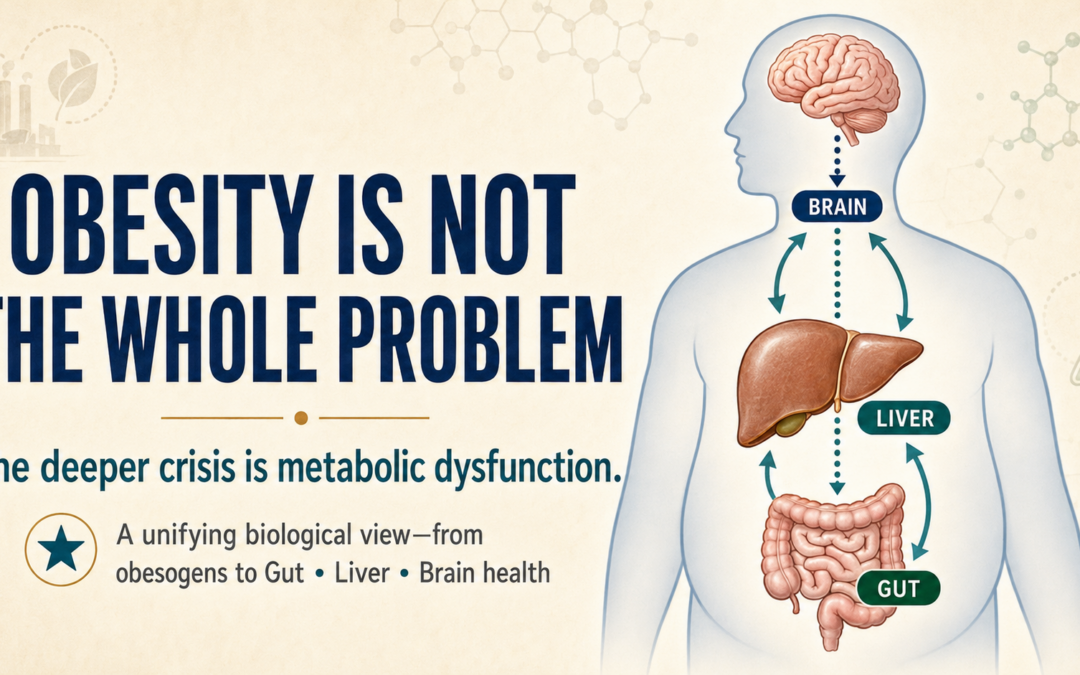
Obesity Is Not the Whole Problem: Reframing the Crisis Around Metabolic Health
For decades, the dominant explanation for obesity has been deceptively simple: people gain weight because they consume more calories than they expend. The prescribed solution follows naturally—eat less and exercise more.
This explanation is not entirely wrong. Energy cannot be created from nothing, and changes in body mass necessarily involve energy balance. But, as Dr. Robert H. Lustig has argued throughout much of his career, energy balance describes what happened; it does not adequately explain why it happened.
Why are people hungrier? Why does the body direct energy toward storage rather than use? Why do some foods promote greater consumption and metabolic dysfunction than others? Why can people with the same calorie intake respond differently? Why is obesity emerging in infants who cannot make dietary choices? And why are metabolic disorders increasingly found in people who do not have obesity?
These questions point toward a different conclusion:
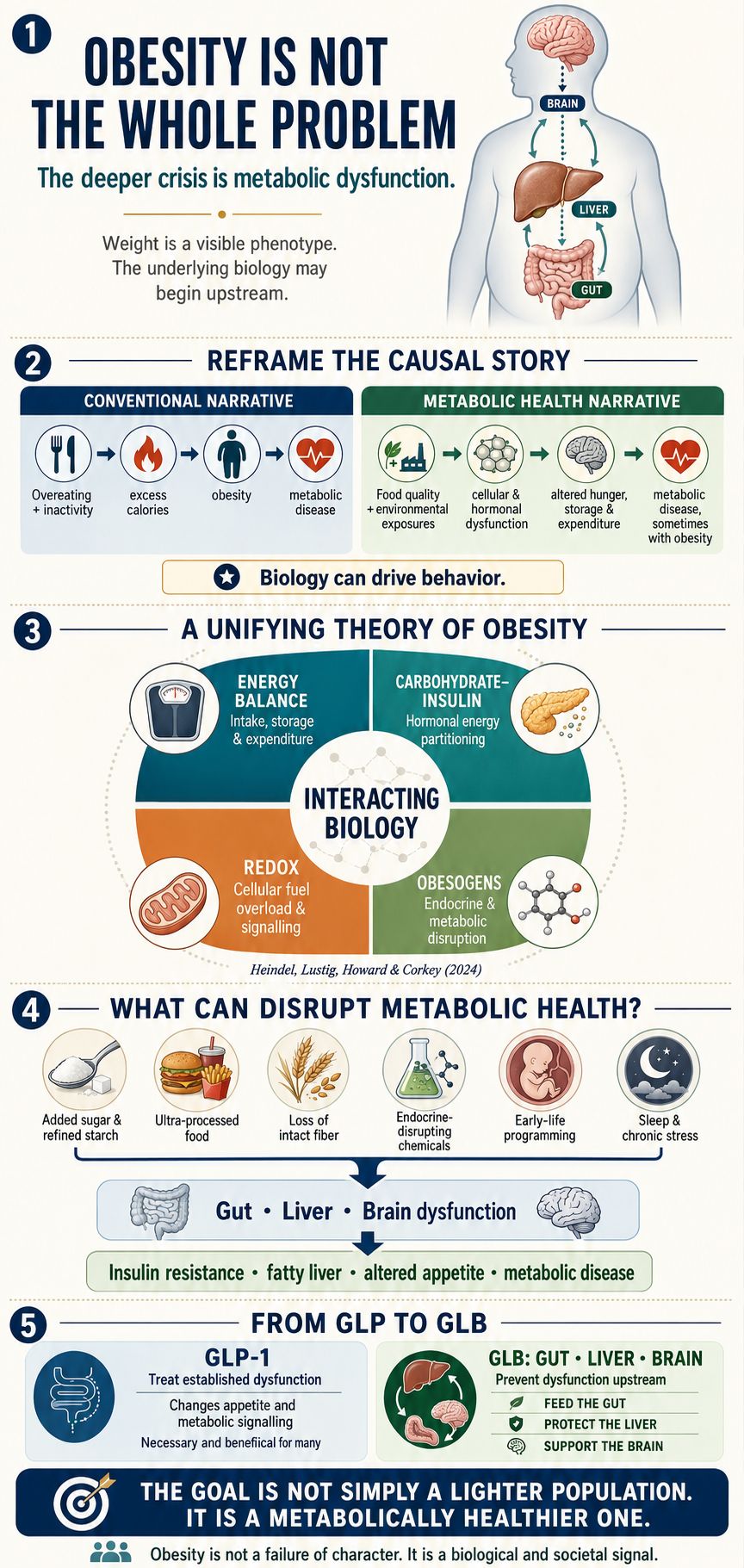
Obesity is not the underlying problem. It is one possible outward manifestation of disrupted metabolic biology.
The deeper public-health crisis is metabolic dysfunction—and it cannot be understood by looking at body weight alone.
When biology drives behavior
The conventional obesity narrative generally assumes the following sequence:
Overeating and inactivity → excess calories → weight gain → metabolic disease
Lustig challenges this causal order. His interpretation is closer to:
Poor-quality food and environmental exposures → cellular, hormonal and neurological dysfunction → altered hunger, energy storage and expenditure → metabolic disease, sometimes accompanied by obesity
This is not a semantic distinction. It changes where responsibility is placed and what solutions become possible.
If overeating is assumed to be the original cause, the individual is told to exert more discipline. But if disrupted insulin signalling, mitochondrial function, appetite regulation and cellular energy processing help drive eating behavior, then overeating may be partly an outcome of the biology.
As Lustig often summarizes the argument: obesity is biochemistry, and behavior can be a consequence of that biochemistry.
The extraordinary effectiveness of GLP-1 medicines reinforces this point. People taking semaglutide or tirzepatide do not suddenly develop stronger character or greater willpower. The medications change biological signalling related to appetite, satiety, gastric emptying and food reward—and behavior changes in response.
Biochemistry is not incidental to behavior. It helps generate behavior.
A unifying theory of obesity
This broader understanding is at the heart of the 2024 review article, “Obesogens: A Unifying Theory for the Global Rise in Obesity”, written by Jerrold J. Heindel, Robert H. Lustig, Sarah Howard and Barbara E. Corkey.
The paper is important because it does not attempt to replace one simplistic theory with another. Instead, the authors integrate four major models of obesity:
| Model | What it contributes |
|---|---|
| Energy Balance Model | Body-weight change necessarily involves energy intake, storage and expenditure. |
| Carbohydrate–Insulin Model | Insulin helps determine whether energy is stored or made available to other tissues. |
| REDOX Model | Disrupted cellular energy processing and oxidative signalling can alter insulin secretion, appetite, fat storage and metabolism. |
| Obesogen Model | Environmental chemicals can disrupt endocrine signalling, mitochondrial function, adipocyte development and metabolic regulation. |
Each model explains something important, but none explains the entire obesity epidemic on its own.
The Energy Balance Model recognizes the laws of physics but can leave the biological regulation of intake and expenditure unexplained. The Carbohydrate–Insulin Model addresses how hormones influence energy partitioning but does not, by itself, explain every form of obesity. The REDOX Model looks deeper inside the cell, while the Obesogen Model expands the field beyond food to include endocrine-disrupting environmental exposures.
The unifying proposition is that these models interact.
Food composition, insulin, cellular fuel overload, mitochondrial dysfunction, environmental chemicals, genetics, epigenetics, the microbiome and neuroendocrine appetite regulation can collectively influence:
-
how hungry a person feels;
-
how quickly satiety develops;
-
how efficiently energy is harvested;
-
where that energy is deposited;
-
whether stored fat can be mobilized;
-
resting energy expenditure;
-
insulin production and sensitivity;
-
adipocyte number and function;
-
susceptibility established during fetal development and early childhood.
Calories still matter—but biology helps determine what happens to those calories and how many calories a person is driven to consume.
Obesogens expand the causal landscape
The paper’s most distinctive contribution is its integration of environmental obesogens: chemicals that may promote adiposity or metabolic dysfunction by interfering with normal biological regulation.
Potential obesogens include certain bisphenols, phthalates, pesticides, PFAS, flame retardants and components of air pollution. Depending on the compound and timing of exposure, proposed mechanisms include effects on:
-
endocrine receptors;
-
pancreatic insulin secretion;
-
mitochondrial function;
-
adipocyte differentiation;
-
appetite regulation;
-
inflammation;
-
epigenetic programming.
This is especially relevant during pregnancy, infancy and childhood, when metabolic systems are still developing. Experimental research suggests that some exposures may change susceptibility to obesity and metabolic disease later in life, with some animal studies also indicating possible effects across generations.
The evidence is not equally strong for every chemical, mechanism or claimed human outcome. Obesogen science should therefore be interpreted carefully, without suggesting that every exposure has been proven to cause human obesity.
Nevertheless, the wider conclusion is compelling: a global rise in obesity cannot credibly be explained as a simultaneous worldwide decline in personal responsibility.
Human biology is interacting with a substantially altered food and chemical environment.
Processed food changes more than calorie delivery
Lustig’s focus on sugar and ultra-processed food is sometimes reduced to the slogan “sugar is toxic.” His scientific argument is more specific: foods differ not only in how much energy they contain, but also in how they affect the liver, gut, brain, hormones and cellular metabolism.
Added sugar—particularly fructose delivered rapidly in sweetened beverages and foods stripped of their natural fiber structure—can create a high substrate load in the liver. When consumed repeatedly and in excess, it can promote hepatic fat production, liver fat accumulation and insulin resistance. Research has documented the connections among fructose consumption, hepatic de novo lipogenesis and fatty liver disease, although effects depend on dose, dietary context and overall energy intake. (Jensen et al., Journal of Hepatology)
Ultra-processed foods can intensify these pressures by combining rapidly absorbable carbohydrates, refined starches, added sugars, disrupted fiber structures, high energy density, rapid eating rates and strong reward characteristics.
In a landmark randomized inpatient trial, participants eating an ultra-processed diet consumed roughly 500 more calories per day and gained weight, despite the diets being designed to match several presented nutrients. Participants lost weight during the minimally processed phase. The study does not prove that every ultra-processed product has the same effect, but it demonstrates that food formulation and structure can alter spontaneous consumption under controlled conditions. (Hall et al., Cell Metabolism)
The important lesson is not that calories are imaginary. It is that the food environment can influence calorie intake before conscious restraint ever enters the equation.
Weight and metabolic health are not interchangeable
If obesity were the underlying disease, weight would function as a reliable diagnosis of metabolic health. It does not.
Some people with obesity maintain relatively normal insulin sensitivity, blood pressure, liver function and lipid profiles, particularly for a period of time. Conversely, people with a “normal” body mass index can have visceral fat, fatty liver disease, insulin resistance, hypertension or type 2 diabetes.
“Metabolically healthy obesity” is not necessarily a permanent or risk-free state; obesity can still create mechanical burdens and raise long-term health risks. But the existence of different metabolic phenotypes demonstrates that body size and metabolic condition are not synonymous. (Blüher, Endocrine Reviews)
A precise formulation is therefore essential:
Obesity can be a disease, an important risk marker and an amplifier of other conditions—but it is not a complete diagnosis of metabolic health or a sufficient explanation for the metabolic disease epidemic.
This reframing also helps address weight stigma. When body size is interpreted as visible proof of poor discipline, biology becomes moralized. People with obesity can then experience discrimination in healthcare, employment, education and relationships—adding psychological and economic stressors that may further worsen health.
The message is not that obesity does not matter. It is that weight does not tell us enough.
GLP-1 treatment—and the need to look upstream
GLP-1-based therapies represent a major medical advance. For many people with obesity or diabetes, these medicines can produce substantial weight loss, improve glycemic control and reduce serious health risks.
But their success should not lead us to define the entire challenge by weight loss or pharmaceutical treatment.
GLP-1 therapies demonstrate that appetite and body weight are biologically regulated. They do not remove the upstream conditions contributing to metabolic dysfunction: poor food formulation, excessive added sugar, loss of intact fiber, environmental exposures, sleep disruption, chronic stress and food systems that prioritize cheap calories over metabolic function.
Medication can be necessary and beneficial while prevention remains indispensable.
This leads to a useful distinction between GLP and GLB:
-
GLP represents an increasingly powerful means of treating established metabolic dysfunction.
-
GLB—Gut, Liver and Brain—provides an upstream framework for protecting metabolic health before pharmacological rescue becomes necessary.
This is the foundation of the Metabolic Matrix: feed the gut, protect the liver and support the brain.
Rather than designing special foods merely to capitalize on the growth of the GLP-1 market, the food and beverage industry should ask a more consequential question:
How can food be redesigned so that fewer people progress toward metabolic dysfunction in the first place?
That means restoring meaningful fiber, reducing added sugar, slowing carbohydrate absorption, protecting the natural food matrix, improving satiety and evaluating products for their effects on hepatic, microbial and neurological function—not merely calories, protein claims or front-of-pack scores.
From weight management to metabolic health
The Heindel–Lustig unifying model invites a fundamental change in the obesity narrative.
We should move:
-
from blaming behavior to understanding biology;
-
from counting calories to examining metabolic effects;
-
from body weight alone to metabolic function;
-
from individual responsibility alone to shared food-system and environmental responsibility;
-
from treating established disease to preventing metabolic dysfunction;
-
from designing products for GLP-1 users to designing a food supply that supports the gut, liver and brain of everyone.
The most important conclusion is not that energy balance is false, nor that obesity is irrelevant. It is that neither tells the whole causal story.
Obesity is visible. Metabolic dysfunction often is not.
If public health, medicine and the food industry continue to treat the visible phenotype while neglecting the underlying biology, we will remain locked into an expensive cycle of disease management. The better objective is not simply to make populations lighter. It is to make them metabolically healthier.
And that begins by recognizing that obesity is not a failure of character. It is a biological and societal signal—one that is telling us something has gone profoundly wrong upstream.