
From Diagnosis to Treatment: Why the Food Industry Must Redesign for Metabolic Health
The food and beverage industry does not lack a diagnosis.
Its leaders know that the prevailing model produces consequences far beyond the supermarket shelf. They know that many products contribute to chronic metabolic disease. They know that environmental and health costs are routinely shifted onto families, healthcare systems, governments, and future generations.
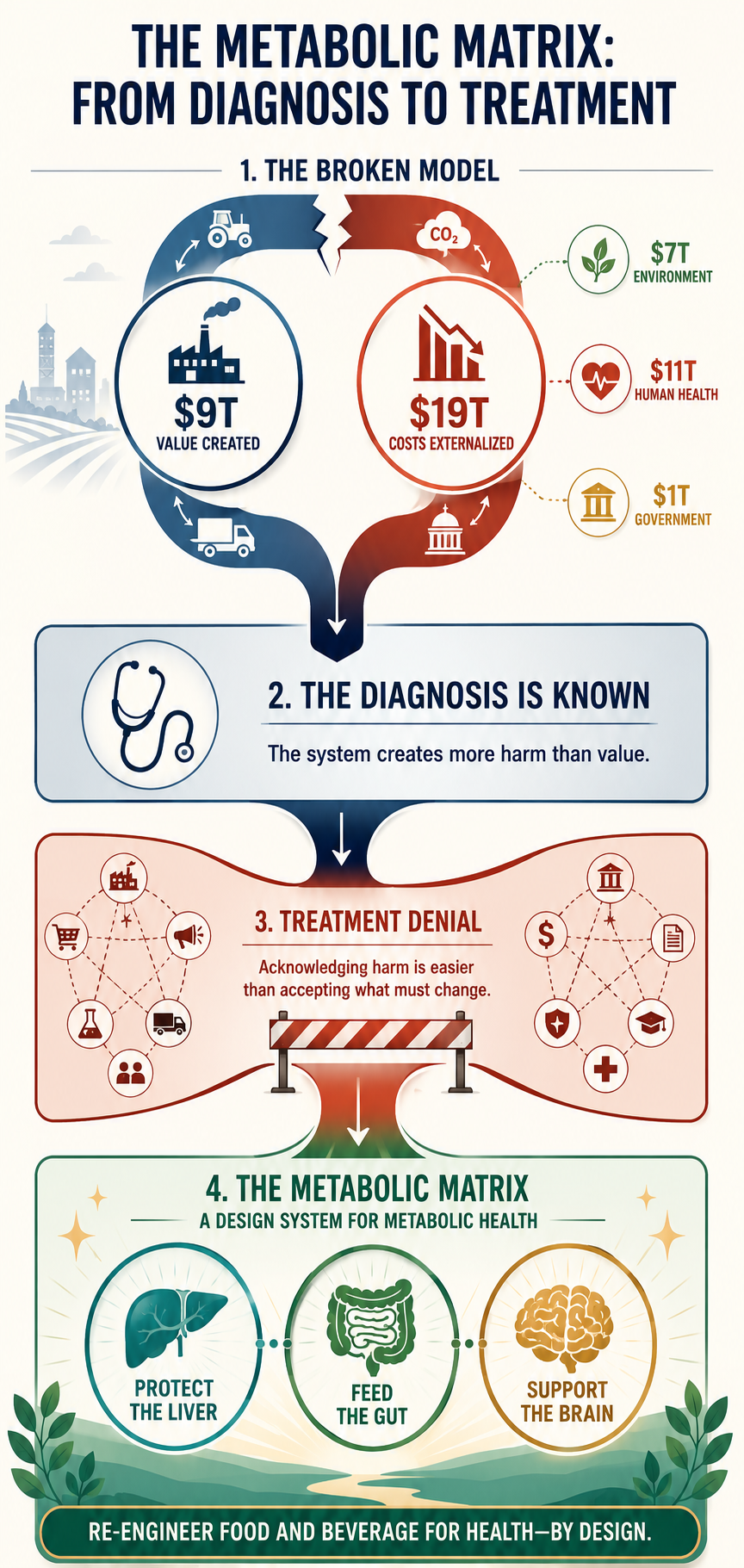
By widely cited estimates, the industry creates approximately $9 trillion in economic value while generating nearly twice that amount in externalized harm: roughly $7 trillion in environmental damage, $11 trillion in human-health costs, and another $1 trillion borne by governments.
The precise estimates vary by methodology, but the conclusion does not: the system creates private value by distributing a substantial share of its true costs across society.
This is not a knowledge problem. It is a treatment problem.
The diagnosis is no longer deniable
For decades, denial could focus on the diagnosis.
Was diet really driving the rise in metabolic disease? Were highly processed products materially different from the foods they replaced? Could declining health instead be explained by individual choices, sedentary lifestyles, genetics, or inadequate consumer education?
That defense has become increasingly difficult to sustain.
The prevalence of obesity, type 2 diabetes, fatty liver disease, cardiovascular disease, and other diet-related conditions has risen too dramatically. The biological effects of excessive sugar, refined carbohydrates, inadequate fiber, and intensive processing are becoming clearer. The economic burden is too large, and the pattern is visible across too many populations.
The industry would have to be uninformed, deeply in denial, or deliberately evasive not to recognize the basic diagnosis: the existing food system is producing negative metabolic consequences at enormous scale.
Yet acknowledging the problem has not produced transformation.
Instead, denial has moved downstream.
The industry may accept that metabolic disease is real while resisting what that diagnosis requires. It may acknowledge the costs while opposing the changes necessary to stop creating them. It may publish health commitments, fund educational campaigns, and introduce a collection of better-for-you products without redesigning the system that continues to generate the harm.
Once the diagnosis can no longer be denied, the treatment becomes the new object of denial.
Why acknowledgment does not lead automatically to action
The problem is systemic, but most decisions are made at the level of the individual company.
A company may recognize that the overall model is broken and still conclude that it cannot afford to change independently. Reformulating products can alter taste, cost, shelf life, manufacturing requirements, and consumer acceptance. A company that moves first may incur the expense while competitors continue to profit from the existing model.
Executives answer to quarterly expectations. Product teams are rewarded for growth, margin, and market share. Investors may support long-term health in principle while continuing to evaluate companies through short-term financial performance. Consumers are asked to navigate an environment designed to maximize convenience, frequency, and consumption—and are then assigned responsibility for the resulting outcomes.
Everyone can see the system-level problem while remaining trapped by company-level incentives.
This creates a dangerous form of paralysis. Each participant can claim that meaningful change depends on someone else: consumers must demand it, regulators must require it, investors must fund it, retailers must prioritize it, or competitors must act at the same time.
The industry continues moving in the same direction, even as its leaders recognize that the road is unsustainable.
The Metabolic Matrix is a treatment architecture
The Metabolic Matrix begins from a different premise: if the dominant model of food design is contributing to metabolic dysfunction, then metabolic health must become an explicit design requirement.
The objective is not to divide products into simplistic categories of good and bad. Nor is it to add another front-of-pack claim, nutrition score, or consumer warning to an already crowded marketplace.
The Metabolic Matrix is a design system for re-engineering food and beverage products around three biological imperatives:
Protect the liver
The liver is central to metabolic health. Products should be designed to reduce the metabolic burden created by excessive sugar, rapidly absorbed carbohydrates, harmful fat profiles, and other ingredients or processing choices that overwhelm the body’s capacity to maintain balance.
Protecting the liver means treating metabolic processing as a product-design consideration—not as a consequence to be managed after consumption.
Feed the gut
Food is not simply a delivery vehicle for calories. It interacts with the gut, the microbiome, the immune system, and the mechanisms that regulate glucose, satiety, and inflammation.
Designing to feed the gut means preserving or restoring the fiber, structure, and nutritional complexity that conventional processing often removes. It means creating products that nourish the biological systems responsible for long-term metabolic resilience.
Support the brain
Food design also influences reward, appetite, mood, cognition, and patterns of repeated consumption. Products engineered primarily for maximum palatability can override satiety and encourage eating beyond metabolic need.
Supporting the brain means designing for nourishment and healthy regulation rather than compulsion. It asks whether a product helps people remain in control of consumption—or is optimized to keep them coming back regardless of biological need.
Together, these three principles translate metabolic science into practical design criteria. They move the conversation from documenting harm to changing the products that produce it.
Better choices are not enough
Much of the industry’s current response places the burden of treatment on the consumer.
People are told to read labels, count calories, exercise restraint, compare nutrient claims, and make better choices. These recommendations may be useful, but they cannot substitute for changing the environment in which those choices are made.
A food system cannot be called healthy merely because healthier options exist somewhere within it. If the most available, affordable, convenient, and heavily promoted products are metabolically harmful, then the system is still designed for the wrong outcome.
The Metabolic Matrix shifts responsibility upstream.
Instead of asking only whether consumers can choose differently, it asks whether companies can design differently. Instead of relying on personal discipline to compensate for harmful product architecture, it makes metabolic function part of the architecture itself.
This is the difference between managing symptoms and treating causes.
The transition must be systemic
No single company created the present food system, and no single company can transform it alone.
That does not absolve individual organizations of responsibility. It means that leadership must be accompanied by coordination.
Manufacturers need shared design principles that can be applied across categories. Retailers need ways to recognize and reward products designed for metabolic health. Investors need measures that value the reduction of long-term health liabilities, not just short-term sales. Governments need standards and incentives that prevent responsible companies from being commercially penalized for acting. Researchers and public-health institutions need to help translate evolving science into usable product criteria.
Most importantly, the industry needs a common treatment framework.
Without one, every organization can acknowledge the diagnosis while arguing that the solution is too uncertain, too complicated, or too risky. The absence of a shared framework becomes an excuse for continued inaction.
The Metabolic Matrix is intended to close that gap. It offers a common language through which scientists, product developers, executives, policymakers, and investors can move from general commitments to concrete redesign.
The real choice
The question is no longer whether the existing system causes harm. The question is whether the industry is prepared to accept what that knowledge requires.
Will metabolic health remain a specialized product category, a marketing position, or a corporate-responsibility initiative? Or will it become a foundational requirement for the way food and beverages are designed?
An industry that accepts the diagnosis but rejects the treatment is not truly confronting the problem. It is managing the narrative while preserving the model.
That model cannot continue indefinitely. The health burden will grow, public costs will rise, regulation will intensify, and trust will continue to erode. The industry can lead an orderly transition now, or it can wait until worsening consequences force change upon it.
The Metabolic Matrix provides a path from acknowledgment to action: protect the liver, feed the gut, and support the brain.
This is not another diagnosis.
It is the beginning of treatment.