
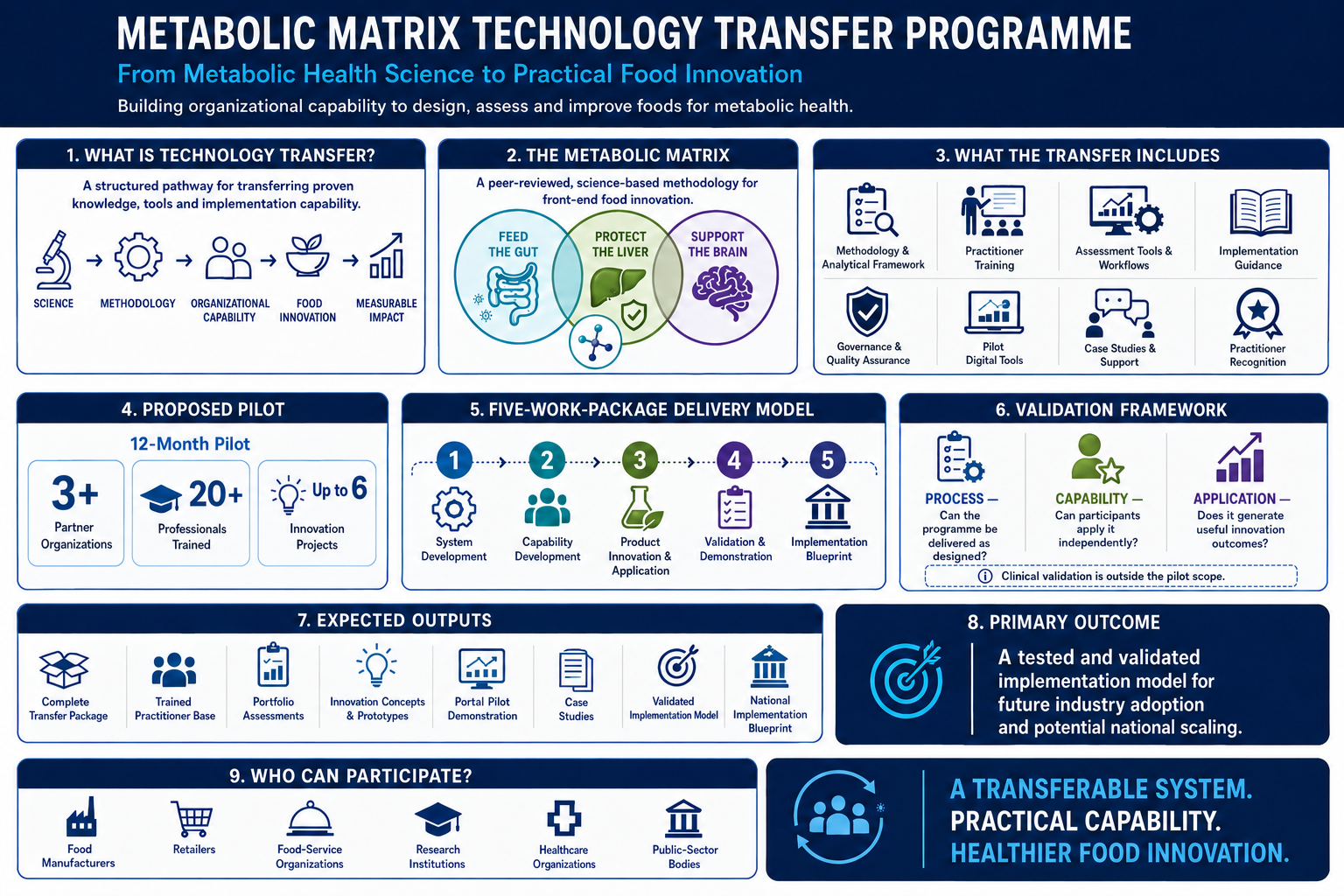
Metabolic Matrix Technology Transfer Programme
From Metabolic Health Science to Practical Food Innovation
KDD is developing a structured Metabolic Matrix Technology Transfer Programme to enable food-sector organizations to adopt and apply the Metabolic Matrix within their own product-development, portfolio-management, and innovation processes.
The Metabolic Matrix is a peer-reviewed, science-based food innovation methodology organized around three metabolic-health objectives:
- Feed the Gut
- Protect the Liver
- Support the Brain
Unlike conventional nutrition-rating systems that primarily assess products after they have been developed, the Metabolic Matrix is designed for use at the front end of innovation. It helps organizations evaluate products and portfolios, identify opportunities for improvement, prioritize innovation activities, and develop foods and beverages that are better aligned with long-term metabolic health.
What Technology Transfer Means
The Metabolic Matrix is not a single product, software platform, or certification scheme. It is an applied innovation system combining scientific methodology, organizational capability, implementation processes, and supporting tools.
The Technology Transfer Programme will provide participating organizations with:
- The Metabolic Matrix methodology and analytical framework
- Practitioner training and structured learning pathways
- Product and portfolio assessment methodologies
- Innovation-prioritization and product-development workflows
- Implementation manuals, templates, tools, and guidance
- Governance and quality-assurance processes
- Case studies, best practices, and implementation support
- Pilot access to approved digital assessment tools
- Practitioner recognition following successful completion
The objective is to create internal capability—not simply to conduct a one-time product assessment.
Proposed Pilot Programme
The pilot is designed to engage:
- Stakeholders in multiple sectors
- Professionals in related fields (food science, public health, government or academia)
- Diverse types of product innovation or renovation projects
Participants will receive training, undertake portfolio assessments, identify innovation opportunities, and apply the methodology within practical product-development activities.
Five-Work-Package Delivery Model
The pilot is organized into five integrated work packages:
1. Technology Transfer System Development
Codify the complete transfer system, including the Technology Transfer Manual, training curriculum, application toolkit, assessment templates, governance framework, and quality-assurance procedures.
2. Partner Capability Development
Recruit and onboard partner organizations, train participating professionals, assess competency, complete baseline portfolio assessments, and prepare organization-specific implementation plans.
3. Product Innovation and Application
Apply the methodology to real-world portfolios, identify innovation and renovation opportunities, develop product concepts, support prototype development, and document implementation experience.
4. Validation and Demonstration
Evaluate the effectiveness of the transfer process, demonstrate the Product Intelligence Portal pilot, conduct product benchmarking and consumer validation activities, and assess organizational adoption.
5. Implementation Blueprint Development
Document lessons from the pilot and produce a National Implementation Blueprint, sustainability framework, final evaluation, and roadmap for potential future expansion.
Product Intelligence Portal Pilot
The programme includes a limited pilot demonstration of a Product Intelligence Portal through which participating organizations may:
- Upload structured product information
- Apply Metabolic Matrix criteria
- Benchmark products within selected categories
- Compare products and portfolios
- Identify potential innovation opportunities
The portal is intended to demonstrate analytical feasibility. Establishing national digital infrastructure, a national branded food database, or retail-facing applications would require separate future initiatives.
How the Pilot Will Be Validated
The programme will evaluate four dimensions:
Process validation: Can the Technology Transfer Programme be delivered as designed?
Capability validation: Can trained participants independently and consistently apply the methodology?
Application validation: Does the methodology generate useful portfolio assessments, innovation opportunities, product concepts, and organizational outcomes?
Clinical validation: Clinical trials, intervention studies, and health-outcome evaluations are explicitly outside the scope of the proposed pilot. These may be considered through separate future research programmes.
Intellectual Property and Participant Access
The Metabolic Matrix methodology, analytical frameworks, scoring architecture, training materials, tools, digital resources, and associated intellectual property will be shared using Creative Commons licenses.
Organizations completing the pilot will receive a non-exclusive, perpetual internal license to use the approved methodology, materials, and tools within their own organizations.
The materials may not be distributed, sublicensed, shared, or used to provide services to third parties without prior written permission.
Expected Outputs
The proposed pilot will produce:
- A complete Technology Transfer Package
- A trained practitioner base
- Partner portfolio-assessment reports
- Product innovation and renovation concepts
- Prototype and case-study documentation
- A Product Intelligence Portal pilot demonstration
- Consumer-validation findings
- Practitioner recognition
- A validated pilot implementation model
- Implementation Blueprints (company or national scale)
- A sustainability framework and future roadmap
The primary outcome will be a tested and validated implementation model capable of informing future industry adoption, research programmes, public-private collaboration, and potential national scaling.
Scope of the Pilot
The pilot focuses on technology transfer, capability development, practical application, and implementation validation.
The following are outside the current pilot scope, but potentially available in future iterations of the Technology Transfer.
- National deployment
- Clinical validation
- Government policy implementation
- Regulatory integration
- National food-database development
- Retail or consumer API deployment
- Advanced certification programmes
- International expansion
- Commercial licensing and partnership arrangements
These opportunities may be considered in subsequent phases following successful completion and evaluation of the pilot.
Proposed Timeline
The pilot will begin in August of 2027.
Implementation remains subject to project approval, partner selection, and formal participation agreements.
Invitation to Collaborate
Food manufacturers, retailers, food-service organizations, research institutions, healthcare organizations, public-sector bodies, and other strategic stakeholders interested in pilot participation or future collaboration are invited to contact the Metabolic Matrix team.
Contact
Wolfram Alderson
Head of Research & Innovation
Kuwaiti Danish Dairy Company (KDD)
walderson@kddc.com