
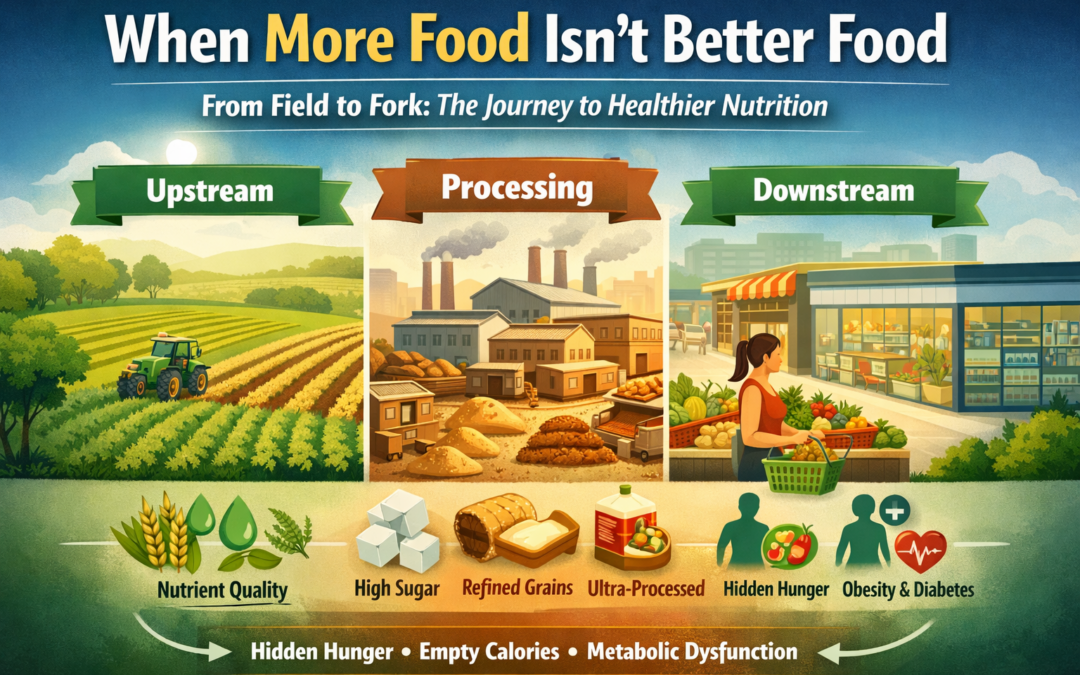
When More Food Isn’t Better Food: The Missing Link in the Global Nutrition Conversation
For decades, the global food agenda has been guided by a clear and urgent objective: produce more.
More yield per hectare.
More resilience in supply chains.
More calories to feed a growing population.
In many ways, that mission succeeded. Agricultural productivity has risen dramatically. Calorie availability per capita has increased across most regions of the world. Famines, while still tragic when they occur, are no longer the defining nutritional crisis of most nations.
And yet, something paradoxical has emerged.
We are producing more food than ever — and global metabolic health is deteriorating.
Obesity, type 2 diabetes, fatty liver disease, and cardiovascular disorders are rising across income levels. At the same time, micronutrient deficiencies persist in both low- and middle-income countries and in affluent societies. Children can be overweight and iron-deficient. Adults can be calorically replete and metabolically malnourished.
The problem is no longer simply food scarcity.
It is food quality — and what happens to food between the field and the fork.
The Yield–Health Disconnect
Agricultural output is measured in tonnage.
Health is measured in metabolic resilience.
These are not the same metric.
A hectare of high-yield grain may dramatically improve calorie availability. But if that grain is refined, stripped of fiber and micronutrients, and reformulated into ultra-processed products high in added sugars and rapidly digestible starch, the nutritional outcome shifts.
The calories remain.
The metabolic integrity does not.
Research over the past decade has clarified this disconnect:
-
Refined grains and high glycemic load diets are associated with increased risk of type 2 diabetes.
-
Added sugars contribute to hepatic fat accumulation and insulin resistance.
-
Ultra-processed food consumption correlates with higher energy intake and weight gain — even under controlled feeding conditions.
-
More than two billion people worldwide still experience micronutrient insufficiency despite adequate caloric intake.
The global food system solved for energy density.
It did not solve for metabolic health.
The Hidden Middle: Processing as a Health Determinant
Much of the public discourse frames nutrition as either an agricultural issue (“produce better crops”) or a consumer issue (“eat better”). But there is a critical layer in between: downstream processing and formulation.
What happens after harvest often determines whether nutritional value is preserved, diluted, or metabolically destabilized.
-
Milling can remove mineral-rich bran and germ.
-
Refinement can increase glycemic response.
-
Formulation can introduce added sugars and emulsifiers.
-
Storage and processing can degrade micronutrients.
In other words, upstream nutrient quality can be undermined by downstream design.
This is where the modern food system becomes metabolically consequential.
The Double Burden of Malnutrition
Today, public health experts describe a “double burden”:
-
Undernutrition and micronutrient deficiency
-
Overnutrition and metabolic disease
Often occurring within the same communities — sometimes within the same individual.
This dual reality reframes malnutrition. It is not simply the absence of calories. It is the absence of nutrient sufficiency and metabolic stability.
Hidden hunger — deficiencies in zinc, iron, iodine, vitamin A — continues to impair cognitive development and immune function globally. Meanwhile, excess free sugars and refined carbohydrates drive insulin resistance and visceral adiposity.
The food system produces both problems simultaneously.
Why Upstream and Downstream Must Converge
If the challenge spans the entire food system, the solution must as well.
Upstream interventions — such as improving soil micronutrient profiles or optimizing fertilizer strategies — can enhance the intrinsic nutrient density of crops. Agronomic biofortification has demonstrated measurable increases in zinc and iron content in staple foods.
But those gains must be preserved and amplified downstream.
That is where harm reduction and metabolic optimization enter the picture:
-
Reducing added sugars without compromising accessibility
-
Fortifying foods strategically where deficiencies are endemic
-
Reformulating products to improve glycemic response and micronutrient retention
-
Designing value-added foods that support metabolic resilience rather than undermine it
The intersection is not ideological. It is structural.
Agriculture defines potential.
Processing defines realized impact.
When upstream nutrient strengthening aligns with downstream metabolic design, the result is not merely more food — but better physiological outcomes at population scale.
Repositioning the Conversation
Global discussions around food reform are increasingly converging around three themes:
-
Hidden hunger
-
Metabolic disease
-
Food system transformation
These are not separate issues. They are manifestations of the same structural misalignment between production and health.
Addressing them requires reframing success.
Not yield per hectare alone.
Not calories per capita alone.
But nutrient density, metabolic response, and long-term health outcomes.
The future of food is not just about producing enough.
It is about ensuring that what we produce — and how we process it — strengthens human metabolism rather than destabilizing it.
Only when upstream agronomy and downstream formulation operate as a unified health strategy can the food system truly claim to nourish the populations it feeds.