
Our food is meant to provide nutrition and energy. But increasingly, what we eat is also making us sick. For decades, people around the world have relied on ultraprocessed foods, designed to be cheap, long-lasting, and convenient. Once celebrated as a marvel of modern efficiency, these foods are now linked to a health crisis that’s become too big to be ignored.
Rates of chronic metabolic diseases like Type 2 diabetes, fatty liver disease, cardiovascular problems, and cognitive disorders have increased sharply. These trends appear across countries and age groups, with even newborns sometimes showing biochemical signs of metabolic dysfunction. The pattern is hard to ignore.
A growing body of research suggests something fundamental is happening: that a food system dominated by highly engineered products is reshaping human biology in ways few anticipated. And counting calories is no longer useful to understanding nutrition and explaining disease patterns. Dr. Robert H. Lustig, leading authority on metabolic health, states: “A calorie burned is a calorie burned. That’s true. That’s the first law of thermodynamics. But that doesn’t mean a calorie eaten is a calorie metabolized. That’s not the same. Metabolism is what matters, not calorie counting.”
A New Way to Look at Food
Scientists now believe the problem goes deeper than eating too many calories. Research increasingly shows that “eat less, move more” does not fully explain today’s metabolic disease patterns. A team of scientists, whose independent work grew out of a collaboration with the Kuwaiti Danish Dairy Company (KDD), believes the crisis is not about energy balance. It is about how industrial foods affect the body’s core metabolic organs: the gut, the liver, and the brain.
The framework, called the Metabolic Matrix, proposes a radically simple premise: foods should feed the gut, protect the liver, and support brain function. The framework is designed to transform food & beverage portfolios to be metabolically positive. The methodology is peer-reviewed, adaptive, scalable, and replicable. Beneath the three GLB pillars are 39 evidence-based criteria in five progressive tiers.
To test their approach, the team set out to see whether the Metabolic Matrix could be applied to real, everyday foods, not just idealized diets or theoretical meal plans.
Putting Theory to the Test
The researchers began by applying the Metabolic Matrix to KDD’s range of 180 products, which included dairy, juices, and ice creams. They found ingredients commonly found in ultra-processed foods worldwide, including added sugars, refined oils, stabilizers, and additives, in addition to low fiber content in some products.
Instead of rejecting these foods outright, the researchers took a different approach. They treated processed foods as something that could be improved. Using a tiered evaluation system, they analyzed ingredients, processing methods, and their likely effects on metabolism. This included looking at sugar structures, fat profiles, micronutrients, stabilizers, and the hidden effects of industrial processing.
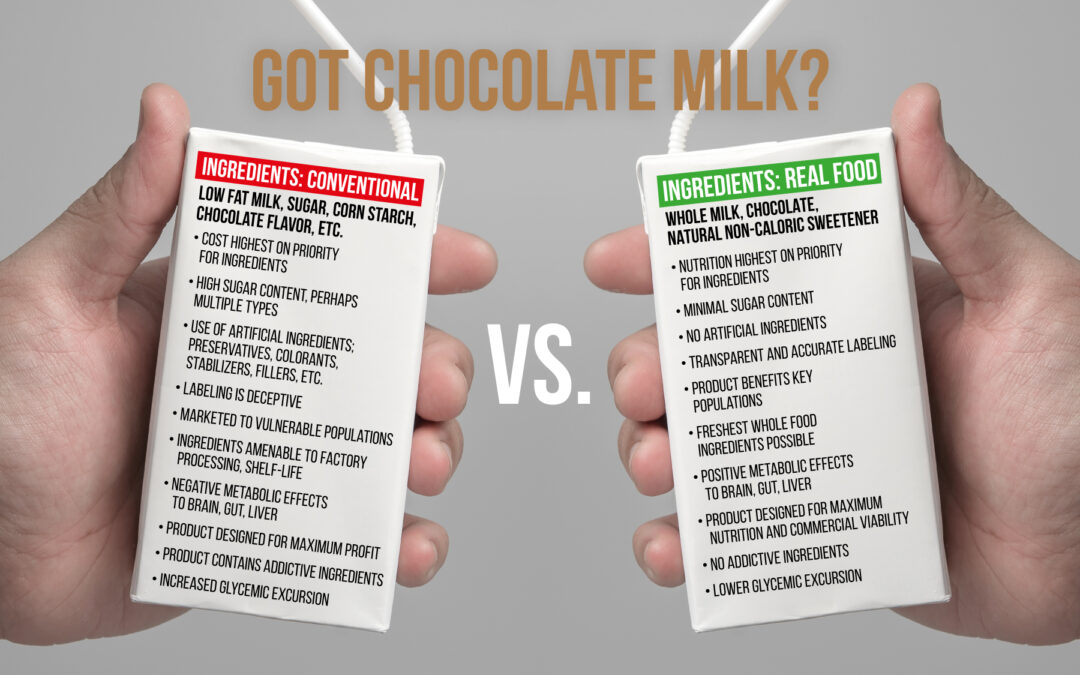
Some re-designs were surprisingly effective. KDD’s extremely popular chocolate milk was reformulated to remove added sugar without changing its distinctive taste. A whole new line of metabolically improved foods was developed called GOOD FOR ME. These products weren’t marketed as “diet foods”. They offer familiar products, redesigned to improve metabolic impact and improve overall nutritional quality. Sir Mohammad Jafaar, KDD Chairman and CEO speaks to the paradigm shift in thinking: “We need to move from health being in the eye of the shareholder to health being in the eye of the metabolism.”
The Limits of Reformulation
The experiment also revealed some obstacles facing any company attempting to change its products for the better. Healthier ingredients often cost more. Promising sugar alternatives are blocked in some regions by regulatory delays. And global subsidies still favor ingredients that form the backbone of many ultra-processed foods: crops like corn, wheat, soy, and sugar.
Together, these conditions create a system where the most metabolically damaging ingredients are often the most profitable. Any company looking to make meaningful, healthier changes to its products has to work against these barriers. The tension between what’s profitable and what’s healthy sits at the center of a much larger global reckoning.
A Turning Point for Ultraprocessed Foods
In the past year, three major reports published on The Lancet platform identified ultraprocessed foods as a major driver of non-communicable diseases worldwide. These conditions, including diabetes, heart disease, and certain cancers, now account for roughly half of all global deaths.
These reports also highlight the hidden costs of the current food system. Ultraprocessed foods may appear cheap at the checkout, but when healthcare spending, environmental damage, and lost productivity are considered, their true costs may far exceed their market value.
The numbers are staggering: trillions of dollars in preventable health burdens, trillions more in environmental and social costs, and growing liabilities for multinational food companies facing lawsuits over the harm their products can cause. Governments are considering warning labels. Insurers are reassessing long-term risk. Investors are questioning business models built on ultraprocessed foods. The parallels to Big Tobacco’s corporate reckoning have become impossible to ignore.
From Research to Global Dialogue
Against this backdrop, KDD hosted an accredited event at the World Economic Forum’s annual meeting in Davos in January 2026 titled Breaking Bad: When Food Targets Health. The goal wasn’t product promotion, but to address a gap in the global conversation—where food systems, metabolic health, and economic stability intersect.
The discussion brought together scientists, policymakers, insurers, manufacturers, and investors. The shared challenge is uncomfortable, but also increasingly clear: ultraprocessed foods are no longer only a nutrition issue; they represent a systemic risk to public health and long-term economic resilience.
At the center of the conversation is a question first explored in KDD’s own products: Can processed foods be redesigned, at scale, to support metabolic health?
An Open Framework for Change
As part of this effort, KDD is developing a technology-transfer framework that would allow other food manufacturers – or any stakeholder – to apply the Metabolic Matrix to their own products or portfolio. The goal isn’t to dictate recipes or eliminate entire food categories, but to offer clear, evidence-based criteria for desi metabolic impact.
In practice, this would allow companies to assess how their product affects the gut, liver, and brain, and to identify where reformulation could make a meaningful difference. The framework is designed to be adaptable, transparent, and open to broad adoption.