
The Future Is Fiber
How food science is opening new possibilities for the foods we already enjoy
For decades, fiber had a modest public identity: roughage. Something to keep digestion moving. Important, certainly, but hardly the ingredient around which we imagined the future of food.
That story has expanded dramatically.
Today, fiber belongs in a much broader conversation about the gut microbiome, carbohydrate quality, and metabolic health. For food manufacturers, it also presents a practical opportunity: improving familiar foods that people already buy, enjoy, and eat regularly.
Three research papers shared by Dr. Wilbert Sybesma, a key member of our scientific advisory team, illustrate that opportunity through bread, cake, and pasta. Researchers investigated how carefully designed blends of fibers could replace part of the flour or semolina, substantially increase fiber content, and preserve desirable product characteristics.
The findings offer an encouraging direction for food innovation—and a useful reminder that better nutrition depends on thoughtful design.
A bigger role in human health
Fiber encompasses a diverse family of substances with different properties and functions. Some fibers hold water and support bowel function. Certain viscous fibers can influence nutrient absorption. Fermentable fibers provide substrates for gut microorganisms, which can produce metabolites such as short-chain fatty acids.
These differences matter. A fiber’s source, structure, dose, and behavior within a food help determine what it does. “Contains fiber” is therefore the beginning of a scientific conversation about a product.
The broader health evidence gives that conversation weight. A major series of systematic reviews published in The Lancet associated higher dietary fiber consumption with lower risks of several chronic diseases and premature mortality. Clinical trials also found improvements in measures including body weight, blood pressure, and total cholesterol when comparing higher with lower fiber intakes. These findings concern dietary patterns and cannot automatically be transferred to every isolated fiber ingredient or fortified product.
The World Health Organization recommends that adults consume at least 25 grams of naturally occurring dietary fiber daily, emphasizing whole grains, vegetables, fruits, and pulses as carbohydrate sources. These foods remain foundational. Reformulation offers an additional way to improve the foods that populate everyday diets.
Three familiar foods, three opportunities
The studies shared by Dr. Sybesma came from a research team led by Professor Elke Arendt at University College Cork, with collaborators. Each explored combinations of fibers with different characteristics, rather than relying on a single ingredient.
| Food | Fiber in the control | Fiber after reformulation | What the study revealed |
|---|---|---|---|
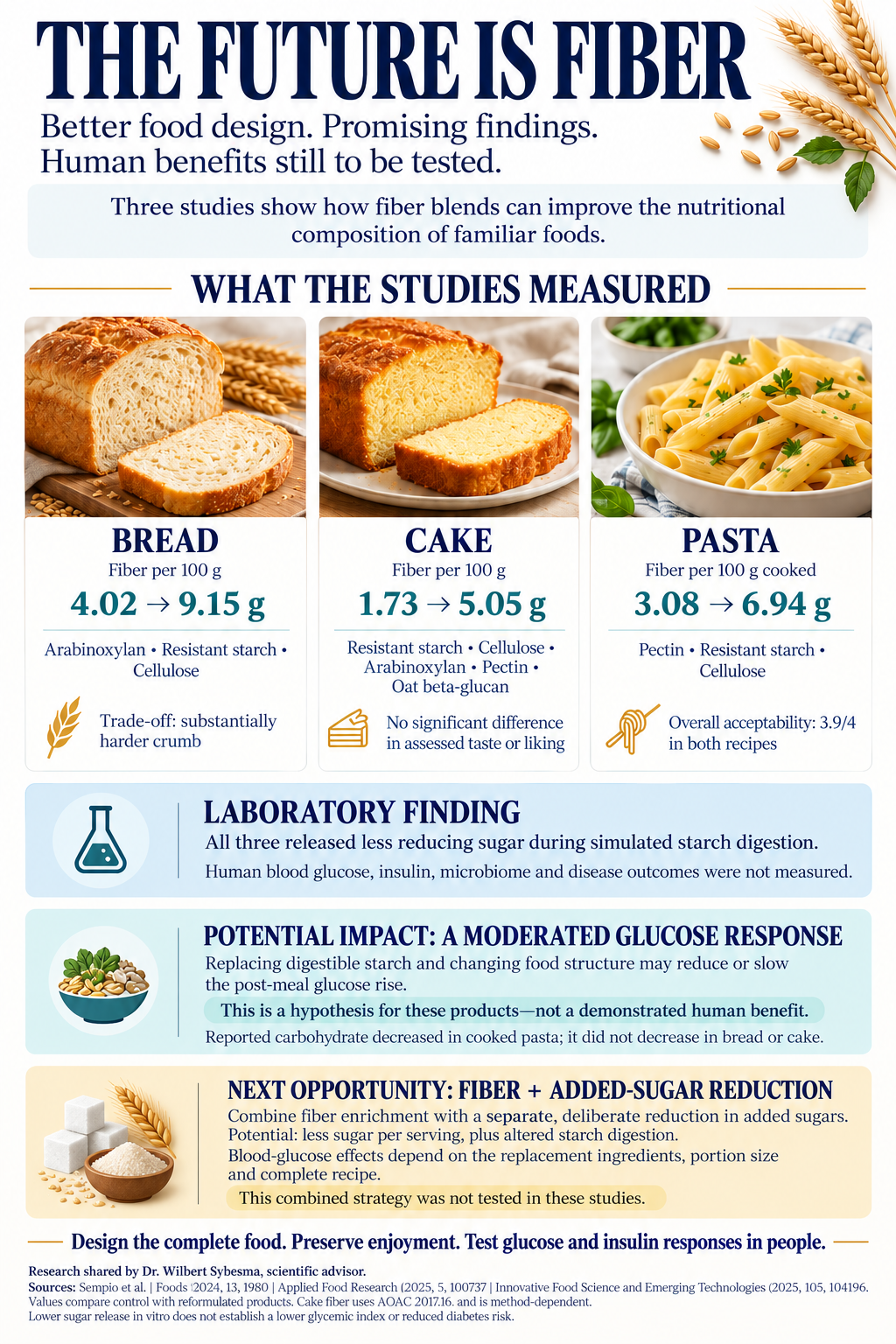
| Bread | 4.02 g/100 g | 9.15 g/100 g | More than doubled fiber, with a substantially harder crumb requiring further texture development |
| Cake | 1.73 g/100 g | 5.05 g/100 g | Nearly tripled fiber, with no significant difference in assessed taste and liking attributes |
| Pasta, cooked | 3.08 g/100 g | 6.94 g/100 g | More than doubled fiber, with identical overall acceptability scores of 3.9 out of 4 |
Values compare each study’s control with its optimized formulation. The cake values use the paper’s AOAC 2017.16 method; different fiber measurement methods can produce different results.
In the bread study, a blend of arabinoxylan, resistant starch, and cellulose replaced 53% of the flour. The nutritional improvement was substantial, but so was the texture challenge. That combination makes the study valuable: it demonstrates both the opportunity and the development work still required.
The cake researchers combined resistant starch, cellulose, arabinoxylan, pectin, and oat beta-glucan, replacing 38.45% of the flour. Their results suggest that a familiar indulgent food can deliver appreciably more fiber while retaining sensory appeal.
For pasta, a blend of pectin, resistant starch, and cellulose replaced 26% of the semolina. Alongside increased fiber, the cooked product contained less reported carbohydrate: 24.32 grams per 100 grams, compared with 30.33 grams in the control. Both versions received the same high overall acceptability score.
The food’s structure matters
Across all three studies, the reformulated products released less reducing sugar during simulated starch digestion.
That is a promising laboratory finding. It suggests that changing ingredients and the structure of a food can alter how starch is broken down. It also highlights why carbohydrate quality deserves attention alongside the number of carbohydrate grams on a label.
However, laboratory digestion does not establish a lower blood glucose response in people. These studies did not demonstrate improvements in diabetes, liver health, or the human microbiome. Such benefits require appropriate human testing.
Nor did fiber enrichment consistently reduce reported carbohydrate content: the bread and cake values were slightly higher after reformulation. Adding fiber and reducing carbohydrate are distinct formulation objectives.
These distinctions strengthen the case for evidence-led innovation. They give us a clearer understanding of what has been achieved and what should be tested next.
Better food requires a complete design approach
For KDD, this work connects directly with the Metabolic Matrix and its three guiding goals: Feed the Gut, Protect the Liver, and Support the Brain.
Fiber selection is particularly relevant to Feed the Gut. Its potential contribution to the other goals depends on the ingredient, the complete formulation, and evidence for the finished product.
Our responsibility is to evaluate the whole food. Fiber enhancement should progress alongside attention to sugars, fat quality, sodium, processing, portion size, and nutritional balance. A cake with more fiber remains a cake; responsible indulgence requires a broader approach to its design.
Commercial success also requires products that people enjoy, tolerate, and can afford. Ingredient costs, manufacturing performance, shelf life, and digestive tolerance all matter. An impressive formulation on paper becomes useful when it works in everyday life.
The opportunity is considerable. Improving a widely eaten staple could help people increase fiber intake through meals they already know. Improving an indulgent product could make that choice nutritionally better while preserving the pleasure people seek.
The future is fiber because fiber gives us more ways to design better food. The challenge now is to translate that potential into products with meaningful nutritional improvements, demonstrated benefits, and lasting consumer appeal.
Acknowledgment: With thanks to Dr. Wilbert Sybesma for sharing the research that informed this article.
Here are the hyperlinks supporting “The Future Is Fiber.”
The three studies shared by Dr. Sybesma
-
Bread: Sempio et al. (2024). Closing the Fibre Gap—The Impact of Combination of Soluble and Insoluble Dietary Fibre on Bread Quality and Health Benefits. Foods, 13, 1980.
https://doi.org/10.3390/foods13131980 -
Cake: Sempio et al. (2025). Cake fortification with dietary fibre: Impact of fibre ingredients in a cake model system. Innovative Food Science and Emerging Technologies, 105, 104196.
https://doi.org/10.1016/j.ifset.2025.104196 -
Pasta: Sempio et al. (2025). Enriching pasta with soluble and insoluble fibre: A strategy for boosting fibre intake. Applied Food Research, 5, 100737.
https://doi.org/10.1016/j.afres.2025.100737
Broader evidence and dietary guidance
-
Fiber, carbohydrate quality, and chronic disease: Reynolds et al. (2019). Carbohydrate quality and human health: a series of systematic reviews and meta-analyses. The Lancet, 393, 434–445.
Journal article · PubMed abstract -
Fiber, the microbiome, and gastrointestinal health: Gill et al. (2021). Dietary fibre in gastrointestinal health and disease. Nature Reviews Gastroenterology & Hepatology, 18, 101–116.
https://doi.org/10.1038/s41575-020-00375-4 -
WHO carbohydrate guideline (2023): Carbohydrate intake for adults and children. Includes the recommendation for at least 25 g/day of naturally occurring dietary fiber for adults.
Full guideline · WHO announcement and key recommendations