
The 2030 Meal: Where Metabolic Health Meets Affordability
The question is no longer simply whether we can grow better food. It is whether the food system can turn it into meals that ordinary households can afford.
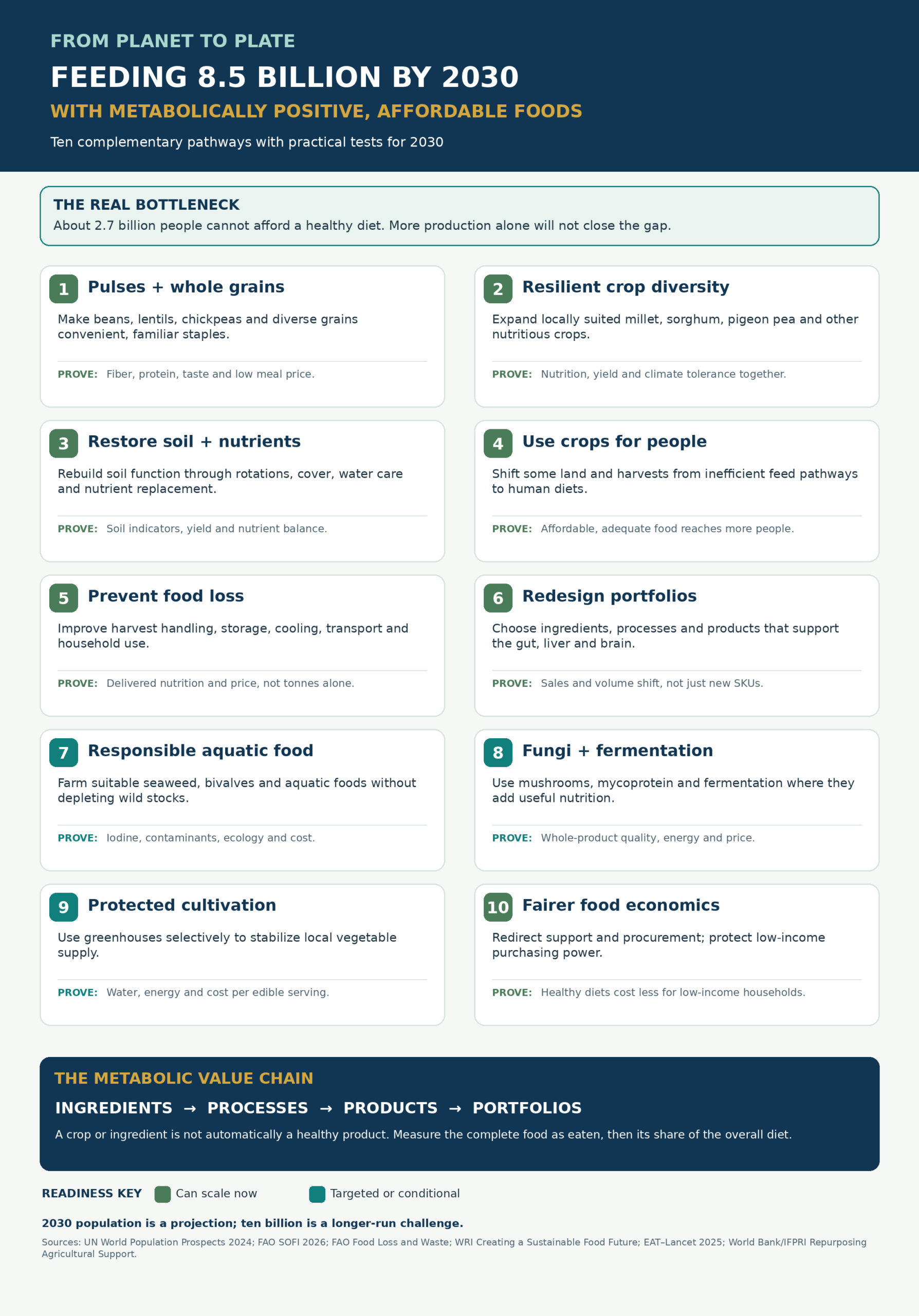
By 2030, the world is projected to have roughly 8.5 billion people. The companion infographic below sets out ten plausible ways to produce and deliver more nutritious food: pulses and whole grains, resilient crops, healthier soils, reduced food loss, aquatic foods, fungi and other pathways. They offer reason to believe that production need not be the defining obstacle.
The harder question sits between the harvest and the plate. What will a metabolically positive meal actually cost in 2030? And will it be affordable to the people whose diets have the most room to improve?
The price of healthy eating is already a barrier
The Food and Agriculture Organization and World Bank estimate that 2.69 billion people could not afford a healthy diet in 2025. Their estimate compares the cost of the least expensive locally available foods meeting dietary guidance with people’s incomes, after allowing for other basic needs. It is a measure of economic access, not a count of people who lack food altogether.
The same analysis puts the population-weighted global average cost of that daily diet at $4.28 in purchasing-power-parity terms. This is a statistical comparison across countries. It is neither the cash price of a prepared meal nor a universal amount every household faces. Costs vary considerably by place; so does the income available to pay them.
Those figures establish the urgency of affordability. They do not yet tell us what a meal designed to support metabolic health would cost.
The Hidden Middle determines what reaches the plate
A nutritious crop does not travel unchanged from soil to stomach. It is selected, stored, transported, processed, formulated, packaged, marketed and sold. This Hidden Middle can preserve or improve a food’s value. It can also remove fiber, concentrate refined starches or sugars, increase costs through avoidable loss, or produce something very different from the promising ingredient with which it began.
The complete product matters. So does the wider portfolio of products people routinely encounter. An occasional premium food will have little effect on population diets if affordable everyday choices remain metabolically poor.
The aim should be clear: make metabolically positive foods the normal, affordable option, rather than a specialty category for households able to pay more. Better ingredients may cost more in some settings today. But the final price also reflects processing, scale, storage, distribution, waste, retail practices and public policy. We need to measure each contribution before assuming that healthy food must always command a premium.
Price the meal, then test who can afford it
There can be no single “2030 meal” for the world. A useful research program would design several culturally appropriate meal formats in different markets—perhaps a pulse-and-whole-grain meal, a fermented-food meal and a shelf-stable complete-meal format. Each would need a defined metabolic standard, adequate nutrition, acceptable taste and a realistic serving size.
For each meal, the analysis should answer five questions:
- What does it cost to make? Include ingredients, processing, energy, packaging and quality assurance.
- What does it cost to deliver and prepare? Include storage, transport, retail margins, household time and food lost along the way.
- What does the consumer pay? Compare the meal with familiar local alternatives, not only with premium health products.
- Who can afford it? Assess the price against incomes and essential non-food expenses, especially for lower-income households.
- What could change by 2030? Model credible improvements in yields, supply chains, scale and public purchasing—as well as unfavorable energy or climate conditions.
The result would be more useful than a single global price. It would show a cost range, the assumptions behind it and the share of households able to buy the meal in each setting. It would also reveal where an intervention in the Hidden Middle lowers cost without sacrificing metabolic quality.
We have promising ways to produce food for a larger population. The test now is whether we can turn that potential into everyday products and meals that support metabolic health at a price people can live with. By 2030, success should be measured not only by how much better food we can make, but by how many people can regularly afford to eat it.
Further reading
-
The State of Food Security and Nutrition in the World 2026 — The starting point for current estimates of healthy-diet costs, affordability and the foods driving those costs. (openknowledge.fao.org)
-
How FAO measures the cost and affordability of a healthy diet — Essential context for interpreting the $4.28 PPP daily benchmark and the estimate of people unable to afford a healthy diet. (www.fao.org)
-
The Healthy Diet Basket is a valid global standard that highlights lack of access to healthy and sustainable diets — The research behind the diet basket used to examine access. (Nature)
-
The hidden middle: the quiet revolution in the midstream of agrifood value chains in developing countries, Thomas Reardon, 2015 — A foundational article on why processing, logistics and wholesale matter as much as farm output to food access and price. (jstor.org)
-
2024 Global Food Policy Report: Food Systems for Healthy Diets and Nutrition — IFPRI’s broad treatment of the policies, markets and food environments needed to make healthy diets accessible and desirable. (IFPRI)
-
2025 EAT–Lancet Commission Summary Report — A framework for healthy diets within environmental limits, with attention to fairness in the transition. (EAT)
-
Creating a Sustainable Food Future — WRI’s modeled “menu” of solutions for feeding a larger population without assuming that one crop or technology will suffice. (www.wri.org)
-
The False Economy of Big Food: 2026 Update, Tim Jackson — A UK case study distinguishing what households pay for food from the wider health-related costs associated with unhealthy diets. Its estimates should not be applied as a global coefficient. (ffcc.co.uk)
-
FAO Food Loss and Food Waste — Data and policy resources on food lost between harvest and retail and wasted after it reaches consumers. (www.fao.org)
-
The Metabolic Matrix: Re-engineering ultraprocessed foods to feed the gut, protect the liver, and support the brain — A proposed product-design framework for examining what happens to metabolic quality within the Hidden Middle. It complements, rather than replaces, diet affordability and outcome research. (frontiersin.org)