
Creating shared value through better food design
What a KDD ice cream trial reveals about metabolic health and the purpose of food innovation
By Wolfram Alderson | metabolicmatrix.info | 15 October 2026
Can improving an everyday food create value for both the people who eat it and the company that makes it? A clinical study led by researchers at Dasman Diabetes Institute (DDI) in Kuwait provides a concrete example of why that question matters.
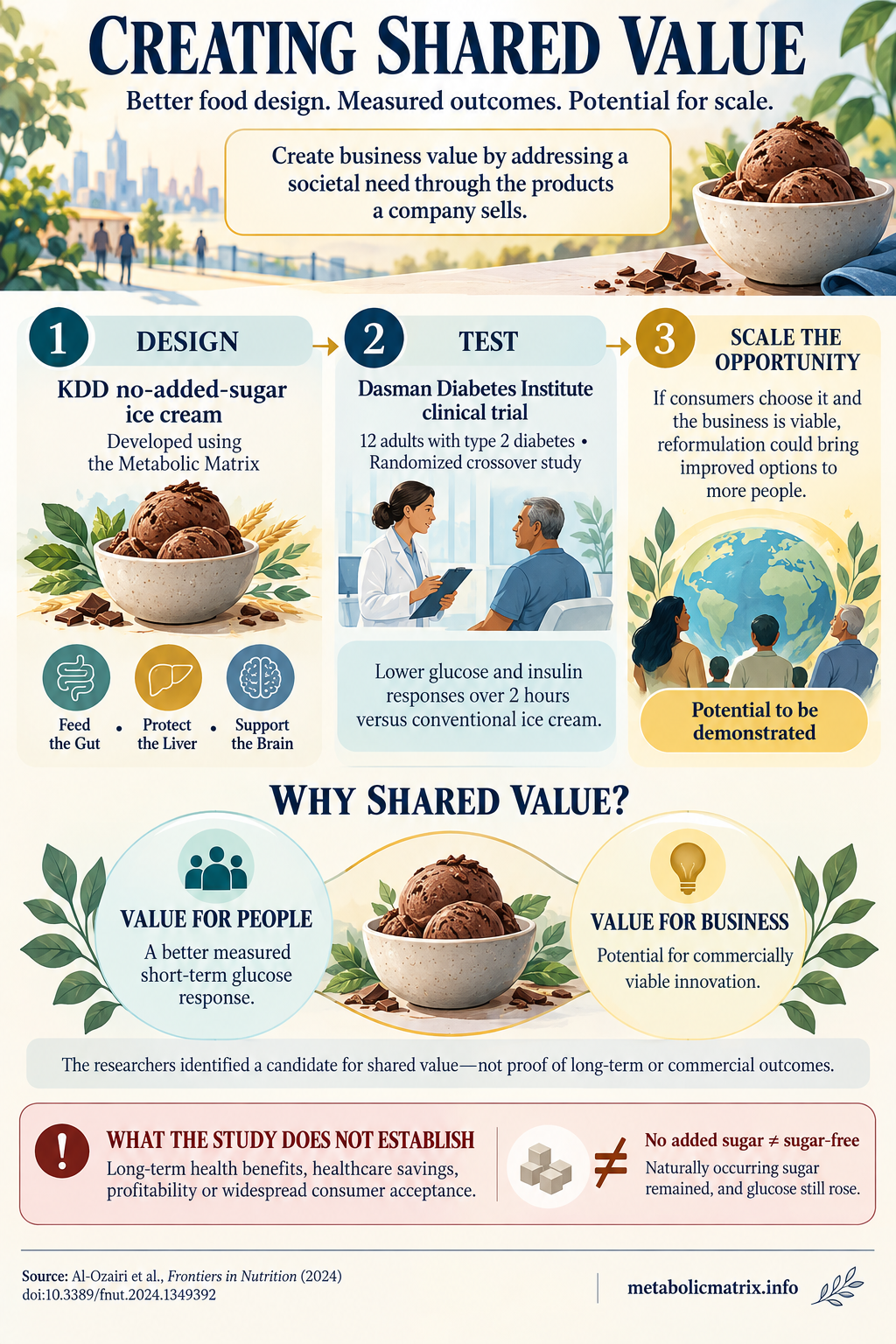
Published in Frontiers in Nutrition in July 2024, the paper examined KDD no-added-sugar ice cream developed using the Metabolic Matrix. Its title went beyond the clinical endpoint: Reformulating ice cream to improve postprandial glucose response: an opportunity for industry to create shared value. [1]
That choice of framing deserves attention. The researchers were considering how a measurable product improvement might become a practical, scalable response to a public health challenge.
What shared value means
In the paper, creating shared value means generating economic value by addressing a societal need through a company’s core products and operations. The concept, associated with Michael Porter and Mark Kramer, connects business success with social progress. [1,3]
For a food manufacturer, this means building health considerations into what it develops, produces and sells. A product that offers a better measured metabolic response, appeals to consumers and can be supplied profitably could serve both a social purpose and a commercial one.
The authors explain why profitability matters: it can support continued investment, production and wider availability without depending on philanthropic funding. The shared value proposition therefore rests on whether a business can make a useful improvement endure and reach more people.
What the trial demonstrated
The randomized, double-blind crossover trial involved 12 adults with type 2 diabetes. Each participant consumed conventional chocolate ice cream and the no-added-sugar version on separate visits. The planned quantity was 300 grams; two participants consumed smaller, individually matched quantities on both occasions. This was an experimental comparison, rather than a recommended serving size. [1]
Over the two hours after consumption, the no-added-sugar ice cream produced a significantly lower overall blood glucose response. Mean peak blood glucose was 8.7 mmol/L, compared with 10.5 mmol/L for conventional ice cream. The overall insulin response was also lower. These findings demonstrate an acute difference between the two formulations in the population studied. [1]
The boundaries matter. The trial did not establish improvements in long-term glucose control, weight loss, diabetes prevention or healthcare costs. Nor did it test every aspect of the Metabolic Matrix. The authors detected no difference in palatability, but explicitly acknowledged that a larger study would be needed to assess consumer satisfaction and palatability adequately.
They also emphasized that no-added-sugar does not mean sugar-free. Naturally occurring sugar remained, and the reformulated product still caused a substantial glucose response. Transparent communication is part of the value proposition.
Why the researchers highlighted shared value
The discussion makes their reasoning explicit. Food companies have the capacity to reformulate familiar products and distribute them widely. Independent nutrition research can test whether those changes deliver the intended effects. If a product is acceptable to consumers and commercially viable, an improvement could be sustained through ordinary business activity. [1]
This also changes where responsibility sits. Alongside individual dietary choices, the authors emphasize the products and food environments that shape those choices. Manufacturers can contribute by improving the options people encounter in everyday life.
Ice cream makes that argument tangible. It is a familiar indulgence. Reformulating it offers a way to investigate whether people can choose an alternative with a lower immediate glucose impact while retaining enjoyment. The commercial and public health opportunity lies in making such alternatives desirable, available and credible.
Importantly, the authors call the ice cream a candidate for creating shared value. The clinical experiment did not measure profitability, market adoption or population health outcomes. It supplied evidence for one essential part of the proposition, while leaving the broader business and social outcomes to be demonstrated.
How the Metabolic Matrix contributes
The Metabolic Matrix offers a framework for designing and reformulating foods around three principles: Feed the Gut, Protect the Liver and Support the Brain. Its 39 criteria bring metabolic considerations into product development. [2]
In this example, the framework guided reformulation, and the clinical trial tested a specific outcome. That connection between design and measurement is valuable: an intended benefit becomes a question that can be investigated.
The findings support the tested product comparison. They do not establish that the ice cream delivers all three pillars, or that every product developed with the framework will produce the same effects. Each formulation and proposed benefit requires appropriate evidence.
A practical agenda for food innovation
For us, the paper points toward a demanding but useful definition of successful innovation: improve the product, test the relevant outcomes, communicate the findings accurately and build a business capable of delivering the improvement at scale.
The next questions extend beyond this initial trial. Will consumers choose the reformulated product repeatedly? Can it remain affordable and commercially viable? What happens when it replaces conventional products over time? Answering those questions would help establish whether the potential for shared value becomes a sustained result.
The opportunity identified by DDI’s researchers is significant precisely because it connects science with everyday commerce. Food businesses can direct their capacity for innovation toward better metabolic outcomes, and research can help determine whether they succeed.
Shared value becomes meaningful when the value created for the business is linked to a demonstrable improvement for the people it serves.
Sources
1. Al-Ozairi E et al. (2024). Reformulating ice cream to improve postprandial glucose response: an opportunity for industry to create shared value. Frontiers in Nutrition 11:1349392.
https://doi.org/10.3389/fnut.2024.1349392
2. Harlan TS et al. (2023). The Metabolic Matrix: Re-engineering ultraprocessed foods to feed the gut, protect the liver, and support the brain. Frontiers in Nutrition 10:1098453.
https://doi.org/10.3389/fnut.2023.1098453
3. Porter ME and Kramer MR (2011). Creating Shared Value. Harvard Business Review. Conceptual source cited by the clinical paper.
https://hbr.org/2011/01/the-big-idea-creating-shared-value
Disclosure
The author is Head of Research and Innovation at KDD and a co-author of the Metabolic Matrix framework paper. The clinical study reports funding from the Kuwait Foundation for the Advancement of Sciences (KFAS).