
Beyond the Injection: GLP‑1 Medicines, Metabolic Health and the Future of Food
GLP‑1 therapies can transform treatment. The Gut–Liver–Brain framework can help transform prevention—and ensure that food remains part of the solution.
GLP‑1 medicines have changed the conversation about obesity and metabolic disease.
Drugs such as semaglutide—and newer therapies such as tirzepatide, which acts on both GIP and GLP‑1 receptors—can produce substantial weight loss, improve blood glucose control and reduce several serious complications associated with metabolic dysfunction. For many people, these medicines are not cosmetic shortcuts. They are powerful clinical interventions capable of improving health and extending life.
But their success raises a larger question:
If medicines can partially correct the biology of metabolic dysfunction, what should the food and beverage industry do about the environmental and nutritional conditions contributing to that dysfunction in the first place?
The answer should not be to oppose the medicines. Nor should it be to place a “GLP‑1 friendly” badge on existing protein bars, shakes and reduced-portion meals.
A more constructive response is to connect treatment with prevention:
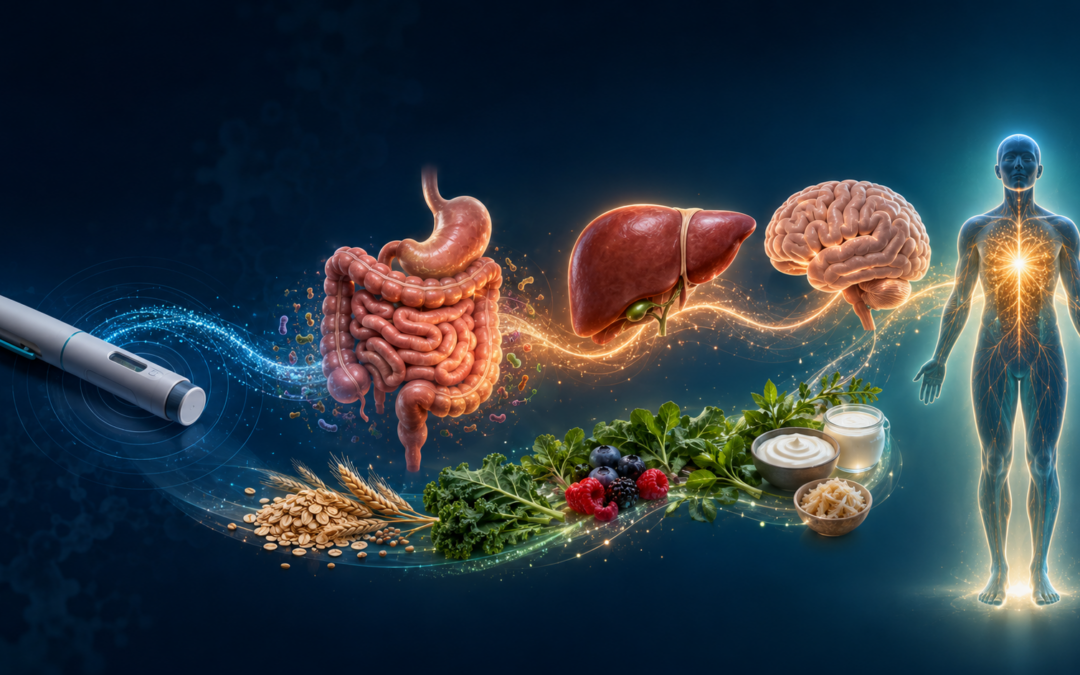
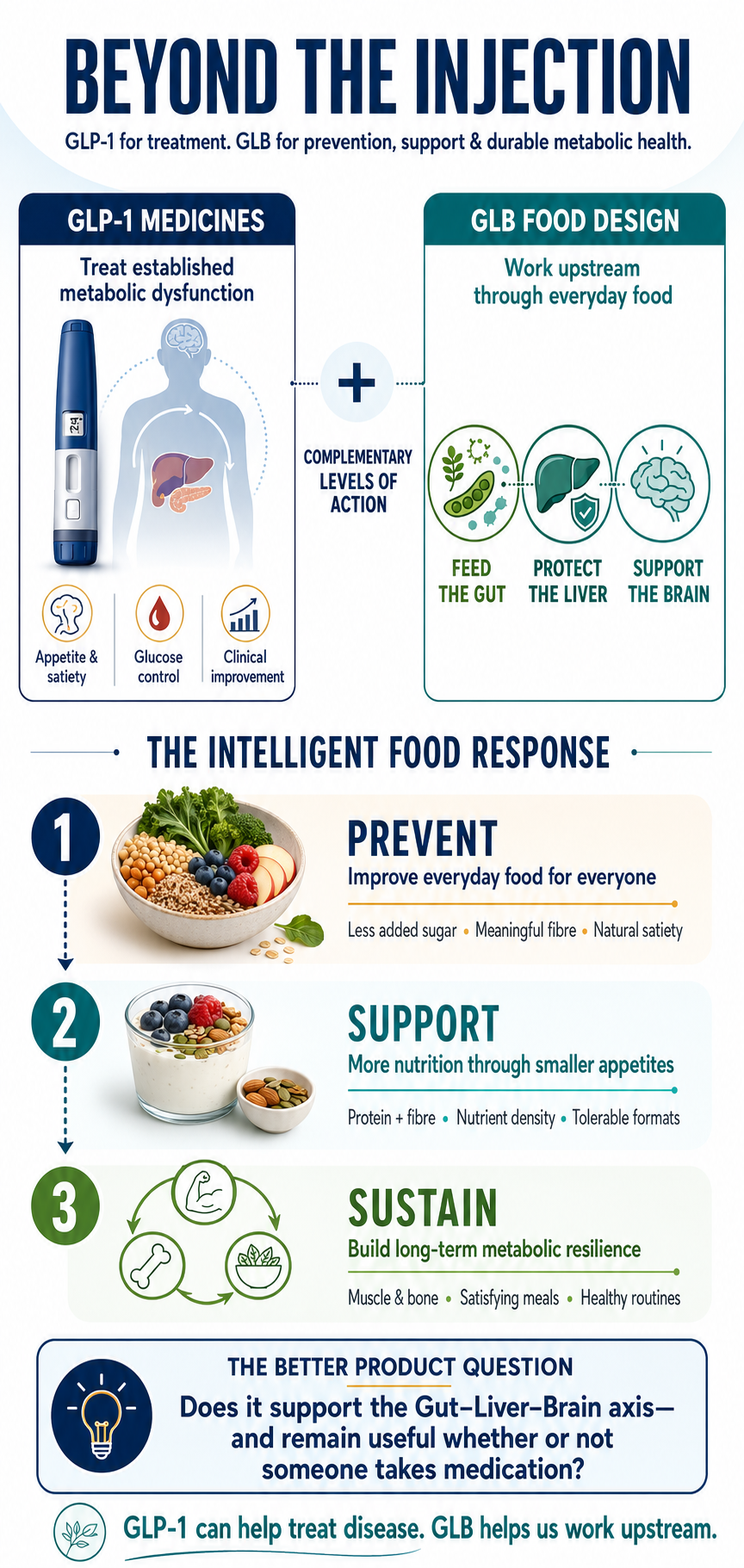
GLP‑1 for treatment; GLB—Gut, Liver and Brain—for prevention, treatment support and durable metabolic health.
GLP‑1 is biology—not merely appetite suppression
Glucagon-like peptide-1, or GLP‑1, is a hormone produced primarily in the intestine in response to food. It participates in communication among the gut, pancreas, liver and brain.
GLP‑1-based therapies strengthen or extend some of these natural signals. Depending on the medicine, they can:
-
Increase glucose-dependent insulin secretion
-
Reduce inappropriate glucagon secretion
-
Slow gastric emptying, particularly during the early stages of treatment
-
Increase satiety and reduce hunger
-
Influence food reward, cravings and appetite in the brain
-
Substantially reduce energy intake
This is one reason the medicines are so effective. They do not simply tell people to exercise more willpower. They change some of the biological signals influencing hunger, satiety, glucose regulation and food choice.
Their benefits also extend beyond the bathroom scale.
In the landmark SELECT trial, semaglutide reduced major cardiovascular events by 20 percent relative to placebo among people with overweight or obesity and established cardiovascular disease but without diabetes. The event rate was 6.5 percent in the semaglutide group and 8.0 percent in the placebo group. SELECT trial
The FLOW trial subsequently demonstrated important kidney and survival benefits among people with type 2 diabetes and chronic kidney disease. FLOW trial
The ESSENCE trial also found that semaglutide could help resolve metabolic dysfunction-associated steatohepatitis, or MASH, and improve liver fibrosis in some patients with moderate-to-advanced disease. ESSENCE trial
This is no longer simply a weight-loss category. GLP‑1-based medicines are becoming an important platform for treating interconnected metabolic diseases involving the cardiovascular system, kidneys, liver and other organs.
A breakthrough—but not a complete food-system solution
Recognizing the value of these medicines does not require us to pretend that medication solves the entire metabolic-health crisis.
GLP‑1 therapies act primarily at the level of the individual patient. They do not redesign the food environment, remove excessive added sugar from the food supply, restore fibre lost through refining, improve the quality of children’s diets or make metabolically supportive food more accessible.
They can treat downstream disease without necessarily changing its upstream drivers.
There are also practical limitations.
Treatment may need to be long term
Obesity and metabolic dysfunction are frequently chronic, relapsing conditions. When treatment stops, appetite-regulating effects diminish and weight regain is common.
A 2026 systematic review and meta-analysis published in The BMJ found that participants regained an average of approximately 0.4 kilograms per month after stopping weight-management medicines. Across the available studies, weight was projected to return to baseline in approximately 1.7 years, while improvements in several cardiometabolic markers also tended to diminish. BMJ systematic review
This does not mean that the medicines damage metabolism or inevitably make people worse. It indicates that their biological effects generally persist only while treatment continues—much as blood pressure may rise again when an effective antihypertensive medicine is withdrawn.
It also highlights the need for better long-term nutrition, physical activity and transition support.
Eating less makes nutritional quality more important
GLP‑1 therapies can markedly reduce food intake. That is central to their effectiveness, but it also means that each meal must work harder nutritionally.
If someone is eating much less, a diet that was already low in fibre, micronutrients or high-quality foods may become even less adequate. Possible concerns include:
-
Insufficient protein or total nutrient intake
-
Low fibre intake and constipation
-
Dehydration
-
Inadequate iron, calcium, magnesium, zinc or vitamins
-
Loss of lean tissue during weight reduction
-
Loss of bone mass
-
Greater risk of frailty among older or vulnerable individuals
A joint advisory from the American College of Lifestyle Medicine, American Society for Nutrition, Obesity Medicine Association and The Obesity Society emphasizes nutrient density, gastrointestinal tolerability, hydration, resistance exercise and the preservation of muscle and bone throughout GLP‑1 treatment. Joint GLP‑1 nutrition advisory
Muscle loss also requires careful interpretation. Effective weight loss—whether achieved through medication, dietary restriction or bariatric surgery—usually includes some lean mass as well as fat. The goal is not to claim that GLP‑1 medicines uniquely “waste muscle,” but to ensure that weight loss is accompanied by adequate nutrition and resistance exercise, particularly among older adults.
The missing support system in Kuwait
Research from Kuwait University provides an especially relevant regional perspective.
In a survey of 486 GLP‑1 medicine users, tirzepatide users reported greater weight loss, satisfaction and quality-of-life improvement than users of semaglutide or liraglutide. However, cost, adverse effects and long-term adherence remained significant challenges.
Only about one-third of participants reported following a diet, dietitian engagement was limited and 47 percent had discontinued treatment by the time of the survey. Because the study was cross-sectional and relied on self-reported outcomes, it cannot establish that one medicine is clinically superior to another. Kuwait GLP‑1 study
Its most important message may be broader: the rapid adoption of GLP‑1 medicines has not yet been matched by the development of a mature nutritional and behavioural support system.
That gap creates both a responsibility and an opportunity for healthcare providers, food companies, researchers and public-health institutions in Kuwait.
GLP and GLB: complementary levels of intervention
The Metabolic Matrix is organized around three mutually reinforcing biological objectives:
-
Feed the Gut
-
Protect the Liver
-
Support the Brain
Together, these form the Gut–Liver–Brain, or GLB, framework.
GLP‑1 medicines interact pharmacologically with all three domains. They originate from our understanding of gut signalling, improve several consequences of liver and systemic insulin resistance, and influence appetite and reward pathways in the brain.
The Metabolic Matrix asks a different but complementary question:
How can food products support these systems physiologically—before metabolic disease develops, while it is being treated and throughout long-term recovery and maintenance?
| Metabolic Matrix pillar | Upstream objective | Relevance during GLP‑1 treatment |
|---|---|---|
| Feed the Gut | Restore meaningful, diverse and tolerable dietary fibre and support microbial ecology | Help maintain bowel function, dietary quality and gut health as food intake declines |
| Protect the Liver | Reduce added sugar, refined carbohydrate overload and metabolic pressure on the liver | Complement improvements in insulin resistance, liver fat and MASH |
| Support the Brain | Promote natural satiety, stable energy and healthier reward signalling | Work with changes in appetite and food reward without exploiting them |
The distinction is therefore not “natural food versus medicine” or “GLB versus GLP‑1.”
It is a distinction between levels of response.
GLP‑1 therapies are extraordinarily valuable when metabolic dysfunction is already present. GLB-oriented food design seeks to improve the conditions that influence whether dysfunction develops—and to support lasting health whether or not a person uses medication.
What should the food and beverage industry do?
The food industry is moving quickly to capture the emerging GLP‑1 market. New products promise high protein, smaller portions, muscle preservation, digestive support or “GLP‑1-friendly” nutrition.
Some of these products may be useful. But the category also risks becoming another marketing halo without a consistent scientific definition.
There is currently no universally accepted standard for a “GLP‑1-friendly” food. A product does not become metabolically supportive merely because it contains added protein, comes in a smaller package or carries a newly created badge.
A responsible industry response should address three needs.
1. Prevention: improve everyday food for everyone
The largest opportunity is not a specialist range for people using injections. It is the redesign of mainstream products so that fewer people progress toward metabolic disease.
This means developing foods and beverages with:
-
No or less added sugar
-
Meaningful amounts of dietary fibre
-
Less refined carbohydrate
-
Appropriate protein rather than indiscriminate protein loading
-
Better fat quality
-
Greater micronutrient density
-
Portion structures that support natural satiety
-
Less dependence on hyper-palatable reward engineering
These products should not require a GLP‑1 label. They should simply be better foods.
This is where the Metabolic Matrix functions differently from a conventional nutrition rating. It is not only intended to classify products after they reach the shelf. It provides non-compensatory, front-end design criteria that can influence ingredients, formulation and processing while the product can still be improved.
2. Treatment support: deliver more nutrition through smaller appetites
People using GLP‑1 therapies may eat smaller amounts, feel full quickly or experience nausea, constipation, bloating or other gastrointestinal symptoms. Food products can respond constructively through formats that offer:
-
High nutritional value in a smaller, satisfying portion
-
Protein combined with fibre—not protein in isolation
-
Diverse, gradually introduced and well-tolerated fibres
-
Fermented or synbiotic foods where supported by the formulation and evidence
-
Adequate micronutrient density
-
Hydration without a large sugar load
-
Moderate fat content when high-fat foods aggravate symptoms
-
Soft, simple and convenient formats for periods of nausea or early satiety
-
Minimal reliance on large quantities of polyols that may worsen bloating or diarrhoea
A high-fibre probiotic Greek yoghurt is a good example of this more integrated approach. Protein can help support lean tissue, while fibre and live cultures can contribute to gut health. The concept delivers a broader metabolic purpose than another protein claim alone.
The same principle can be applied to soups, smaller meals, porridges, dairy products, hydration beverages and nutrient-dense snacks.
3. Maintenance: design beyond the medication window
The least developed opportunity may be the most important.
If people reduce or discontinue medication under medical supervision, they may face increasing hunger and the return of previous food cues. Food alone cannot guarantee weight maintenance, but the food system can help people build patterns that medication does not automatically teach.
Useful approaches could include:
-
Fibre-rich foods that help restore satisfying meal structures
-
Protein distributed appropriately across meals
-
Products supporting muscle and bone health
-
Portion guidance that is practical rather than punitive
-
Foods designed for natural satiety rather than maximum consumption
-
Behavioural, digital or professional support connected to the product
-
Gradual nutrition pathways for medically supervised treatment transitions
This is not a basis for promising that a product prevents post-treatment weight regain. It is an opportunity to support dietary quality, metabolic resilience and functional health over the long term.
Where “GLP‑1-friendly” marketing can go wrong
The poorest industry response would be to exploit the popularity of these medicines while leaving the disease-promoting mainstream portfolio unchanged.
Warning signs include:
-
Rebranding existing high-protein products without meaningful reformulation
-
Treating grams of protein as a complete measure of nutritional quality
-
Selling highly processed bars with little fibre or food structure
-
Using excessive isolated fibre or polyols that may worsen gastrointestinal symptoms
-
Adding vitamins to a nutritionally weak product and calling it nutrient-dense
-
Making vague claims about “boosting” or “supporting” GLP‑1 without credible evidence
-
Designing only for medicated consumers instead of improving food for the wider population
-
Implying that a commercial food can replace individual medical or dietetic advice
The better product-development question is not:
Can we put a GLP‑1 badge on this product?
It is:
Does this product provide meaningful nutrition through a smaller intake, support the Gut–Liver–Brain axis, preserve metabolic and functional health, and remain valuable whether or not the consumer is taking medication?
The real opportunity: innovation before disease
GLP‑1 medicines have demonstrated that obesity is not adequately explained as a simple failure of willpower. Human appetite and metabolism are governed by powerful biochemical signals.
That insight should change medicine—but it should also change food design.
The pharmaceutical industry has learned how to act on the biology of satiety and metabolic regulation. The food and beverage industry must now ask whether its products support that biology or continually work against it.
This leads to a balanced division of responsibility:
GLP‑1 therapies can help treat established obesity and metabolic disease. GLB-oriented food design can help prevent metabolic dysfunction, support people receiving treatment and build the foundations for durable health.
We should welcome clinical innovation without allowing it to distract us from prevention.
We should support people using these medicines without manufacturing an opportunistic category around them.
And we should use this moment to redesign food—not simply for smaller appetites, but for healthier guts, protected livers, supported brains and a population that is metabolically healthier from the beginning.
GLP‑1 can help treat the disease. GLB helps us work upstream.