
Vitamins: More Than Nutrients—A Partnership Between You and Your Microbiome
Most of us think of vitamins as nutrients that come from food or supplements. We learn that vitamin C comes from citrus fruits, vitamin D from sunlight, and vitamin B12 from animal products. While that is true, it is only part of the story.
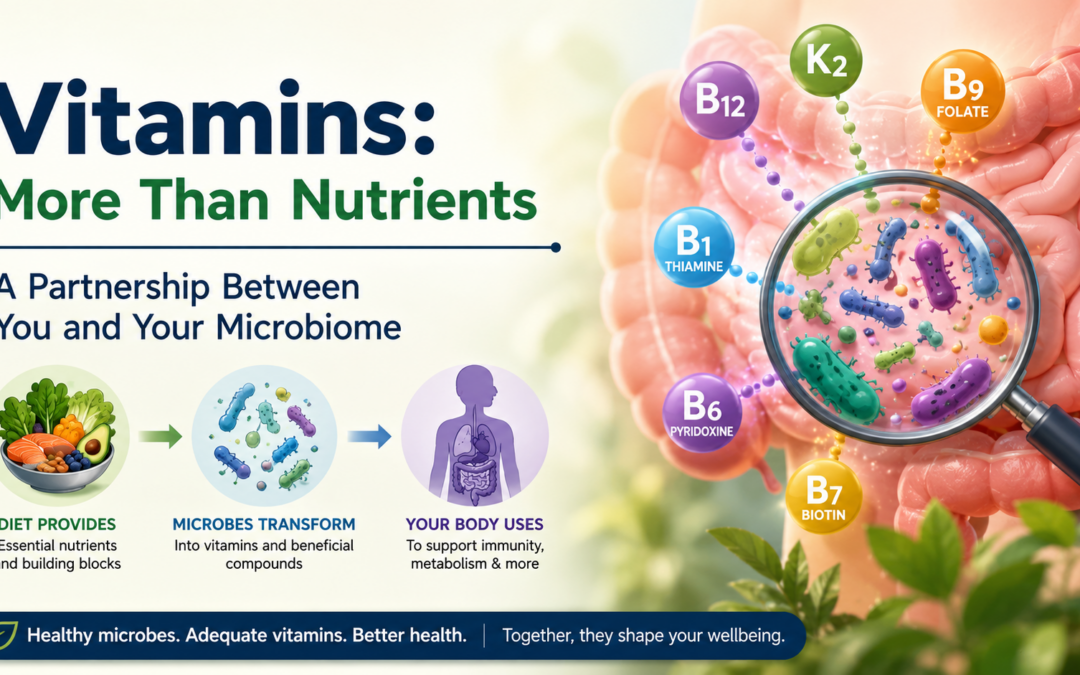
Inside every healthy person lives a vast microbial ecosystem that also participates in vitamin metabolism. Your microbiome helps produce certain vitamins, transforms nutrients into biologically active compounds, and influences how your body uses many of the vitamins you consume.
The relationship is not one-sided. Vitamins support microbial growth and function, while microbes help shape vitamin availability, metabolism, and even some of the molecular signals that regulate gene expression.
In many ways, health depends on a three-way partnership:
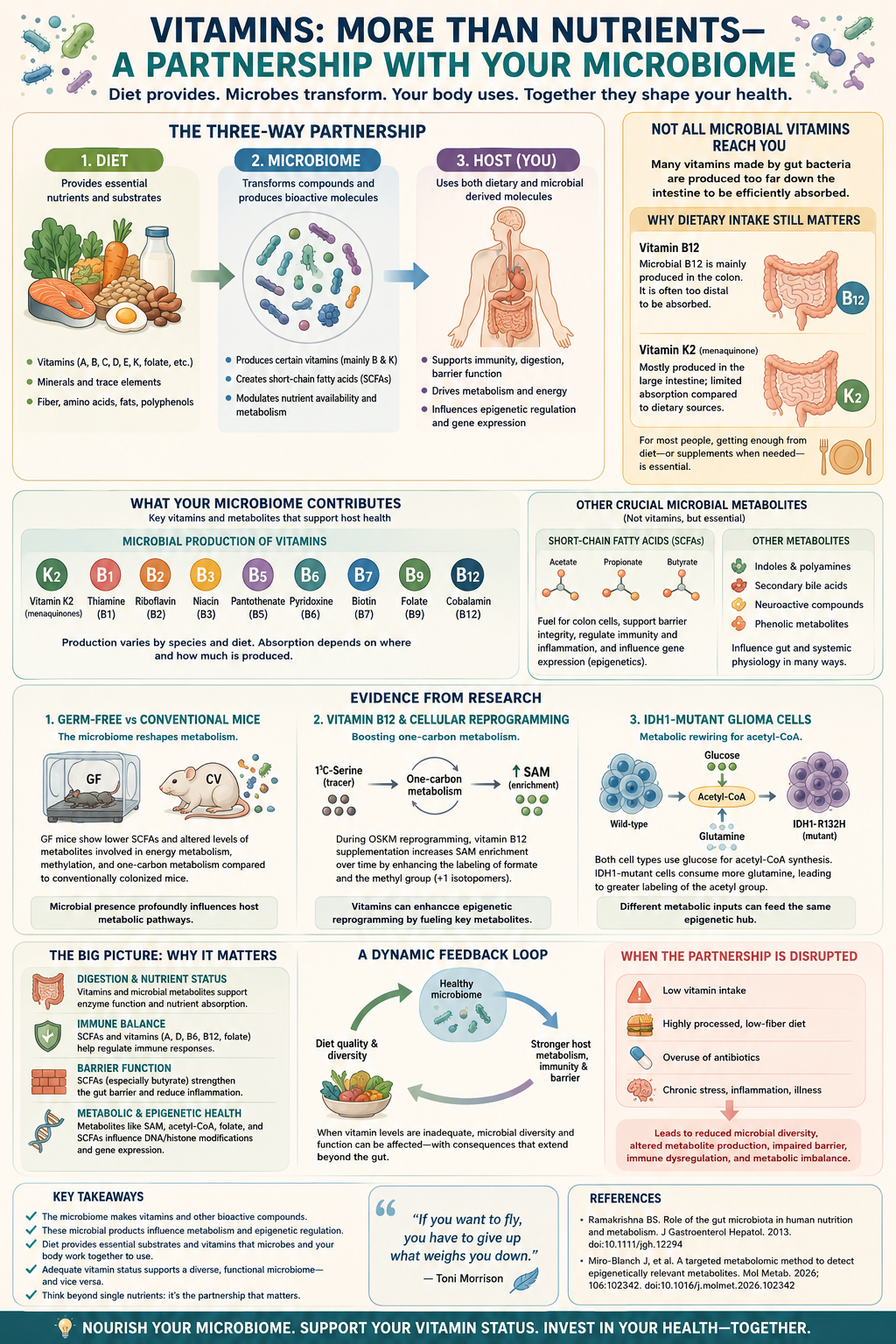
Diet provides. Microbes transform. The body uses.
The Body and the Microbiome Work Together
Humans can make only a limited number of vitamins on their own.
For example:
-
Vitamin D can be synthesized in the skin following sunlight exposure.
-
Small amounts of niacin (vitamin B3) can be produced from tryptophan.
-
Vitamin A can be generated from dietary carotenoids such as beta-carotene.
Many other vitamins must come from food.
At the same time, microbes living primarily in the large intestine can produce several vitamins, including:
-
Vitamin K2 (menaquinones)
-
Folate (vitamin B9)
-
Biotin (vitamin B7)
-
Thiamine (vitamin B1)
-
Riboflavin (vitamin B2)
-
Pantothenate (vitamin B5)
-
Pyridoxine (vitamin B6)
-
Certain forms of vitamin B12
This microbial contribution has long been recognized as one of the important nutritional functions of the gut microbiota.
However, an important nuance is often overlooked.
If Microbes Make Vitamins, Why Do We Still Need Them in Our Diet?
The answer lies in geography.
Many vitamins produced by gut bacteria are synthesized in the colon, whereas absorption of some vitamins occurs earlier in the digestive tract.
Vitamin B12 is the classic example.
Although certain gut microbes can produce B12, much of this production occurs too far downstream to be efficiently absorbed. As a result, dietary sources remain essential for most people.
A similar issue exists for vitamin K2. Microbial production may contribute to overall vitamin status, but dietary sources often remain important.
This is why the statement “gut bacteria make all the vitamins we need” is inaccurate.
A more accurate statement is:
Gut microbes contribute to vitamin metabolism, but they do not eliminate the need for a nutrient-dense diet.
The Story Goes Beyond Vitamins
One of the most interesting findings emerging from modern microbiome research is that vitamins are only part of the picture.
Microbes also produce a wide range of biologically active molecules that communicate with the host.
Among the most important are the short-chain fatty acids (SCFAs):
-
Acetate
-
Propionate
-
Butyrate
These compounds are generated when microbes ferment dietary fibers.
Butyrate is particularly important because it:
-
Serves as a major fuel source for colon cells
-
Supports gut barrier integrity
-
Helps regulate immune responses
-
Influences inflammation
-
Participates in regulation of gene expression
In many respects, SCFAs act as molecular messengers linking diet, microbiome activity, and host physiology.
What the New Research Adds
A fascinating paper published in Molecular Metabolism by Miro-Blanch and colleagues takes this concept even further. Rather than focusing on vitamins alone, the researchers examined a broader network of metabolites that connect microbiota, nutrition, metabolism, and epigenetics.
The authors developed a new analytical method capable of simultaneously measuring more than 30 metabolites involved in epigenetic regulation, including:
-
Short-chain fatty acids
-
Folate-related metabolites
-
S-adenosylmethionine (SAM)
-
Acetyl-CoA
-
Coenzyme A
-
Various amino acids and metabolic intermediates
These molecules are important because they help control chemical modifications on DNA and histone proteins that regulate gene activity.
In other words, metabolism can influence which genes are turned on or off.
What Happens Without a Microbiome?
One of the most interesting experiments in the study compared conventional mice with germ-free mice that were raised without microorganisms.
As expected, germ-free mice had dramatically lower levels of microbial short-chain fatty acids in the gut. However, the differences did not stop there. The researchers also found reductions in several metabolites involved in:
-
Energy production
-
One-carbon metabolism
-
Methylation pathways
-
Coenzyme A metabolism
These findings suggest that the microbiome influences much more than digestion. It helps shape the host metabolic environment in ways that may affect cellular function throughout the body.
Vitamin B12 and Epigenetic Programming
Another notable finding involved vitamin B12.
The investigators studied cellular reprogramming and showed that vitamin B12 supplementation increased labeling of S-adenosylmethionine (SAM), the body’s primary methyl donor. SAM is central to methylation reactions that influence gene regulation.
This does not mean that taking extra B12 automatically changes gene expression in healthy individuals.
However, it does demonstrate an important principle:
Vitamin availability can influence the metabolic pathways that supply the building blocks for epigenetic regulation.
This helps explain why nutrition can have effects that extend far beyond preventing classic deficiency diseases.
The Emerging View: A Metabolic-Epigenetic Network
The traditional view of vitamins focused mainly on deficiency syndromes:
-
Vitamin C prevents scurvy.
-
Vitamin D prevents rickets.
-
Folate prevents megaloblastic anemia.
Those functions remain critically important.
But modern research suggests vitamins and microbial metabolites also participate in a much larger network involving:
-
Energy metabolism
-
Immune regulation
-
Gut barrier function
-
Cell signaling
-
DNA methylation
-
Histone modification
-
Gene expression
The microbiome sits at the center of many of these interactions.
Practical Takeaways
What does all of this mean in everyday life?
First, diet still matters enormously. Microbes cannot compensate for chronically poor nutrition.
Second, microbial diversity matters because diverse microbial communities are more capable of producing beneficial metabolites.
Third, fiber-rich foods support microbial production of short-chain fatty acids, which may be among the most important microbiome-derived molecules for human health.
Finally, vitamins should not be viewed as isolated nutrients. They operate within a complex ecosystem involving food, microbes, metabolism, and the body’s own physiology.
The most accurate picture is not that vitamins come from food or from microbes.
It is that health emerges from the interaction of all three partners:
Your diet. Your microbiome. Your body.
When those systems work together, they create a metabolic environment that supports resilience, balance, and long-term health.
“The future of nutrition may not be about individual vitamins alone, but about understanding the ecosystem that connects nutrients, microbes, metabolism, and human health.”
References
- Ramakrishna BS. Role of the gut microbiota in human nutrition and metabolism. Journal of Gastroenterology and Hepatology. 2013;28 Suppl 4:9–17. doi:10.1111/jgh.12294
- Miro-Blanch J, Junza A, Capellades J, Balvay A, Maudet C, Kovatcheva M, et al. A targeted metabolomic method to detect epigenetically relevant metabolites. Molecular Metabolism. 2026;106:102342. doi:10.1016/j.molmet.2026.102342
- Kovatcheva M, Melendez E, Chondronasiou D, Pietrocola F, Bernad R, Caballe A, et al. Vitamin B12 is a limiting factor for induced cellular plasticity and tissue repair. Nature Metabolism. 2023.
- Krautkramer KA, Kreznar JH, Romano KA, Vivas EI, Barrett-Wilt GA, Rabaglia ME, et al. Diet-microbiota interactions mediate global epigenetic programming in multiple host tissues. Molecular Cell. 2016;64(5):982–992.
- Lund PJ, Gates LA, Leboeuf M, Smith SA, Chau L, Lopes M, et al. Stable isotope tracing in vivo reveals a metabolic bridge linking the microbiota to host histone acetylation. Cell Reports. 2022;41(11):111809.
- Chang PV, Hao L, Offermanns S, Medzhitov R. The microbial metabolite butyrate regulates intestinal macrophage function via histone deacetylase inhibition. Proceedings of the National Academy of Sciences USA. 2014;111(6):2247–2252.
- Crider KS, Yang TP, Berry RJ, Bailey LB. Folate and DNA methylation: A review of molecular mechanisms and the evidence for folate’s role. Advances in Nutrition. 2012;3(1):21–38.
- Ducker GS, Rabinowitz JD. One-carbon metabolism in health and disease. Cell Metabolism. 2017;25(1):27–42.
- Miro-Blanch J, Yanes O. Epigenetic regulation at the interplay between gut microbiota and host metabolism. Frontiers in Genetics. 2019;10:638.