Food Noise or Food Information? Reframing How We Think About Obesity
A recent opinion piece by Giuseppe Marzio in de Volkskrant argues that if we want to tackle obesity, we need to stop focusing exclusively on individuals and start addressing what the author calls “food pollution.”
The article makes a compelling case that the obesity epidemic is not simply a failure of willpower, but the predictable outcome of a food environment saturated with ultra-processed, highly engineered products.
Is it possible to take this argument one step further?
To understand obesity, metabolic disease, and many of the chronic health challenges facing modern societies, perhaps we need to recognize a simple but profound truth:
Food is information.
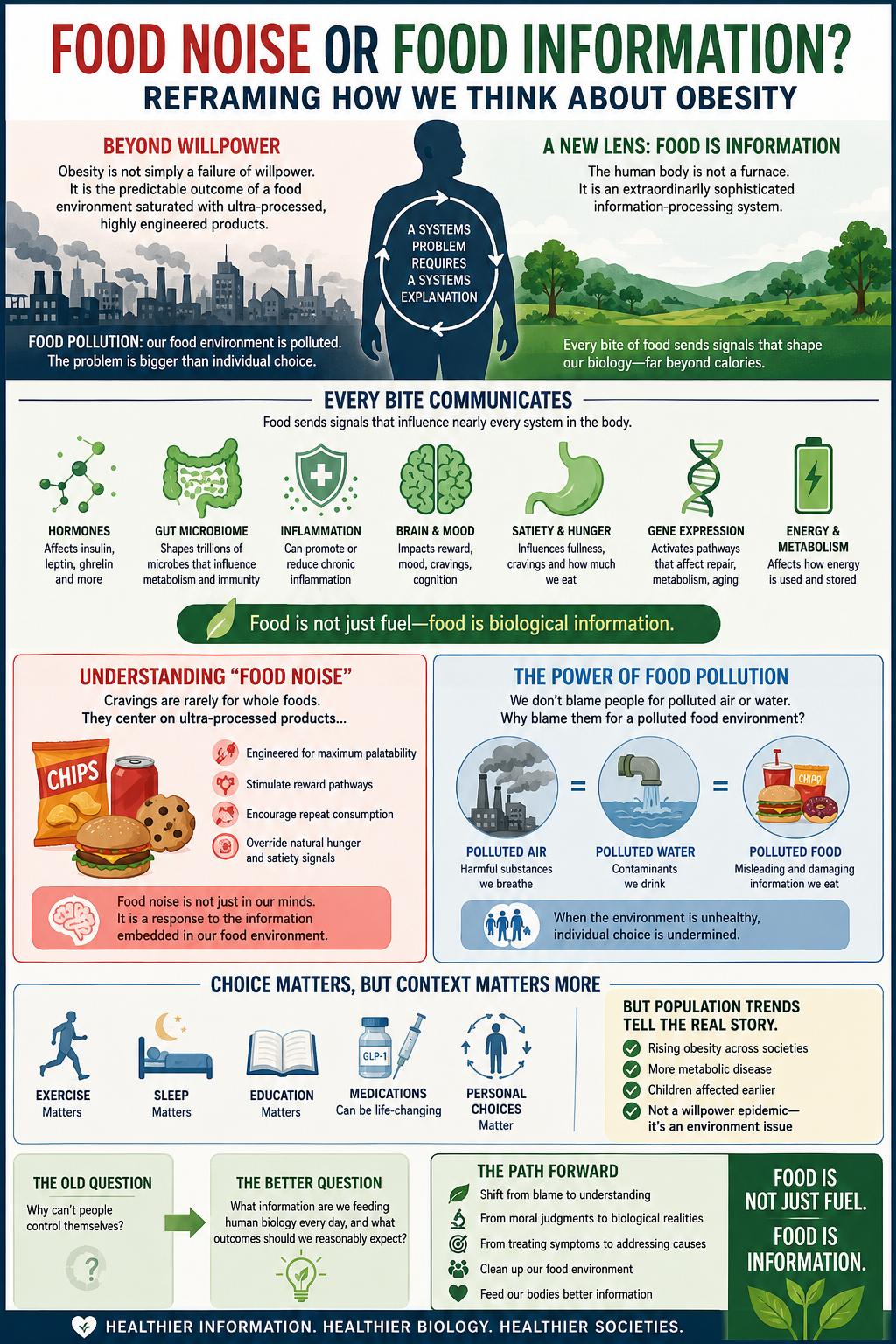
For decades, we have been taught to think about food primarily as fuel. Calories in, calories out. Energy consumed, energy expended. While calories matter, this framework is incomplete because the human body is not a furnace. It is an extraordinarily sophisticated information-processing system.
Every bite of food sends signals.
Food communicates with our hormones. It shapes our gut microbiome. It influences inflammation, satiety, mood, cognition, and metabolism. Nutrients activate genetic pathways, regulate cellular repair mechanisms, and affect how our bodies allocate and use energy. In this sense, food is not merely fuel—it is biological information.
Seen through this lens, the concept of “food noise” becomes easier to understand.
When we talk about persistent cravings for chips, soda, cookies, fast food, or other ultra-processed products, we are rarely talking about an overwhelming desire for broccoli, lentils, or whole grains. The cravings tend to center around foods specifically designed to maximize palatability and consumption.
These products are not accidental creations. They are engineered to capture our attention, stimulate reward pathways, and encourage repeat consumption. They deliver powerful signals to the brain and body—signals that often override the natural mechanisms that regulate hunger and satiety.
The term food noise suggests that the problem resides primarily in our minds. But what if much of that noise is actually a response to the information embedded within our food environment?
This is where the article’s concept of food pollution becomes particularly powerful.
We readily understand that polluted air contains harmful substances that affect human health. Polluted water carries contaminants that disrupt biological systems. We do not blame individuals for breathing polluted air or drinking contaminated water. We recognize that the environment itself has become unhealthy.
Why should food be any different?
When our food environment is dominated by products engineered to exploit (intentionally or unintentionally) biological vulnerabilities, we are no longer dealing solely with individual choice. We are dealing with an environment that continuously feeds misleading and often damaging information into human biology.
This does not remove personal responsibility. Our choices matter. Exercise matters. Sleep matters. Education matters. For many people, medications such as GLP-1 agonists are proving transformative and life-changing.
But personal responsibility alone cannot explain population-wide trends.
When obesity rates rise across entire societies, when metabolic disease becomes increasingly common, and when children develop conditions once associated primarily with adulthood, it becomes difficult to argue that millions of people simultaneously lost their willpower.
A systems problem requires a systems explanation.
If food is information, then the quality of that information matters. Whole foods tend to provide complex, coherent signals that align with human physiology. Many ultra-processed foods provide simplified, amplified, and often distorted signals designed primarily to maximize consumption.
The question is no longer simply, Why can’t people control themselves?
The more important question becomes:
What information are we feeding human biology every day, and what outcomes should we reasonably expect?
That shift in perspective changes the conversation.
It moves us away from blame and toward understanding. Away from moral judgments and toward biological realities. Away from treating symptoms alone and toward addressing causes.
Perhaps food noise is not the root problem after all.
Perhaps it is what happens when human biology is immersed in a sea of conflicting and corrupted information.
If we want healthier societies, we need more than better medications and stronger willpower. We need healthier information entering our bodies in the first place.
Because food is not just fuel.
Food is information.