
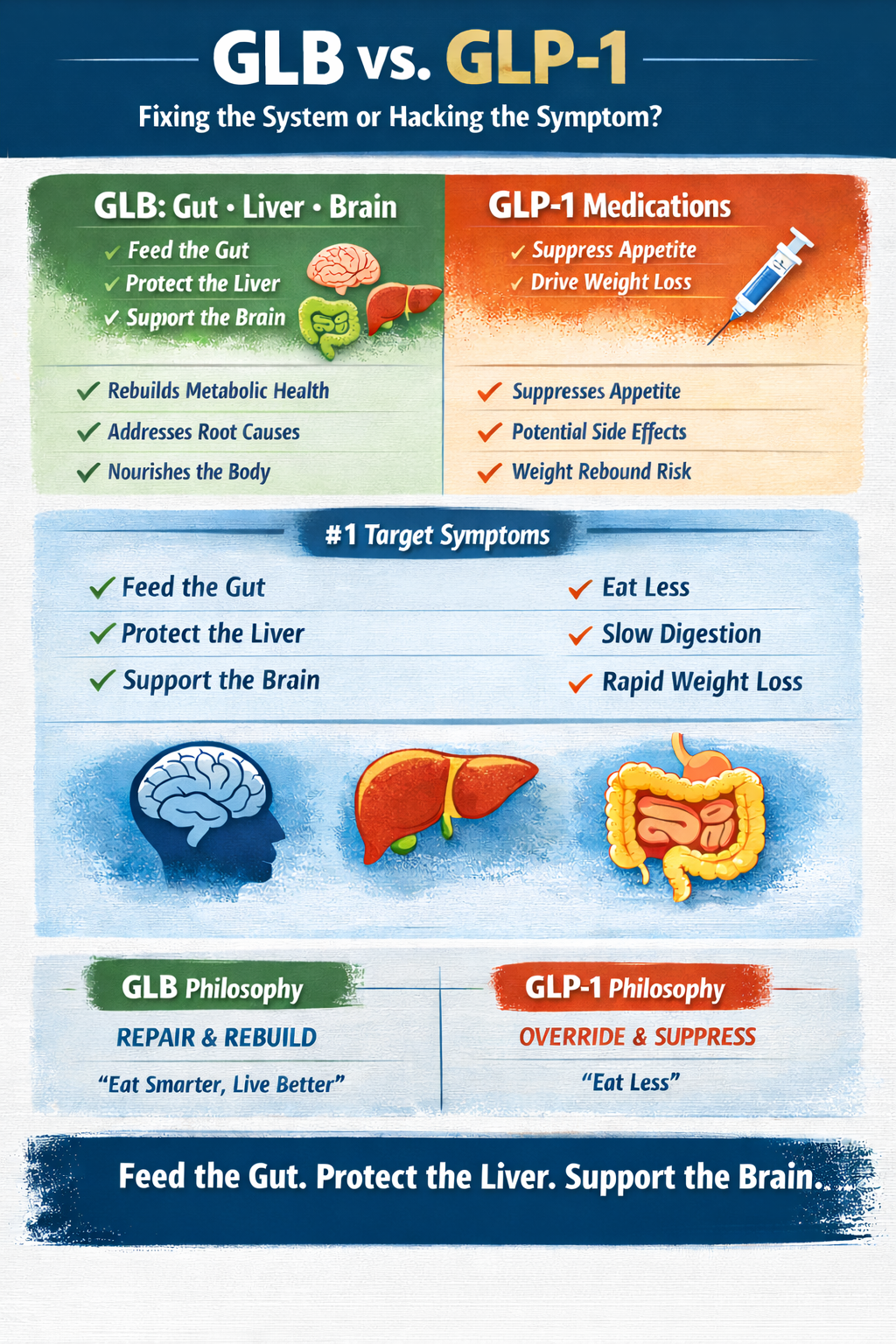
GLB vs. GLP-1: Fixing the System or Hacking the Symptom?
We are living in an age of metabolic confusion. Rates of obesity, diabetes, fatty liver disease, depression, and inflammatory illness are climbing together, like a badly synchronized choir. In response, science has produced a powerful new soloist: GLP-1 drugs. They suppress appetite, slow digestion, and often produce dramatic weight loss.
They work. That matters.
But working is not the same as healing.
Alongside this pharmaceutical solution is a quieter, deeper framework: GLB — Gut, Liver, Brain. It is not a product. It is not a pill. It is a way of designing health by supporting the three systems that actually run human metabolism:
Support the brain.
Protect the liver.
Feed the gut.
These two approaches—GLP-1 and GLB—represent two philosophies of health: override the system, or rebuild it.
What GLP-1 Really Does
GLP-1 drugs mimic a natural hormone that regulates appetite and blood sugar. In pharmaceutical doses, they:
-
Reduce hunger and cravings
-
Slow stomach emptying
-
Improve blood sugar control
-
Often lead to rapid weight loss
For people with severe obesity or advanced metabolic disease, this can be life-saving. That is not trivial.
But GLP-1 is essentially a volume knob on appetite. It turns hunger down. It does not ask why hunger was screaming in the first place.
The Cost of a Shortcut
Like all powerful tools, GLP-1 has trade-offs:
-
Muscle loss is common without careful protein intake and resistance training
-
Nausea, food aversion, and digestive distress are frequent
-
Many regain weight after stopping
-
It does little to repair insulin resistance, fatty liver, or gut dysfunction
-
Long-term effects of lifelong use are still being discovered
Most importantly, GLP-1 does not teach the body how to be healthy. It simply tells it to eat less—whether the food is nourishing or not.
That is symptom control, not system repair.
GLB: Gut, Liver, Brain
GLB starts from a different premise: metabolism is not a calorie counter. It is an ecosystem.
Three organs run that ecosystem:
-
The gut decides what gets absorbed and how inflammation is shaped
-
The liver decides what gets stored, burned, or detoxified
-
The brain decides behavior, hunger, stress, sleep, and impulse
If those three are sick, no amount of willpower or appetite suppression will create lasting health.
GLB asks three daily questions:
Does this support my brain?
Does this protect my liver?
Does this feed my gut?
If the answer is yes to all three, you are not dieting. You are rebuilding biology.
Support the Brain
The brain is not about willpower. It is about chemistry.
A supported brain has:
-
Stable blood sugar
-
Adequate protein and amino acids
-
Healthy fats for neural membranes
-
Micronutrients for neurotransmitters
-
Low inflammation
When the brain is nourished, cravings fall naturally—not because appetite is suppressed, but because the brain is finally getting what it needs.
Protect the Liver
The liver is metabolic central command. It manages blood sugar, fat storage, detoxification, and hormone processing.
A protected liver means:
-
Less sugar and refined starch
-
Fewer industrial seed oils
-
More whole foods
-
Adequate protein
-
Polyphenols and antioxidants
When the liver heals, insulin sensitivity improves. Fat loss becomes easier without force.
Feed the Gut
The gut is not a tube. It is a rainforest.
A healthy gut regulates inflammation, communicates with the brain, shapes immunity, and influences insulin sensitivity.
Feeding the gut means:
-
Fiber from real plants
-
Fermented foods or probiotics
-
Polyphenol-rich foods
-
Minimal ultra-processed ingredients
A fed gut trains your metabolism to work with you instead of against you.
GLP-1 vs. GLB
GLP-1 says: “Eat less.”
GLB says: “Eat smarter, live better, rebuild systems.”
GLP-1 overrides appetite.
GLB retrains appetite.
GLP-1 manages symptoms.
GLB repairs causes.
GLP-1 can be useful—especially in crisis.
GLB is what you build your life on.
The Real Future: Integration, Not War
This is not about rejecting medicine. It is about context.
GLP-1 can be:
-
A bridge
-
A stabilizer
-
A temporary support
But GLB must be:
-
The foundation
-
The education
-
The long-term strategy
Without GLB, GLP-1 becomes a dependency.
With GLB, GLP-1—if needed—becomes a tool, not a crutch.
The Root Problem Isn’t Weight
Weight is not the disease. It is a signal.
The real problem is metabolic dysfunction—broken communication between gut, liver, and brain.
Fix the gut.
Heal the liver.
Support the brain.
Do that, and weight becomes a side effect of health, not a battlefield.
That is GLB.
Not a drug.
Not a hack.
A return to biological sanity.