
Activating the WHA Resolution on Liver Disease: From Recognition to Transformation
The World Health Assembly’s adoption of the resolution “Steatotic liver disease: a missing piece in the global noncommunicable disease response” marks a watershed moment in global health. For the first time, liver disease has been formally recognized as an integral component of the noncommunicable disease (NCD) agenda, creating a powerful mandate for countries to integrate liver health into prevention, primary care, universal health coverage, surveillance, and health system planning.
This recognition is long overdue.
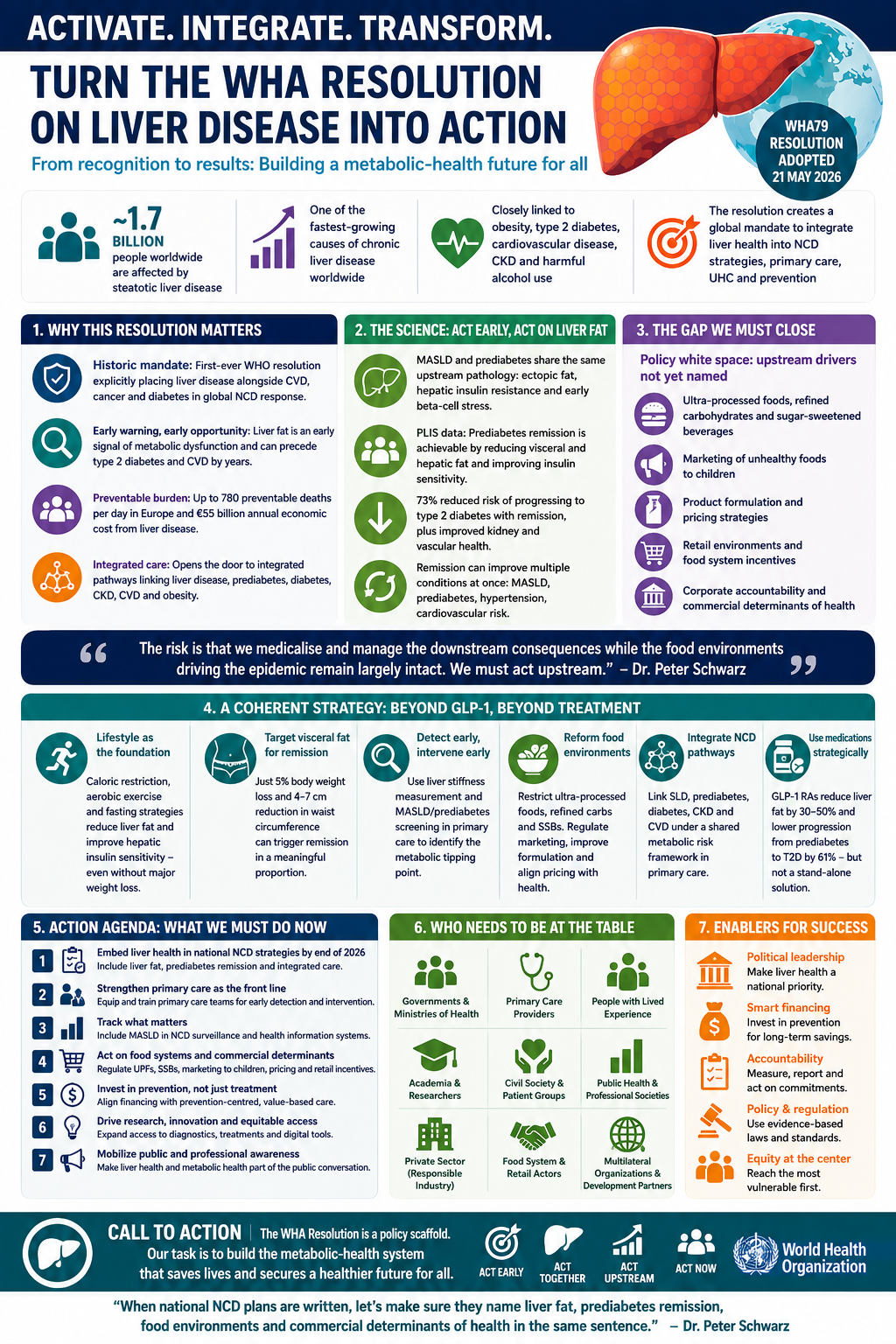
Steatotic liver disease affects an estimated 1.7 billion people worldwide and is among the fastest-growing causes of chronic liver disease. Yet its significance extends far beyond hepatology. Liver disease sits at the centre of a broader metabolic health crisis, closely linked to obesity, prediabetes, type 2 diabetes, cardiovascular disease, chronic kidney disease, and unhealthy food environments. The liver is often one of the earliest organs to signal metabolic dysfunction, providing a critical opportunity for prevention long before irreversible disease develops.
The resolution acknowledges many of these connections. It calls for integrated action, stronger primary care, improved surveillance, earlier detection, increased awareness, and greater investment in prevention. These are essential foundations for progress.
But the resolution also highlights an important challenge.
While it recognizes unhealthy diets, harmful alcohol use, and the influence of economic and commercial factors on health, it stops short of explicitly addressing some of the most powerful drivers of metabolic disease: ultra-processed foods, sugar-sweetened beverages, unhealthy food marketing, product formulation, and the broader commercial determinants of health. Without addressing these upstream influences, there is a risk that health systems will continue managing the consequences of metabolic dysfunction while the environments driving the epidemic remain largely unchanged.
The opportunity created by this resolution is therefore much larger than liver disease alone.
Emerging evidence increasingly demonstrates that reducing liver fat can improve insulin sensitivity, support remission of prediabetes, reduce progression to type 2 diabetes, and improve cardiovascular and kidney health. This creates the possibility of moving beyond fragmented disease management towards a more integrated model of metabolic health—one that recognizes the shared biological pathways linking liver disease, diabetes, obesity, cardiovascular disease, and chronic kidney disease.
Achieving that vision will require action across multiple fronts. Earlier detection of liver fat and fibrosis must become part of routine primary care. Prevention strategies must focus not only on individual behaviour change but also on healthier food environments. Health systems must align liver health with broader cardiometabolic care pathways. Researchers, clinicians, policymakers, patient advocates, and civil society must work together to ensure that liver health becomes a visible and measurable component of national NCD strategies.
The WHA resolution provides the policy framework. The next step is implementation.
Its success will not be measured by the number of resolutions adopted, but by the number of lives improved, diseases prevented, and health systems transformed. If countries use this moment to build integrated, prevention-centred metabolic health strategies, the resolution could become a turning point in the global response to chronic disease.
The liver has long been a missing piece in the NCD response.
Now it has a seat at the table.
The challenge—and the opportunity—is to ensure that this recognition becomes meaningful action.