
Food systems were not designed to produce metabolic disease, but that has become their dominant outcome. Across countries and income levels, noncommunicable diseases now account for the majority of healthcare costs, lost productivity, and premature mortality. Obesity, type 2 diabetes, fatty liver disease, and cardiovascular disease are often framed as problems of personal choice, yet the scale and consistency of the pattern tell a different story.
These are system failures, not individual ones.
One of the core challenges has been visibility. Governments struggle to see what is actually in their national food supply. Health systems track outcomes but not upstream drivers. Policymakers set targets without a clear picture of where metabolic risk is concentrated or how it enters daily diets. At the same time, food and beverage companies are asked to reformulate and improve products without a shared definition of what “better” looks like in metabolic terms.
The result is fragmentation: good intentions, partial data, and slow impact.
The Metabolic Matrix was developed to address this structural gap. It is not a nutrition label or a single-score rating system. At its core, it is a food data science engine designed to translate composition, processing, and ingredient choices into measurable metabolic-health signals. What makes it powerful is not only its scientific foundation, but its scalability.
The same logic that can assess a single product can be applied to an entire portfolio, and the same logic that can map a portfolio can be extended to a national food system.
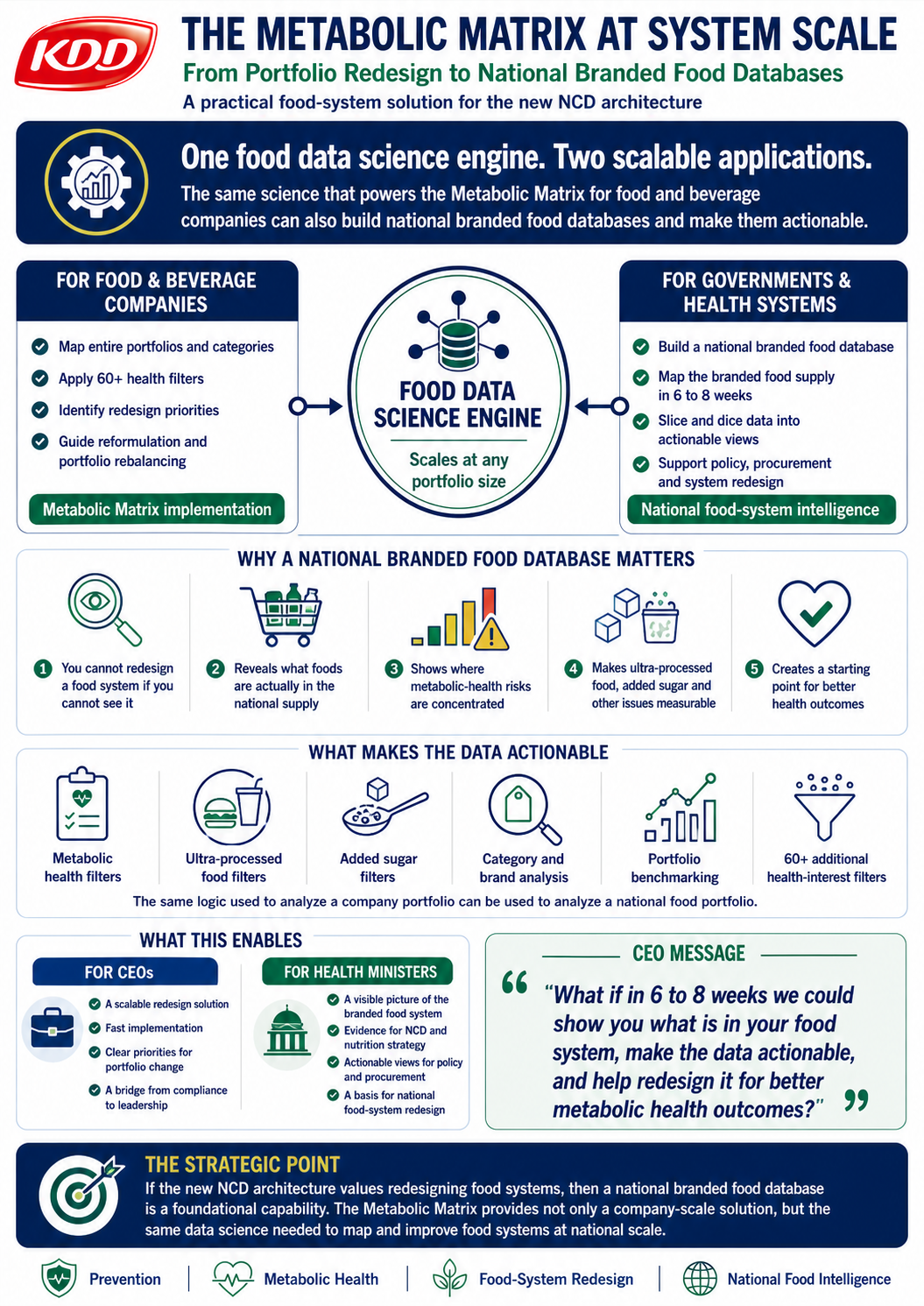
For food and beverage companies, this shift is transformative. Instead of approaching reformulation product by product, the Metabolic Matrix allows teams to see their portfolios as systems. Categories can be mapped in their entirety. Products can be filtered through more than sixty metabolic and health-interest lenses. Redesign priorities become visible rather than debated. Leaders can identify which products are already best-in-class, which ones carry the greatest metabolic risk, and where reformulation delivers the greatest return for both health and business performance.
Reformulation stops being reactive and becomes strategic.
What is less widely appreciated is that the same data engine can be used beyond company walls. When applied at national scale, the Metabolic Matrix becomes the backbone of a branded food database that governments and health systems have long lacked. In as little as six to eight weeks, it can be used to map the branded food supply across categories, identify where metabolic-health risks are concentrated, and turn issues like ultra-processing and added sugar into measurable, explorable variables.
Instead of static reports, policymakers gain dynamic views that can be sliced by category, brand, processing intensity, or health concern.
This matters because food policy cannot succeed in the dark. Without a clear picture of what foods people are actually exposed to, strategies for noncommunicable disease prevention remain abstract. A national branded food database built on metabolic-health logic reveals what is truly in the system, not just what guidelines assume is there. It shows where risk accumulates, where reformulation could have outsized impact, and where procurement and policy levers can be applied with confidence.
Perhaps most importantly, it provides a real starting point for redesigning food systems rather than managing their downstream consequences.
Data alone, however, does not change outcomes. What turns information into action is structure. The Metabolic Matrix makes data actionable because it applies consistent logic across scales. Metabolic health filters, ultra-processed food classifications, added sugar thresholds, category and brand analysis, and portfolio benchmarking all operate within the same framework. The exact same analytical rules that guide a company’s internal decisions can guide national strategy.
This alignment between private-sector capability and public-health need is rare, and it is precisely what the current NCD challenge demands.
The implications are practical. For CEOs, the Metabolic Matrix offers a scalable redesign solution that can be implemented quickly, clarifies portfolio priorities, and creates a bridge between compliance and leadership. It allows companies to move ahead of regulation rather than react to it, grounding decisions in metabolic health rather than marketing narratives. For health ministers and system leaders, it delivers something equally valuable: visibility. A clear picture of the branded food system. Evidence to support nutrition and NCD strategies. Actionable intelligence for procurement, policy, and system redesign.
A foundation upon which long-term prevention efforts can finally be built.
If the global conversation around noncommunicable diseases is serious about prevention, then food systems themselves must change.
That requires more than guidelines or consumer education. It requires infrastructure. A national branded food database is not a nice-to-have in this context; it is a foundational capability. The Metabolic Matrix demonstrates that this capability does not need to be built from scratch. The science already exists. The data logic already works at company scale.
What is required now is the decision to apply it at system scale.
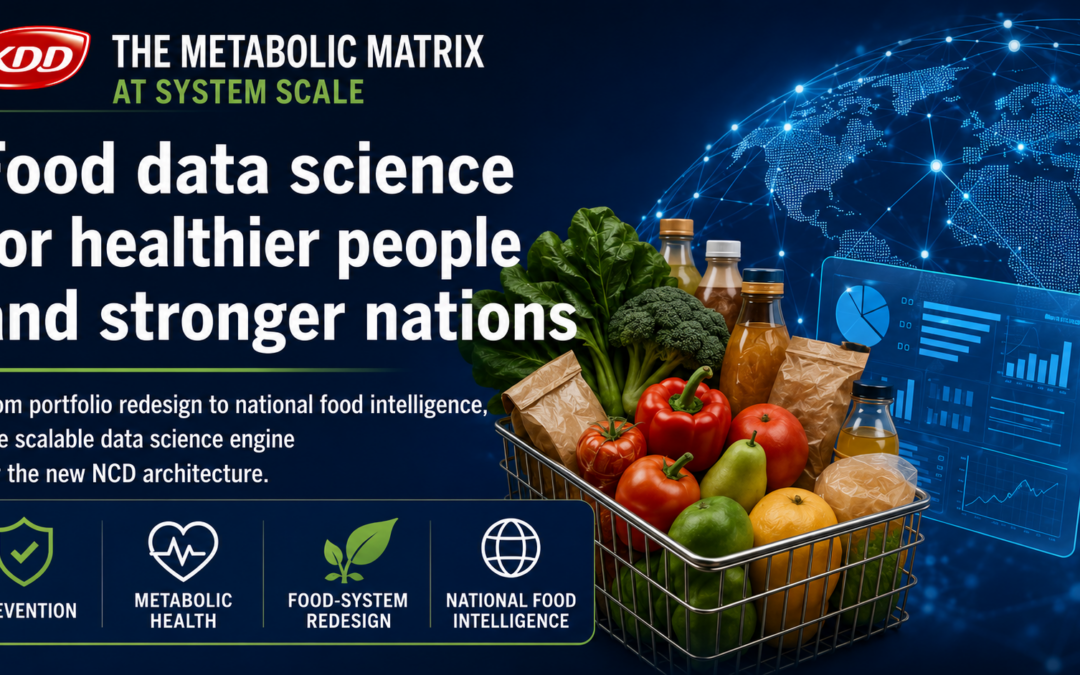
Prevention, metabolic health, food-system redesign, and national food intelligence are no longer separate agendas – they never were. They are part of the same problem, and increasingly, part of the same solution.