
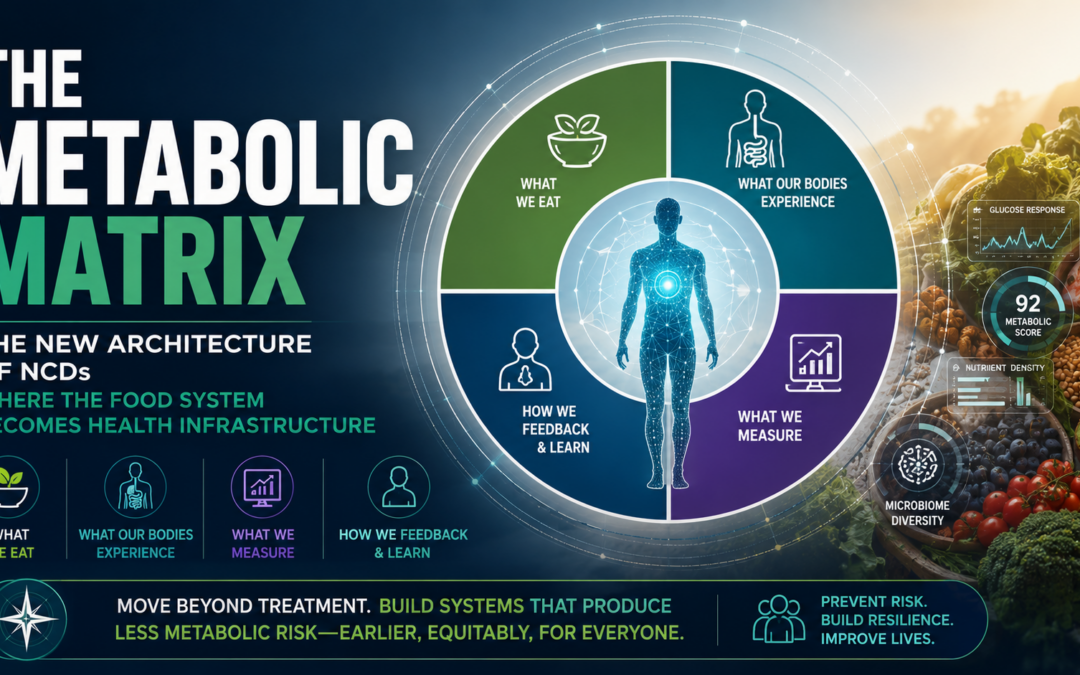
The Metabolic Matrix: The New Architecture of NCDs
Where the food system becomes health infrastructure
As the World Health Assembly convenes, the global conversation on noncommunicable diseases needs a new frame.
For decades, NCDs have been treated primarily as a clinical and behavioral challenge: people develop obesity, diabetes, cardiovascular disease, fatty liver disease, or other chronic conditions; health systems diagnose and treat them; public health campaigns urge individuals to make better choices.
But this framing is no longer sufficient.
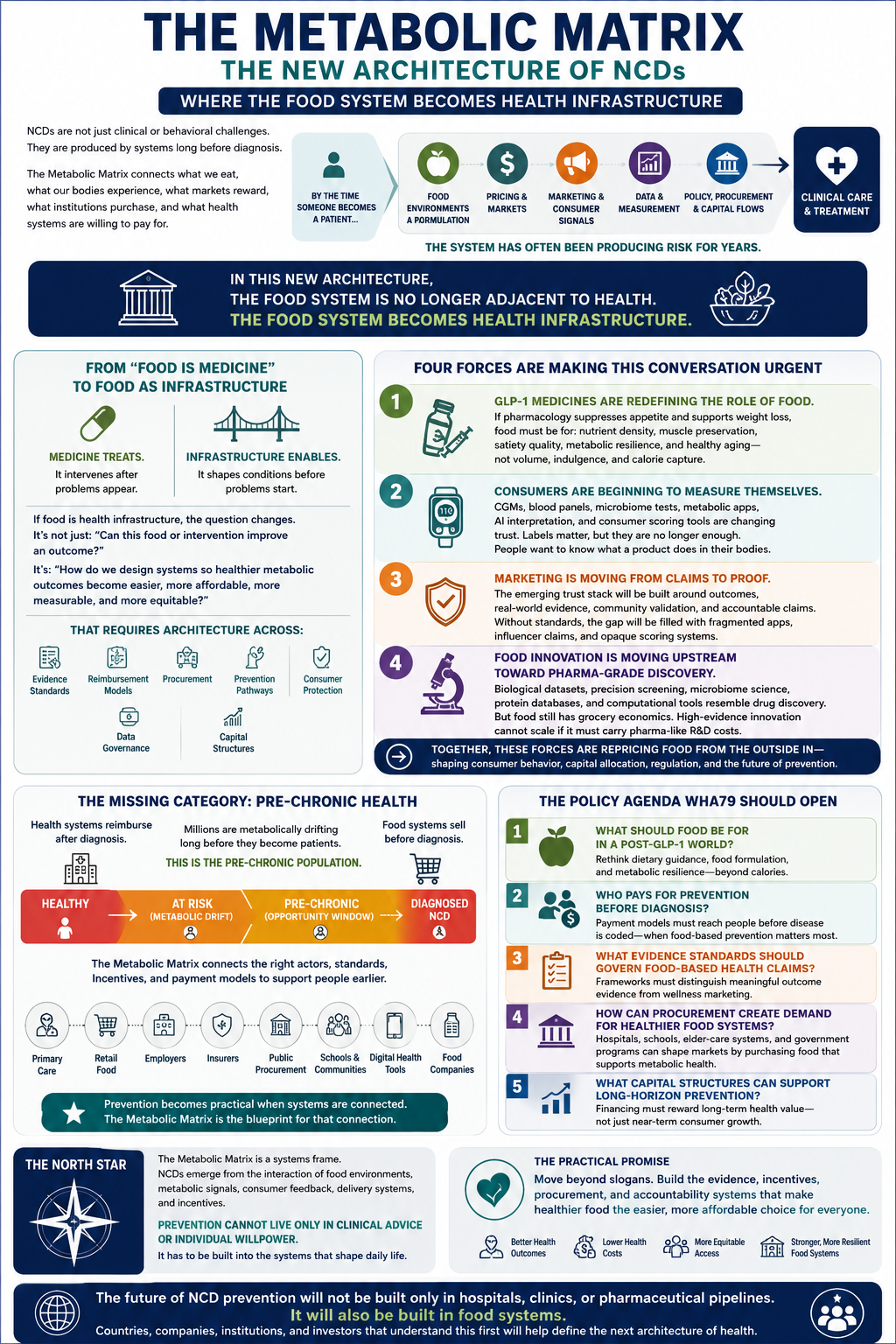
The real architecture of NCDs is built much earlier, upstream of diagnosis. It is shaped by food environments, pricing, formulation, procurement, marketing, metabolic signals, data systems, care pathways, capital flows, and policy incentives. By the time someone becomes a patient, the system has often been producing risk for years.
That is why we need the Metabolic Matrix.
The Metabolic Matrix reframes NCDs not as isolated disease categories, but as the result of interacting systems. It connects what people eat, what their bodies experience, what markets reward, what institutions purchase, and what health systems are willing to pay for.
In this new architecture, the food system is no longer adjacent to health.
The food system becomes health infrastructure.
From “food is medicine” to food as infrastructure
“Food is medicine” has helped open an important door. It reminds policymakers, clinicians, and the public that diet is not peripheral to health. But as a policy frame, it can become too narrow.
Medicine treats. Infrastructure enables.
If food is health infrastructure, then the question changes. We are no longer asking only whether a particular product, prescription meal, or intervention can improve a health outcome. We are asking how entire systems should be designed so that healthier metabolic outcomes become easier, more affordable, more measurable, and more equitable.
That means moving beyond slogans and into architecture: evidence standards, reimbursement models, public procurement, prevention pathways, consumer protection, data governance, and capital structures.
The question for WHA79 should not simply be, “How do we treat more NCDs?”
It should be:
How do we build systems that produce less metabolic risk in the first place?
Four forces are making this conversation urgent
Several forces are converging at once.
First, GLP-1 medicines are redefining the role of food. If pharmacology increasingly suppresses appetite and supports weight loss, the food sector has to answer a deeper question: what is food for? The answer cannot be volume, indulgence, and calorie capture. It must be nutrient density, muscle preservation, satiety quality, metabolic resilience, and healthy aging.
Second, consumers are beginning to measure themselves. Continuous glucose monitors, blood panels, microbiome tests, metabolic apps, AI interpretation, and consumer scoring tools are changing the trust relationship between people and food. Labels still matter, but they are no longer enough. People increasingly want to know what a product does in their own bodies.
Third, marketing is moving from claims to proof. “High protein,” “low sugar,” “natural,” and “functional” were built for an era of front-of-pack persuasion. The emerging trust stack will be built around outcomes, real-world evidence, community validation, and accountable claims. This creates both opportunity and risk. Without standards, the market will fill the gap with fragmented apps, influencer claims, and opaque scoring systems.
Fourth, food innovation is moving upstream toward pharma-grade discovery. Ingredient discovery is increasingly using biological datasets, precision screening, microbiome science, protein databases, and computational tools that resemble drug discovery infrastructure. But food still has grocery economics. High-evidence innovation cannot scale if it is expected to carry pharma-like R&D costs while selling at commodity prices.
Together, these forces are repricing food from the outside in. They are changing how consumers behave, how capital assesses value, how regulators will need to think about claims, and how health systems should define prevention.
The missing category: pre-chronic health
The largest opportunity may sit between two systems that do not currently meet.
Health systems tend to reimburse disease after diagnosis. Food systems tend to sell products before diagnosis.
But millions of people are metabolically drifting long before they become formal patients. They may have rising glucose, increasing waist circumference, early fatty liver risk, hypertension, inflammation, declining muscle mass, or other warning signs. They are not yet coded as sick, but they are not well served by the current consumer food environment either.
This is the pre-chronic population.
The pre-chronic population is where prevention becomes practical. It is also where the Metabolic Matrix becomes useful. It asks: what would need to be connected so that people at metabolic risk are supported earlier?
That connection could include primary care, retail food, employers, insurers, public procurement, schools, community organizations, digital health tools, and food companies. But those actors will not align on their own. They need shared standards, incentives, and payment models.
The policy agenda WHA79 should open
If WHA79 is serious about NCDs, food, and prevention, the conversation should include five topics.
1. What should food be for in a post-GLP-1 world?
GLP-1s should not become a pharmaceutical patch on top of an unchanged food system. They should force a broader rethink of dietary guidance, food formulation, and metabolic resilience.
2. Who pays for prevention before diagnosis?
If health systems only reimburse once disease is coded, they will continue to miss the window where food-based prevention can matter most.
3. What evidence standards should govern food-based health claims?
As consumers generate more personal health data, regulators need frameworks that distinguish meaningful outcome evidence from wellness marketing.
4. How can procurement create demand for healthier food systems?
Hospitals, schools, elder-care systems, public institutions, and government programs can shape markets by purchasing food that supports metabolic health.
5. What capital structures can support long-horizon prevention?
Quarterly pressure and short-duration venture models are often poorly matched to prevention. We need financing models that reward long-term health value, not only near-term consumer growth.
The North Star
The Metabolic Matrix is not a metaphor for personalized nutrition alone. It is a systems frame.
It says that NCDs emerge from the interaction of food environments, metabolic signals, consumer feedback, delivery systems, and incentives. It says that prevention cannot live only in clinical advice or individual willpower. It has to be built into the systems that shape daily life.
The practical promise is this:
Move beyond slogans. Build the evidence, incentives, procurement, and accountability systems that make healthier food the easier, more affordable choice for everyone.
That is the conversation WHA79 should be having.
Because the future of NCD prevention will not be built only in hospitals, clinics, or pharmaceutical pipelines.
It will also be built in food systems.
And the countries, companies, institutions, and investors that understand this first will help define the next architecture of health.