
From Reformulation to Re‑Engineering: Why Incremental Change Is No Longer Enough
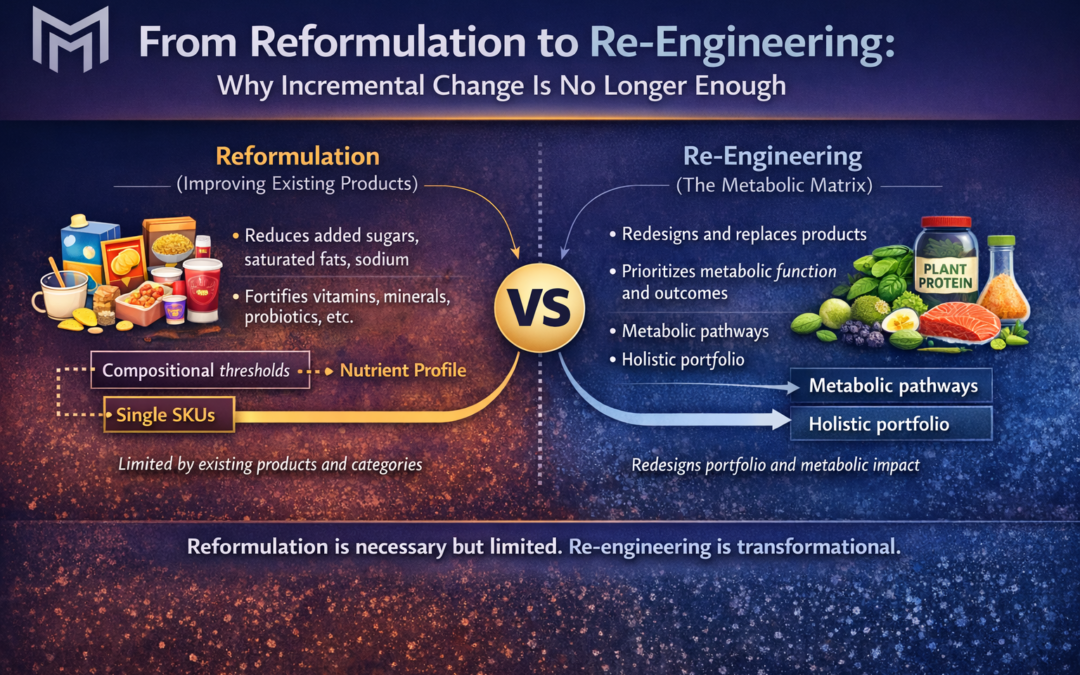
Product reformulation has become one of the most widely used levers to improve the nutritional quality of the global food supply. At its core, reformulation refers to altering the processing or composition of existing food and beverage products to improve their nutrient profile per portion. This typically involves reducing nutrients of concern such as added sugars, saturated fats, or sodium, and, in some cases, fortifying products with vitamins, minerals, probiotics, or fiber.
The World Health Organization and many national regulatory bodies have explicitly encouraged this approach, recognizing that reformulation can improve population health without requiring individuals to radically change their eating habits. By changing what people already consume, reformulation offers a pragmatic path to better diets at scale. [who.int]
In response to this regulatory guidance and to growing consumer awareness, major food and beverage companies have set global nutrition targets and now regularly report on the evolution of their product portfolios. Sugar, salt, and calorie reduction programs have become embedded in corporate strategies, supported by nutrient profiling systems, front‑of‑pack labeling, and voluntary or mandatory reformulation benchmarks. Reformulation has delivered measurable public‑health gains, particularly for sodium and trans‑fat reduction, and remains an important and necessary tool. [epha.org]
Yet reformulation has inherent limits.
Altering the recipe of an ultra‑processed product does not fundamentally change the role that product plays in metabolism, dietary patterns, or chronic disease risk. A cereal with slightly less sugar is still a refined carbohydrate base. A beverage with non‑nutritive sweeteners may meet reformulation targets while continuing to reinforce sweet preference and high glycemic exposure. In other words, reformulation typically operates within the boundaries of existing products, categories, and consumption occasions.
This is where re‑engineering food and beverage portfolios represents a fundamentally different ambition.
Re‑engineering, as embodied by the Metabolic Matrix, does not start with nutrients in isolation. It starts with metabolic function. Instead of asking, “How can we reduce sugar by 10% in this product?”, the question becomes, “What is this product doing to the liver, the brain, the gut, muscle metabolism, and long‑term metabolic resilience?” The unit of change is no longer a single SKU, but the entire portfolio and the metabolic signals it sends to consumers day after day.
Under a re‑engineering approach, some products are reformulated, some are redesigned entirely, and others may be strategically deprioritized or replaced. Formulation decisions are guided by metabolic pathways rather than solely by compositional thresholds. Glycemic load, fructose burden, protein quality, micronutrient density, hydration, and food matrix effects become primary design criteria, rather than secondary adjustments after the fact.
This shift mirrors what we are already seeing at the business‑model level across the food system. Many traditional meat producers, for example, are no longer just reformulating processed meats; they are investing in plant‑based proteins, precision fermentation, and cultivated protein platforms that fundamentally change both inputs and outputs [3](https://www.mckinsey.com/industries/agriculture/our-insights/ingredients-for-the-future-bringing-the-biotech-revolution-to-food). Ingredient companies are moving downstream into farm‑to‑fork solutions, investing in traceability technologies, and rethinking how value is created and captured across the supply chain.
In this sense, portfolio re‑engineering is not only a nutrition strategy, but a strategic transformation. It aligns product design with emerging science on metabolic health, with long‑term regulatory trajectories, and with evolving consumer expectations around transparency, functionality, and trust. It also acknowledges that incremental nutrient reduction alone will not reverse the rising burden of metabolic disease.
Reformulation remains necessary. Re‑engineering is what makes it sufficient.
The Metabolic Matrix offers a structured way to operationalize this transition. By mapping products and categories against metabolic outcomes rather than single nutrients, it allows companies to move beyond one‑off improvements toward coherent, health‑oriented portfolios. It reframes “healthier options” not as a subset of products, but as a design principle applied across the business.
As regulatory pressure intensifies, health systems strain under the cost of non‑communicable disease, and consumers increasingly connect food choices to long‑term well‑being, the distinction between reformulation and re‑engineering becomes critical. The future of food will not be defined by how much sugar is removed from yesterday’s products, but by how deliberately today’s portfolios are designed for human metabolism.
The Metabolic Matrix offers a detailed and evidence-based methodology to transform food and beverage portfolios to optimize positive metabolic health outcomes. Learn more by reading the peer reviewed method’s paper in Frontiers inNutrition: The Metabolic Matrix: Re-engineering ultraprocessed foods to feed the gut, protect the liver, and support the brain