
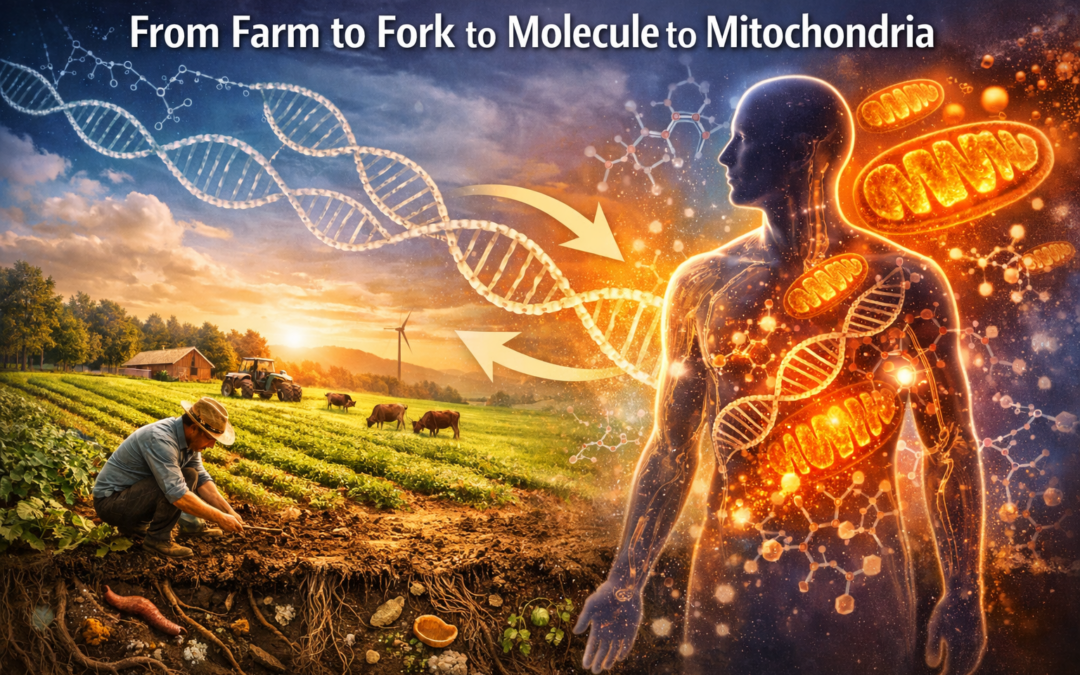
From Farm to Fork to Molecule to Mitochondria
Why the future of food and health begins in the soil—and ends in the cell
For years, “farm to fork” has been the rallying cry of a more conscious food movement. It promised transparency. Traceability. A reconnection between the person growing the food and the person eating it. Farmers’ markets flourished. Menus named their suppliers. Consumers leaned closer to the origin story of what was on their plates.
It was an important correction.
But a quiet realization is now reshaping the conversation among soil scientists, metabolic researchers, regenerative farmers, and forward-thinking clinicians: knowing where food comes from is not enough. The deeper question is what that food does—not just to taste buds or even to waistlines, but to the mitochondria inside our cells.
The emerging paradigm moves beyond “farm to fork” to something more biologically precise: molecule to mitochondria.
This shift marks a convergence between two movements that have evolved in parallel—regenerative agriculture and regenerative health. Together, they suggest that the health of our ecosystems and the health of our cells are not separate conversations. They are the same story told at different scales.
The Soil Beneath the Symptoms
Drive across vast stretches of industrial farmland and you’ll see uniformity: monocultures planted in geometric precision, soil treated as a production medium, efficiency measured in yield per acre. For decades, this model optimized calories and commodity output. It did not optimize biology.
Regenerative agriculture proposes a different view. Soil is not dirt; it is a living metabolic system. Beneath every field lies a dense network of fungi, bacteria, protozoa, minerals, and organic matter exchanging nutrients, storing carbon, regulating water, and communicating chemically in ways we are only beginning to understand.
When this underground ecosystem thrives, plants are not just larger—they are biochemically richer. They contain more diverse phytochemicals, more balanced fatty acid profiles, more bioavailable minerals. They develop more robust defense compounds, many of which become the very molecules that interact with human physiology.
In other words, when soil metabolism improves, plant chemistry changes.
And that is where the human story begins.
Food as Biological Instruction
For most of modern nutrition history, food has been reduced to macronutrients: carbohydrates, fats, proteins. Calories in, calories out. But metabolism is not an accounting exercise. It is a dynamic, multi-layered network of biochemical reactions occurring across trillions of cells.
Every bite of food carries molecular signals. Polyphenols influence gene expression. Micronutrients serve as cofactors for enzymatic reactions. Fatty acids alter membrane fluidity and inflammatory tone. Phytochemicals activate pathways involved in mitochondrial biogenesis and antioxidant defense.
At the center of this complexity sits the mitochondrion—the tiny organelle often described as the “powerhouse” of the cell. It is here that nutrients are converted into usable energy. It is here that oxidative stress is regulated, that metabolic flexibility is determined, that cellular aging is influenced.
When mitochondrial function falters, the ripple effects are systemic. Fatigue, insulin resistance, chronic inflammation, cognitive decline—many of the conditions that define modern chronic disease share a common thread: impaired cellular energetics.
The provocative implication is this: the quality of our soil may influence the efficiency of our mitochondria.
Metabolism Scales
What makes this convergence so compelling is that the science of metabolism operates across scales.
At the micro level, metabolism is molecular—electron transport chains, ATP synthesis, redox balance.
At the meso level, it becomes organ-level physiology—liver detoxification, immune modulation, neuroendocrine signaling.
At the macro level, it expands into ecosystems—carbon sequestration, nitrogen cycling, biodiversity resilience.
The principles remain consistent: diversity enhances stability. Feedback loops regulate balance. Energy flow determines system health.
Industrial agriculture simplified ecosystems to maximize yield. Ultra-processed food simplified human diets to maximize shelf life and convenience. In both cases, biological diversity declined. In both cases, resilience weakened.
Regeneration, whether in soil or in the human body, is about restoring complexity and adaptive capacity.
Beyond Sustainability
Sustainability has long been the benchmark for responsible systems. But sustainability, by definition, aims to maintain. It prevents further damage. It stabilizes decline.
Regeneration aims higher. It seeks to restore function.
In agriculture, that means rebuilding soil carbon, increasing microbial diversity, improving water retention, and reactivating nutrient cycles. In medicine, it means restoring metabolic flexibility, improving mitochondrial efficiency, resolving chronic inflammation, and reestablishing physiological adaptability.
This is more than parallel evolution in two industries. It is a shared biological imperative.
When agricultural systems regenerate, they produce food with different molecular signatures. When humans consume those molecules, cellular metabolism responds. The loop closes.
A New Infrastructure for Health
Healthcare systems worldwide are buckling under the cost of chronic metabolic disease. Diabetes, cardiovascular disease, neurodegenerative conditions, autoimmune disorders—these are not isolated pathologies. They are systemic expressions of metabolic dysfunction.
At the same time, farmers face depleted soils, input dependency, and diminishing returns.
What if these crises are interconnected?
If regenerative agriculture enhances nutrient density and reduces chemical load, and if those shifts improve mitochondrial performance and metabolic resilience, then agriculture is not merely a food production system. It is a foundational layer of public health infrastructure.
This reframing carries economic implications as well. Investing in soil health may ultimately influence healthcare expenditures. Measuring nutrient density and metabolic impact may become as relevant as measuring yield.
The value chain shifts from output volume to biological vitality.
The Next Narrative
“Farm to fork” helped reconnect us to place. It reminded us that food has an origin story. The next chapter asks us to consider its destination story.
What happens after the fork?
The molecule enters circulation. It crosses membranes. It interacts with receptors. It fuels—or fails to fuel—mitochondrial respiration. It influences inflammation, cognition, endurance, aging.
The journey from soil to cell is continuous.
As regenerative agriculture and regenerative health converge, a more sophisticated narrative emerges—one rooted in systems biology rather than slogans. It recognizes that human vitality is downstream from ecological vitality. That metabolism is not confined to the body but is mirrored in the field. That restoring life to soil may be inseparable from restoring energy to people.
The shift from “farm to fork” to “molecule to mitochondria” is not a marketing phrase. It is a recalibration of perspective.
The future of food is not only about how it is grown.
It is about how it powers life.
Mitochondrial Dysfunction
Imagine an old-style factory with a coal-burning furnace. The coal is transported on railroad cars, and there are able-bodied furnace stokers working in shifts to feed the furnace. As long as the rate of arrival of the coal and the offload by the stokers are matched, the factory runs at full capacity. Now imagine that many of the furnace stokers are old and infirm, or perhaps stricken ill at once. There just aren’t enough stokers for continual twenty-four-hour work. As a result, they’re not going to generate enough energy for the furnace to burn at full capacity, and the factory will not put out the best product. There’s also the scenario where the railroad cars filled with coal start arriving inside the factory walls faster than the furnace stokers can unload it—the cars build up, taking over the factory floor, and eventually the factory will be overwhelmed, will choke off, and shut down. Now imagine both of these issues happening at the same time. That’s mitochondrial dysfunction. Chronic disease is mitochondrial dysfunction, and mitochondrial dysfunction is chronic disease. They are one and the same.