
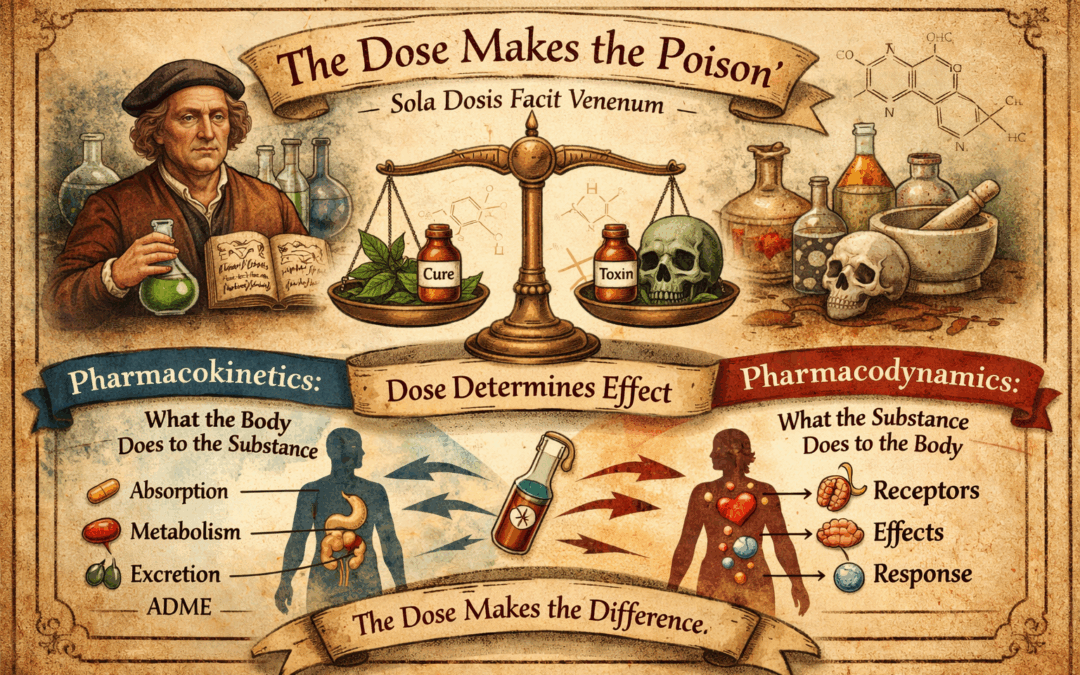
The saying “All things are poison, and nothing is without poison; only the dose makes a thing not poisonous” is correctly attributed to the Renaissance physician and alchemist Paracelsus. This idea is foundational to modern toxicology and is commonly condensed into the maxim: “The dose makes the poison” (sola dosis facit venenum).
Though often quoted in this concise form, the phrase reflects a broader principle articulated repeatedly across Paracelsus’s work rather than a single verbatim sentence.
Historical Origin
Paracelsus (born Philippus Aureolus Theophrastus Bombastus von Hohenheim, 1493–1541) expressed this concept throughout his medical and philosophical writings. It is most frequently associated with Septem Defensiones (Seven Defenses), published posthumously in 1564. In these texts, Paracelsus challenged the dominant Galenic humoral theory and argued for a chemically grounded understanding of physiology and disease.
His central claim was radical for its time: toxicity is not an inherent property of a substance, but a function of quantity and context. This idea laid the groundwork for modern pharmacology, toxicology, and risk assessment.
Meaning and Modern Relevance
The principle signifies that any substance can be harmful at a sufficiently high dose, including elements essential for life such as water, oxygen, sodium, or iron. Conversely, substances traditionally classified as poisons—such as arsenic, botulinum toxin, or digitalis—can exert therapeutic effects when administered in small, controlled amounts.
In contemporary science, this concept underpins:
- Pharmacology and drug development
- Nutritional biochemistry
- Environmental and occupational health
- Regulatory toxicology and exposure limits
Rather than categorizing compounds as inherently “good” or “bad,” modern medicine evaluates dose, duration, frequency, and biological context.
Pharmacodynamics vs. Pharmacokinetics: How Dose Becomes Effect
While Paracelsus emphasized that dose determines toxicity, modern biomedical science refines this insight through two complementary disciplines: pharmacodynamics and pharmacokinetics. Together, they explain why the same dose can produce very different effects across individuals—or even within the same individual over time.
Pharmacodynamics: What the Substance Does to the Body
Pharmacodynamics describes the biological effects of a substance on the body. It addresses questions such as:
- What receptors, enzymes, or signaling pathways does the compound interact with?
- What physiological effects are produced?
- How strong is the effect at a given concentration?
In short, pharmacodynamics explains mechanism of action—how a compound produces therapeutic benefits, side effects, or toxic outcomes once it reaches its target tissues.
For example, caffeine increases alertness by antagonizing adenosine receptors. At higher doses, the same mechanism can result in anxiety, insomnia, palpitations, or elevated cortisol—illustrating how effect scales with dose.
Pharmacokinetics: What the Body Does to the Substance
Pharmacokinetics describes how the body handles a compound over time. It is commonly summarized by the acronym ADME:
- Absorption – how the substance enters the bloodstream
- Distribution – how it is transported and stored in tissues
- Metabolism – how it is chemically modified, primarily by the liver
- Excretion – how it is eliminated, via kidneys, bile, lungs, or sweat
Two people may ingest the same dose of a nutrient, drug, or environmental chemical, yet experience vastly different outcomes due to differences in digestion, liver enzyme activity, gut microbiota, kidney function, hormonal status, or genetic polymorphisms.
From a metabolic perspective, pharmacokinetics explains why standardized dosing often fails to account for individual variability.
Why the Distinction Matters
Paracelsus taught that dose makes the poison, but modern science shows that dose alone is not sufficient. The real biological impact of any compound depends on:
- How the body processes the dose (pharmacokinetics), and
- How the compound acts at its targets (pharmacodynamics)
This distinction is critical when evaluating medications, supplements, micronutrients, hormones, and environmental exposures. A substance may be benign or beneficial in theory, yet harmful in practice if metabolism, clearance, or tissue sensitivity is impaired.
Why This Matters for Metabolic Health
Metabolic health is not achieved by eliminating all “toxins,” nor by indiscriminately adding supplements. It depends on thresholds, timing, cumulative exposure, and individual physiology.
Understanding dose-dependence—and the interplay between pharmacokinetics and pharmacodynamics—allows for more precise thinking about:
- Nutrient sufficiency versus overload
- Hormesis and adaptive stress
- Detoxification capacity
- Personalized supplementation and medication strategies
These concepts trace directly back to Paracelsus’s insight more than 500 years ago, yet remain central to modern discussions of metabolism, resilience, and long-term health.