
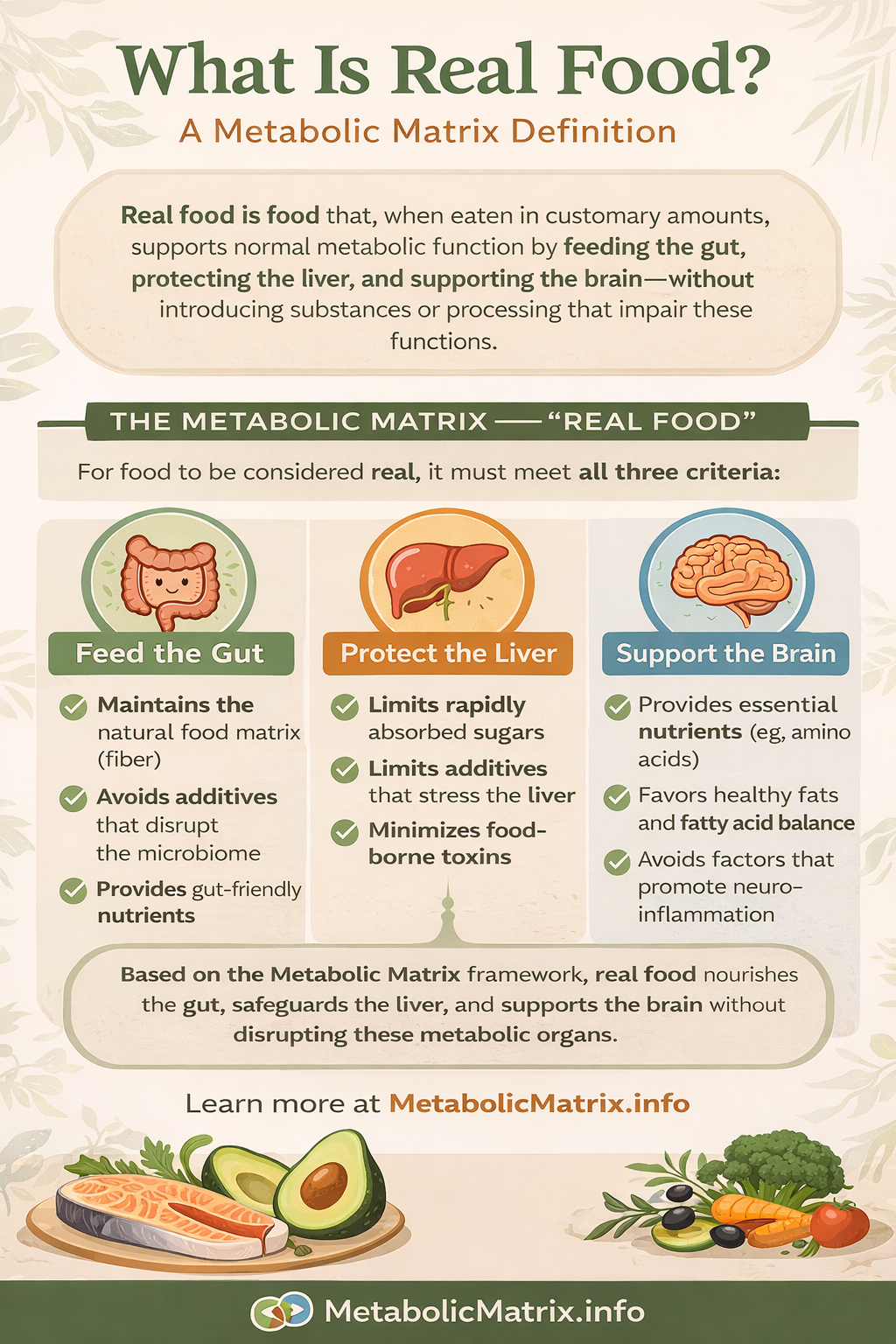
What Is Real Food? (A Metabolic Matrix Definition)
The phrase “real food” is everywhere. It appears on packaging, in social media, in policy discussions, and in wellness marketing. Yet despite its popularity, the term has no consistent scientific meaning. Too often, it is reduced to vague ideas about being “natural,” “clean,” or “unprocessed,” which can obscure rather than clarify what actually matters for human health.
At MetabolicMatrix.info, we use the term real food in a precise, evidence-based way—grounded in human physiology and metabolic science, not ideology or marketing.
Why We Need a Better Definition
Modern nutrition debates frequently focus on calories, macronutrients, or isolated ingredients. But decades of metabolic research show that chronic disease is driven less by how much we eat and more by how food interacts with core metabolic systems—particularly the gut, the liver, and the brain.
This understanding is the foundation of the Metabolic Matrix, a science-based framework built around three essential biological priorities:
- Feed the gut
- Protect the liver
- Support the brain
Using this framework, real food can be defined not by appearance, origin, or trendiness, but by what it does inside the body.
A Scientific Definition of Real Food
Real food is food that, when eaten in customary amounts, supports normal metabolic function by feeding the gut, protecting the liver, and supporting the brain—without introducing substances or processing that impair these functions.
This definition is intentionally simple, but it is not simplistic. Each component reflects well-established mechanisms linking diet quality to metabolic health.
What “Real Food” Means in Practice
1. Real Food Feeds the Gut
The gut is not merely a digestive tube—it is a critical metabolic and immune organ. Real food supports gut health by:
- Preserving the natural food matrix (the cellular structure of food),
- Providing fermentable substrates such as soluble and insoluble fiber,
- Supporting a diverse and functional gut microbiome,
- Avoiding additives and processing methods known to disrupt gut barrier integrity or microbial balance.
Foods that feed the gut help regulate inflammation, glucose metabolism, and downstream signaling to other organs.
2. Real Food Protects the Liver
The liver is the body’s central metabolic processing unit. It governs energy partitioning, detoxification, and hormonal signaling. Real food protects the liver by:
- Limiting rapidly absorbable sugars, especially fructose,
- Avoiding excess glycemic load that drives de novo lipogenesis,
- Reducing exposure to food-borne toxins, contaminants, and metabolic disruptors,
- Minimizing ingredients and processing that impair mitochondrial function.
When liver metabolism is preserved, insulin sensitivity and metabolic flexibility are preserved as well.
3. Real Food Supports the Brain
The brain is a metabolically demanding organ with specific nutritional requirements. Real food supports brain health by:
- Providing adequate essential nutrients, including amino acids, vitamins, and minerals,
- Supplying appropriate fats, particularly those that support neuronal structure and reduce inflammation,
- Maintaining a healthy balance of fatty acids,
- Avoiding dietary patterns that promote neuroinflammation or brain insulin resistance.
Because the brain regulates appetite, reward, mood, and decision-making, supporting brain metabolism is central to long-term health.
What This Definition Avoids
Importantly, this definition of real food does not rely on:
- Buzzwords such as “natural,” “clean,” or “ancient,”
- Ingredient count alone,
- Calories or macronutrient ratios in isolation,
- Moral judgments about food choices,
- A false dichotomy between “processed” and “unprocessed” foods.
Processing itself is not the problem. Metabolic impact is. A food can be processed and still be real if it supports gut, liver, and brain function. Conversely, a food can appear “natural” and still be metabolically harmful.
Why This Matters
In a world where food language is routinely distorted by marketing and politics, an evidence-based definition of real food is essential. By anchoring the term in measurable metabolic outcomes, the Metabolic Matrix provides a framework that is:
- Scientifically grounded,
- Clinically relevant,
- Applicable across cultures and food systems,
- Useful for consumers, clinicians, policymakers, and food producers alike.
A Simple Takeaway
If food is judged by how it affects human metabolism rather than how it is marketed, the question becomes straightforward:
Does this food feed the gut, protect the liver, and support the brain?
If the answer is yes, it qualifies as real food—by definition, not by trend.
This definition is based on the Metabolic Matrix framework developed to evaluate foods by their metabolic effects rather than by ideology, ingredients alone, or marketing claims.
Dr. Robert Lustig on why current thinking about food and health is wrong and how we begin to change it
(Exerpt from an aticle on Levels Metabolic Insights)
Here we are talking about food. What is “food”? What’s the definition of food? Anybody got a definition?
Audience member: Fuel.
Dr. Lustig: Fuel. Well, not quite, almost, but not really. Try again.
Audience member: Organic matter that can be turned into energy.
Dr. Lustig: Turned into energy. You’re halfway there. If you go to Webster’s and look at the definition of food, it is “Substrate that contributes to either the growth or burning of an organism.” Any substrate that you would use can cause growth, or it can cause burning, but it can’t do both at the same time.
Kind of like a piece of wood in your house: it can be used for building furniture, or it can be used for firewood, but it can’t be used for both. Any specific molecule that you consume can be burned down to carbon dioxide and ATP, or it can be used for its structural components to form lipids, amino acids, ribose, etc., for cell growth. Those are your choices.
There are three enzymes in each cell that determine which way the substrate goes: they’re all kinases, and they have receptors and transcription factors that run them.
So that’s the definition of food. But what if a substrate inhibited burning?
The molecule fructose, the sweet molecule in sugar, inhibits three separate enzymes in mitochondria that prevent burning: AMP kinase, ACADL, CPT1. The primary component of ultra-processed food inhibits burning.
Let’s take growth. If something causes growth, that makes it food. What if the substrate inhibited growth? My colleague, Dr. Efrat Monsonego-Ornan, who is the Chairman of Nutrition at Hebrew University-Jerusalem, just wrote a paper on how ultra-processed food inhibits skeletal growth, calcium accretion and causes inhibition of structural growth. In addition, we know that those same things promote cancer development.
Ultra-processed food inhibits growth and inhibits burning. It’s not food. It’s poison. That’s not taking a disparaging view. That’s taking a very epistemological view of this, and it’s not conferring any sort of social inequity phenomenon. Because lots of elite people eat ultra-processed food, too. But what it’s doing is calling attention to the science and then using the people’s brains to turn that science into rational policy.