The $16.4 Trillion Question: Can Better Food Create Better Health?
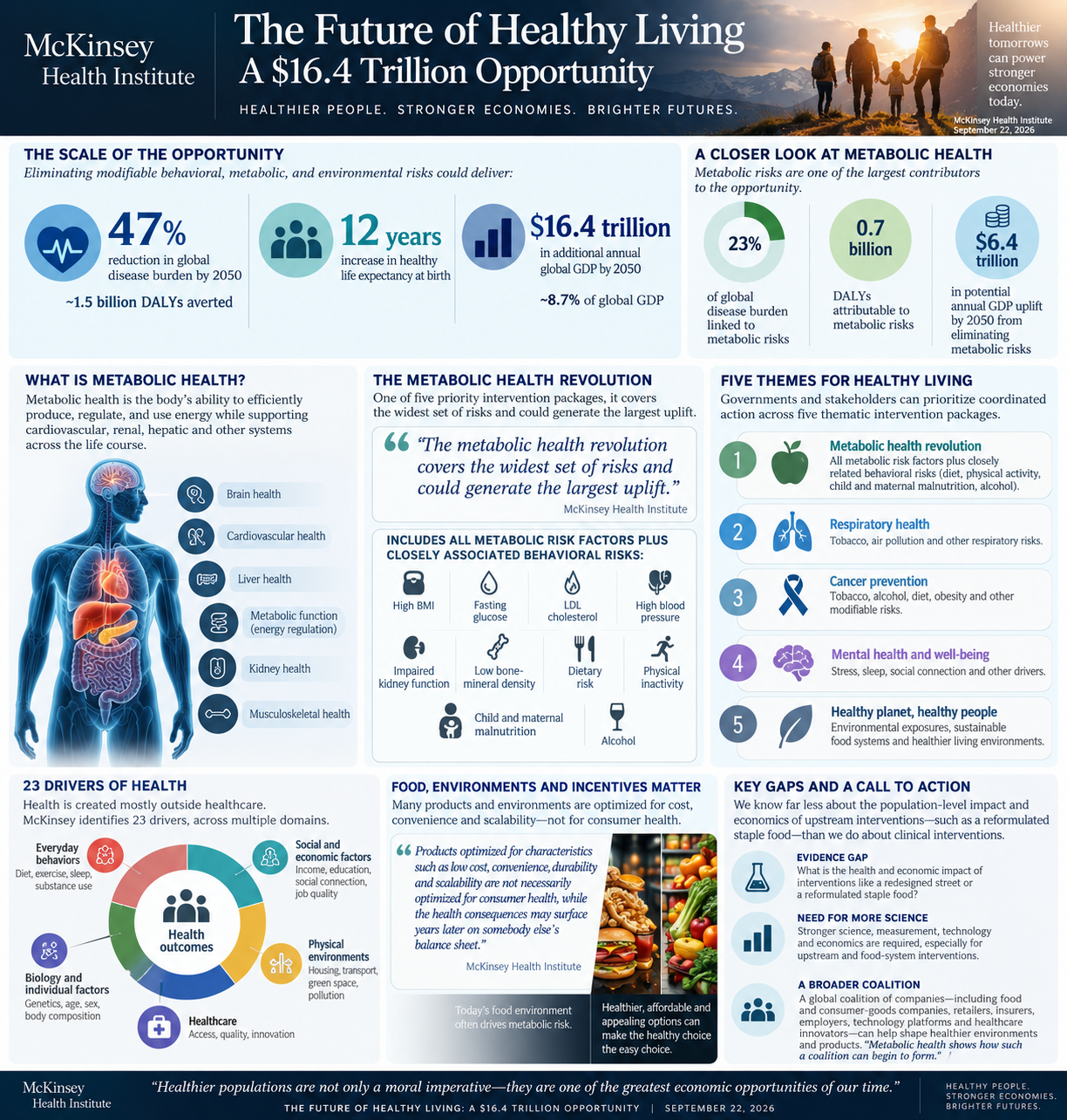
The headline number in the McKinsey Health Institute’s latest report, The Future of Healthy Living, is hard to ignore: $16.4 trillion.
That is MHI’s estimate of the additional annual global economic output that could potentially be generated by 2050 by addressing modifiable behavioral, metabolic and environmental health risks. The report, The Future of Healthy Living: A $16.4 Trillion Opportunity, estimates that doing so could reduce projected global disease burden by 47 percent and add around 12 years to healthy life expectancy at birth.
But behind that enormous economic number is another story—one that may ultimately prove more important.
Metabolic health is moving toward the center of the global health and economic conversation.
MHI estimates that metabolic risks alone are linked to around 23 percent of global disease burden and that eliminating them could potentially contribute some $6.4 trillion in additional annual GDP by 2050.
The report goes further, describing a “metabolic health revolution” encompassing metabolic risk factors alongside closely related behavioral risks such as poor diet and physical inactivity. Its conclusion is striking:
“The metabolic health revolution covers the widest set of risks and could generate the largest uplift.”
This matters because it moves metabolic health beyond the familiar conversation about obesity.
Diabetes, cardiovascular disease, metabolic liver disease and other chronic conditions may present differently, but many share underlying metabolic dysfunction. And that dysfunction often begins years before someone becomes a patient.
Health begins before healthcare
One of the strongest ideas running through the MHI report is that much of health is created outside the healthcare system.
It is shaped by how we sleep and move, the environments in which we live and, several times every day, what we eat.
That creates an intriguing challenge.
Medicine has become exceptionally sophisticated at measuring what happens when we change a drug or clinical intervention. We know considerably less about what happens when we systematically change everyday environments—including food.
McKinsey explicitly identifies a “reformulated staple food” as an example of an upstream intervention for which better evidence is needed.
That seemingly small example points toward a very big question.
What happens if we redesign the food itself?
Imagine reducing added sugar, restoring fiber, changing fat quality or redesigning food structure across products consumed not by thousands, but by millions of people.
What happens to metabolic health after one meal? After a thousand meals? Across an entire population?
And what would those improvements be worth?
The missing link between food and the $16.4 trillion opportunity
McKinsey provides a compelling economic pathway:
Lower risk → less disease → more healthy life → greater productivity → greater economic value.
What remains much less developed is the pathway leading into it:
Better food → better metabolic response → better metabolic health → lower disease risk.
Connecting those two pathways may be one of the great opportunities for food and nutrition science.
It also requires moving beyond simplistic arguments about calories or whether food is “processed.”
Food processing has brought enormous benefits in safety, affordability, availability and convenience. The more important question is what we ask processing to accomplish.
For decades, food has been brilliantly engineered for taste, price, consistency, shelf life and scale.
What if metabolic health became another fundamental design requirement?
That is where the Metabolic Matrix comes in
The Metabolic Matrix was developed around precisely this idea: food should be evaluated not simply by what it contains or how it was processed, but by what it does inside the human body.
Its three organizing principles are simple:
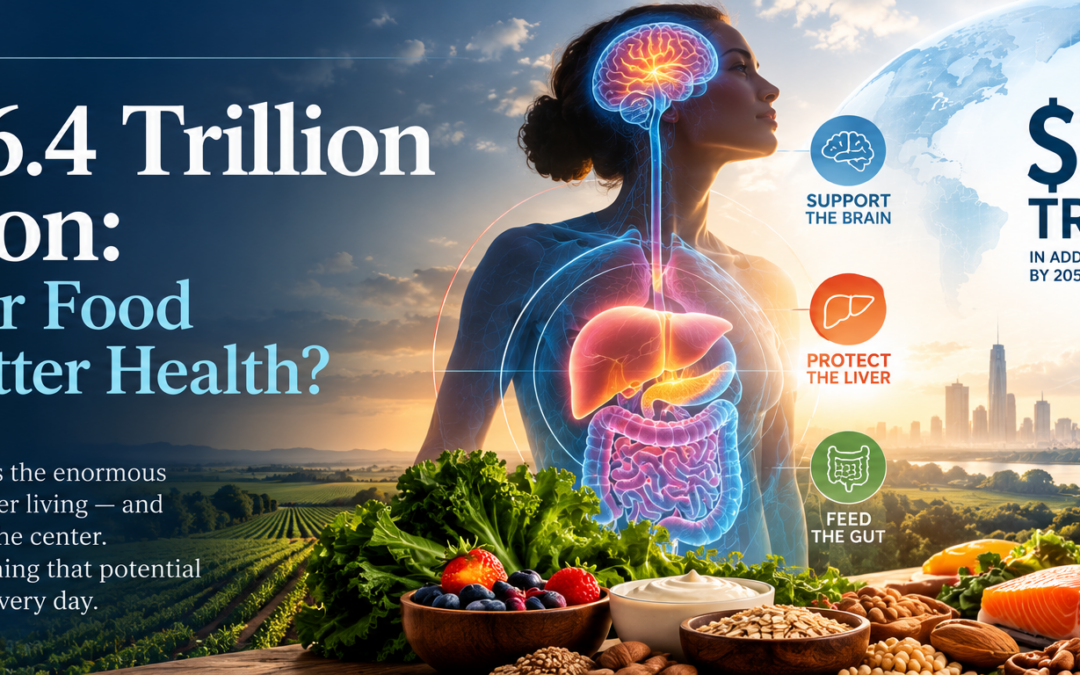
Feed the Gut. Protect the Liver. Support the Brain.
Behind them is a deeper framework for examining ingredients, food structure and metabolic function—and for using that science to reformulate existing products and design better ones.
The objective isn’t another definition of “healthy food.” It is to make metabolic health a practical food-design parameter.
Ultimately, the chain runs from molecules to ingredients, ingredients to products, products to diets, diets to metabolism—and metabolism to health.
McKinsey is now helping quantify what happens at the other end of that chain: healthier populations live longer, participate more fully in society and create enormous economic value.
The challenge is to connect the two.
If better metabolic health really represents trillions of dollars in unrealized economic value, we should be asking a deceptively simple question:
How much of that opportunity could begin with better food?
The $16.4 trillion figure tells us how large the destination might be.
The next task is designing the food that helps us get there.
Read the full report: https://www.mckinsey.com/mhi/our-insights/the-future-of-healthy-living-a-16-4-trillion-opportunity