The False Economy of Big Food Is Getting More Expensive
Two years ago, in a ground-breaking report, The False Economy of Big Food, economist Tim Jackson calculated the hidden health cost of Britain’s food system at £268 billion a year. He has just updated the numbers. The bill has risen to £298 billion—and the implications reach far beyond Britain.
Something remarkable happened to the economics of food in Britain over the last two years.
Food became more expensive. Households spent more on it. The National Health Service, social-care system and welfare system spent more dealing with chronic illness. Lost productivity and the human costs associated with ill health increased.
Yet the amount of additional money Jackson estimates would be required to bridge the gap between what British households currently spend on food and the cost of a diet consistent with the government’s Eatwell Guide actually fell.
That is the uncomfortable arithmetic at the heart of Professor Tim Jackson’s September 2026 update to The False Economy of Big Food.
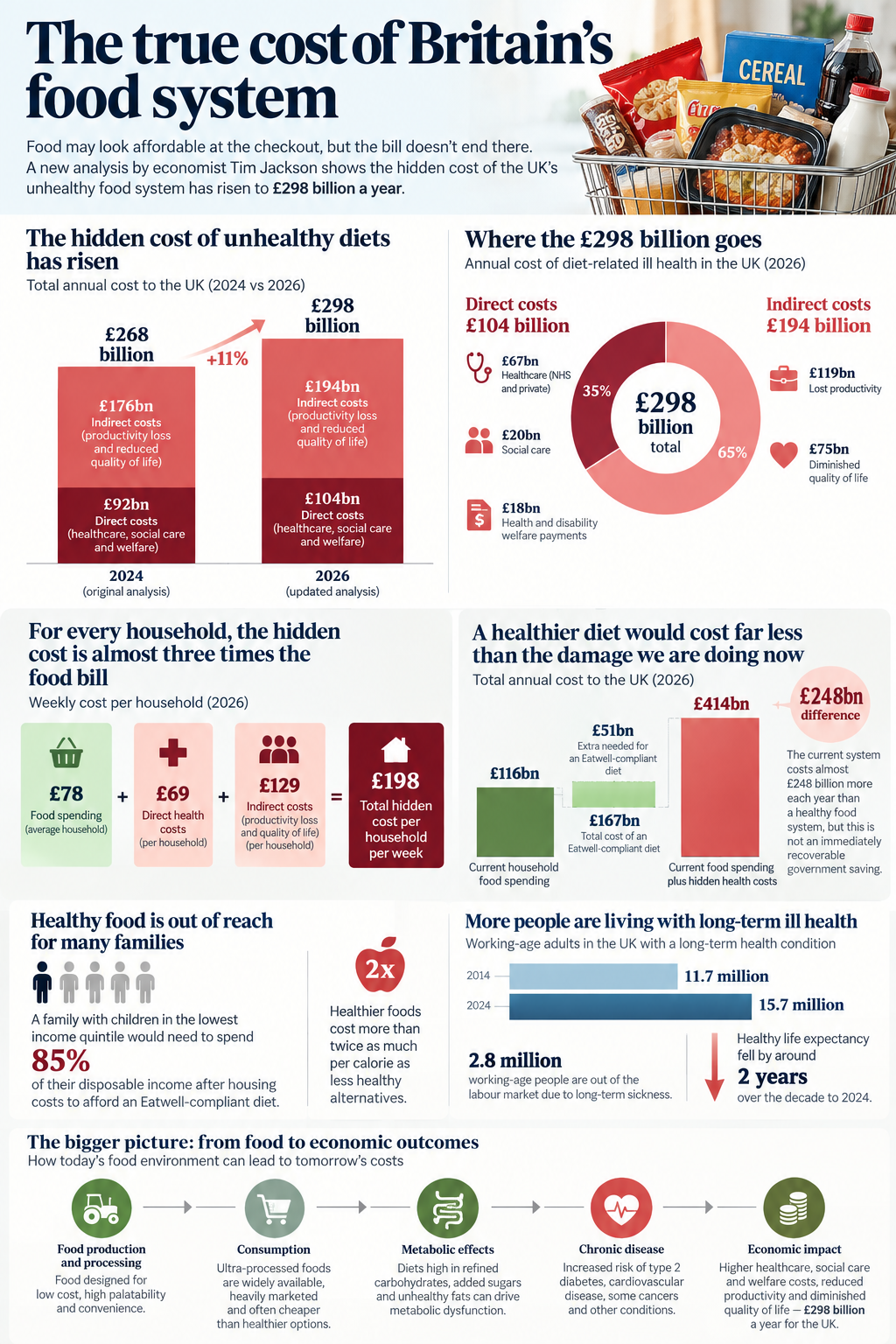
When Jackson first ran the numbers for the Food, Farming and Countryside Commission in 2024, he estimated that unhealthy diets imposed approximately £268 billion a year in health-related costs on the United Kingdom.
Two years later, the figure is £298 billion.
Meanwhile, the estimated gap between current household food expenditure and the cost of achieving an Eatwell-compliant diet has fallen from £57 billion to £51 billion.
The hidden cost of unhealthy diets is now almost six times larger than the estimated expenditure gap associated with eating well.
That makes Jackson’s original argument harder to dismiss.
We have spent decades worrying about the price of food.
Perhaps we should have been worrying about its cost.
The bill that arrives somewhere else
The distinction matters.
Walk through a supermarket and the economics of food appear straightforward. There is a product, a price and a customer. Manufacturers compete relentlessly over ingredient costs, production efficiencies and margins. Retailers compete on price. Governments worry, quite reasonably, about food inflation and affordability.
That is the visible food economy.
Jackson is interested in the one we don’t see.
His updated £298 billion estimate includes £104 billion in direct costs associated with healthcare, social care and welfare payments. Another £194 billion represents indirect losses associated with reduced productivity and diminished quality of life.
Look inside those numbers and the story becomes even more tangible: approximately £67 billion in healthcare costs, £20 billion in social care, £18 billion in health and disability welfare payments, £119 billion in productivity losses and £75 billion attributed to diminished quality of life.
The supermarket receipt records none of this.
The manufacturer records the sale. The retailer records the margin. But when poor health emerges years later, the costs migrate onto entirely different balance sheets—to hospitals, employers, taxpayers, families and individuals.
Jackson’s achievement is to bring those ledgers back together.
And when he does, the definition of “cheap food” begins to unravel.
The average British household currently spends about £78 a week on food. Jackson’s direct health-related costs work out to roughly another £69 per household per week. Include the wider economic and human burden and the hidden cost approaches £198 a week per household.
The apparent bargain starts looking rather different.
And the gap is widening
The comparison with 2024 is particularly revealing.
Direct costs have risen from £92 billion to £104 billion. Indirect costs have climbed from £176 billion to £194 billion. Overall household spending on food and non-alcoholic drinks has increased to approximately £116 billion.
Yet Jackson calculates that an Eatwell-compliant national diet would cost around £167 billion—leaving an expenditure gap of approximately £51 billion.
Put the two sides of the ledger together and the contrast is striking.
Current household food spending plus the estimated hidden health burden comes to more than £414 billion a year.
The estimated expenditure required for an Eatwell-compliant diet is just under £167 billion.
The difference is almost £248 billion.
That number needs to be handled carefully. Jackson does not claim that Britain could simply change everyone’s diet and discover £248 billion sitting in the Treasury the following morning. Disease takes years to develop and years to prevent. Healthcare infrastructure cannot instantly be dismantled when population health improves. Some of the £298 billion represents lost productivity and quality of life rather than government expenditure.
Jackson explicitly warns against interpreting the comparison as an immediately recoverable fiscal saving.
Nor does he claim that the Eatwell Guide is a cure for Britain’s existing metabolic dysfunction.
What the calculation provides is something different: a measure of the extraordinary imbalance between what society invests in healthier food and what it spends—or loses—dealing with poor health.
Even the £104 billion in direct costs alone is more than twice the £51 billion expenditure gap.
That is difficult arithmetic to ignore.
Poor health is becoming an economic constraint
The 2026 update also broadens the story beyond food.
Jackson cites new Health Foundation analysis showing that 15.7 million working-age adults in Britain now live with a long-term health condition, up from 11.7 million in 2014. Almost 2.8 million working-age people are outside the labour market because of long-term sickness, while healthy life expectancy fell by around two years over the decade to 2024.
This changes the economic frame.
Health is not simply something governments spend money on after people become sick. It is part of a country’s productive capacity.
Workers who remain healthy participate in the economy. They produce, earn, consume and pay taxes. Chronic illness works in the opposite direction.
The food debate therefore starts escaping the boundaries of agriculture departments and health ministries.
Food policy becomes economic policy.
That is one of Jackson’s explicit conclusions in the new report: prevention should be regarded as productive investment rather than discretionary social expenditure.
And that idea deserves attention far beyond Whitehall.
But who can actually afford to eat well?
There is another side to Jackson’s analysis that prevents this from becoming a simplistic lecture about individual responsibility.
Healthy food remains profoundly unequal in its affordability.
The 2026 update cites Food Foundation analysis estimating that a family with children in Britain’s lowest income quintile would need to spend approximately 85% of its disposable income after housing costs to afford a diet consistent with the Eatwell Guide.
Healthier foods were also found to cost more than twice as much per calorie as less healthy alternatives.
That makes “people should simply make better choices” a remarkably inadequate policy response.
Choices take place inside a food environment.
Price matters. Availability matters. Convenience matters. Marketing matters. Formulation matters. What manufacturers choose to make matters.
Indeed, one of the significant additions to Jackson’s 2026 update is greater attention to what public-health researchers call the commercial determinants of health: the ways product formulation, pricing, availability, marketing, retail environments and corporate practices shape population health.
That is where Jackson’s economic argument becomes especially challenging for the food industry.
But it is also where I believe an opportunity appears.
What if the answer isn’t to get rid of Big Food?
It would be easy to read The False Economy of Big Food simply as an indictment of industrial food.
I think that would miss a more interesting possibility.
Modern food manufacturing is extraordinarily good at solving problems. It has learned how to make food safe, inexpensive, shelf-stable, pleasurable and available at enormous scale. Its factories, ingredient science, refrigeration networks, packaging technologies and global distribution systems represent a formidable technological infrastructure.
Those capabilities are not inherently unhealthy.
The question is what we ask them to optimize.
For decades, the dominant design brief has been some combination of taste, price, convenience, safety, shelf life and margin.
What if we added another requirement?
Metabolic health.
That would move us beyond the increasingly polarized argument between “Big Food” and “real food,” or between processed and unprocessed food.
Instead, we would begin asking more precise questions.
What happened to a food as it moved from agriculture through processing and formulation? What was removed? What was added? What happened to its physical structure? How much fibre survived? How rapidly will its carbohydrates become available? How will its ingredients interact with the microbiome? What metabolic burden will arrive at the liver? What signals will ultimately reach the brain?
This is the territory that the Metabolic Matrix was created to explore.
Its proposition—Feed the Gut, Protect the Liver, Support the Brain—is not intended as another front-of-pack definition of “healthy.” It is an attempt to move the design conversation upstream, into the architecture of the food itself.
Rather than formulating a product and subsequently asking whether we can make a health claim about it, we can begin by asking:
What biological outcome are we designing this food to support?
Jackson doesn’t make that argument. It is where I think his argument leads.
From classification to redesign
This distinction matters particularly in the debate around ultra-processed foods.
There is now substantial evidence associating high UPF consumption with adverse health outcomes. Jackson’s work rightly takes that literature seriously.
But “processing” alone tells us relatively little about what food science should actually do next.
A food can be industrially manufactured while preserving fibre, minimizing added sugar, improving fat quality and supporting the microbiome. Conversely, a product presented as natural can still deliver a substantial metabolic load.
The actionable scientific question is therefore not simply was this processed?
It is:
What did processing do to it—and what happens when we metabolize the result?
That takes us from classification toward causation.
And once we reach that point, a rather different future for the food industry becomes imaginable.
Instead of dismantling the productive infrastructure of Big Food, we could repurpose its extraordinary capabilities.
Use food science to make metabolically positive products delicious.
Use manufacturing to make them affordable.
Use distribution to make them ubiquitous.
Use scale to move them out of specialist health-food categories and into the mass market.
That is a much harder challenge than simply telling people what not to eat.
It may also be considerably more consequential.
The balance sheet we still haven’t built
Jackson’s updated analysis ultimately leaves us with an accounting problem.
We know what a tonne of ingredients costs. We know the cost of a factory line. We know the margin on a beverage, yoghurt or snack. We can calculate logistics costs to fractions of a cent.
But we have remarkably weak accounting for what happens after the product enters the human body.
That may be the missing balance sheet of the modern food economy.
Imagine being able to follow value all the way from soil, genetics and agricultural production through processing, formulation and retail—and then onward through human metabolism into health, productivity and economic outcomes.
Instead of measuring food-system productivity simply in tonnes, calories or revenue, we might eventually ask a radically different question:
How many healthy human years are we creating per unit of food-system investment?
We are nowhere near being able to answer that question reliably.
But Jackson’s numbers suggest that we should start trying.
His 2024 report estimated the hidden health cost of Britain’s unhealthy food system at £268 billion.
Two years later, it is £298 billion.
The number will undoubtedly continue to be debated, refined and challenged. It should be. Jackson himself describes the update as a limited methodological refresh rather than a definitive cost-benefit analysis and acknowledges the statistical uncertainty surrounding the estimates.
But the direction of the argument is increasingly difficult to avoid.
The food industry has spent much of the last century becoming extraordinarily good at making food economically cheap.
The next great challenge may be ensuring that it is not biologically expensive.
Because when food looks inexpensive at the checkout but its consequences reappear in hospitals, welfare budgets, workplaces and diminished years of healthy life, the cost has not disappeared.
We have simply been sending the bill somewhere else.
Read Professor Jackson’s own reflections on the updated report here: https://ffcc.co.uk/conversations/held-hostage