The Health of Nations: Why Prevention May Be One of the World’s Best Investments
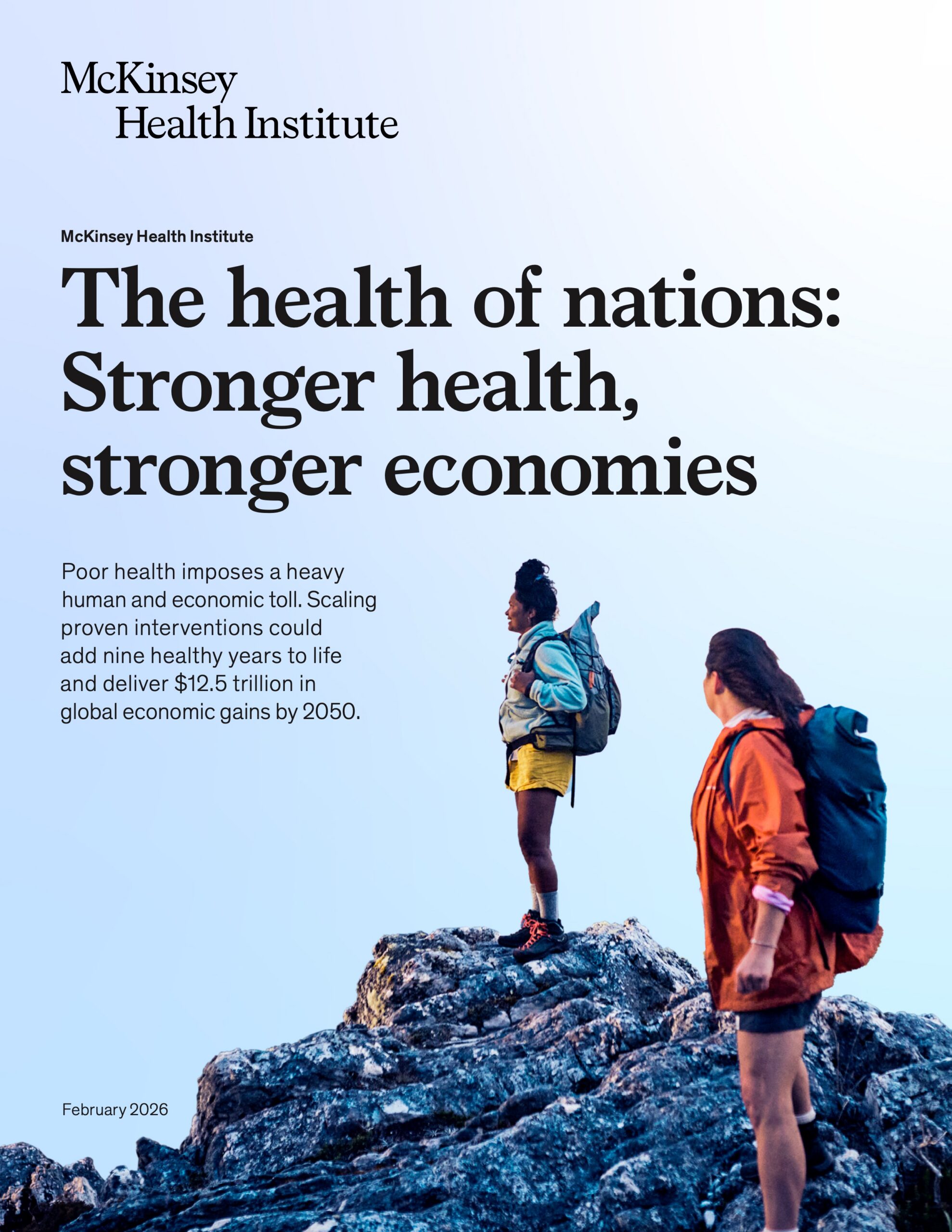
An excellent report, The health of nations: Stronger health, stronger economies, by McKinsey offers a remarkable perspective on the health of natioins.
For decades, we have tended to talk about health as a cost.
Healthcare spending. Insurance costs. Hospital budgets. Pharmaceutical costs. The fiscal burden of aging populations.
The February 2026 report from the McKinsey Health Institute, The Health of Nations: Stronger Health, Stronger Economies, asks us to turn that equation around.
What if health is not primarily an expense?
What if it is one of the most valuable forms of capital a society possesses?
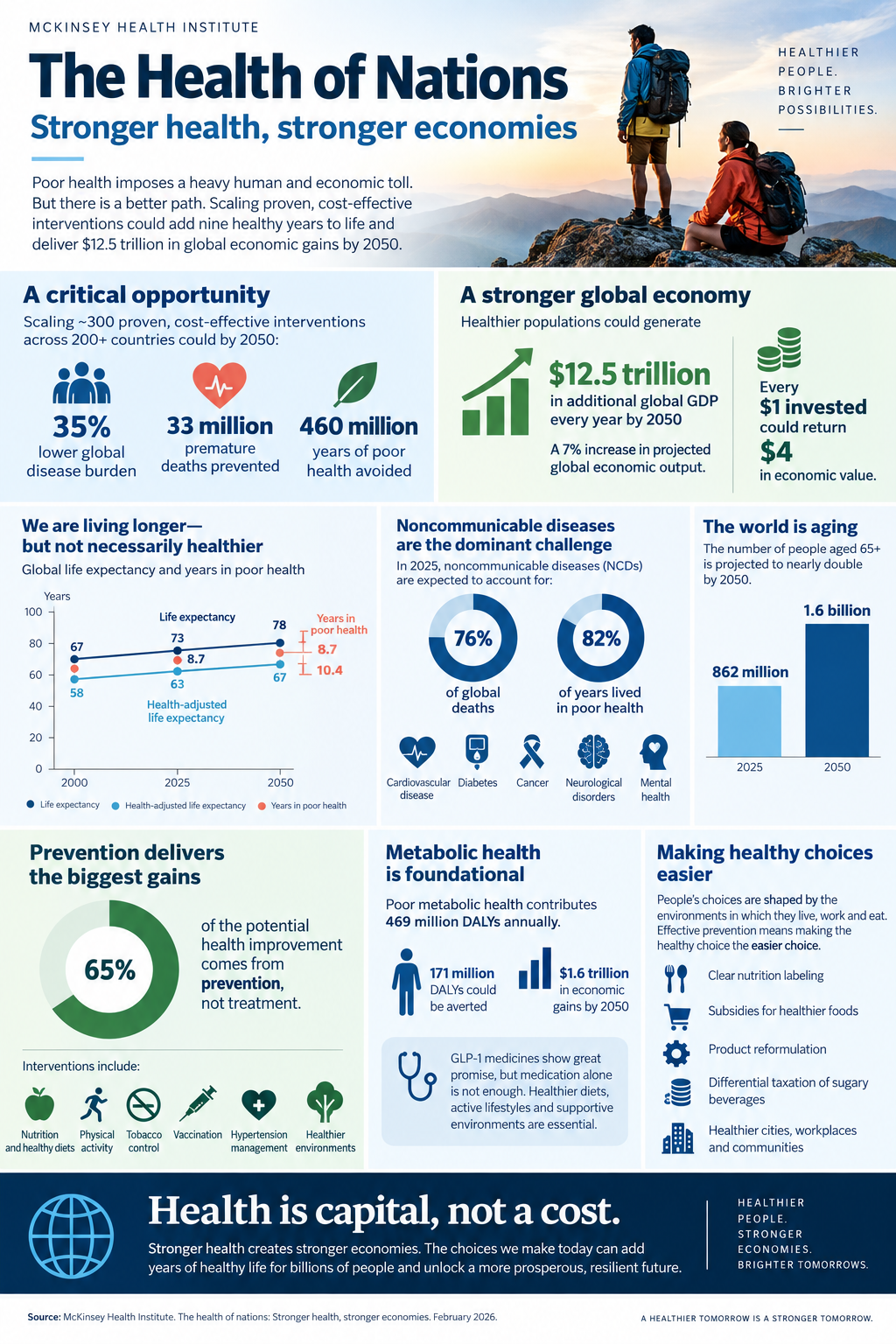
The report makes an unusually powerful economic case for that proposition. Drawing on Global Burden of Disease data and modeling nearly 300 proven, cost-effective interventions across more than 200 countries, McKinsey estimates that scaling interventions we already know how to deliver could reduce the global disease burden by 35 percent by 2050, prevent 33 million premature deaths, and avert more than 460 million years of poor health.
And the economic consequences could be enormous:
$12.5 trillion in additional global GDP every year by 2050.
That is roughly a 7 percent increase in projected global economic output.
The central message is remarkably simple:
Healthy people are not merely the beneficiaries of prosperous economies. They are one of the reasons prosperous economies exist.
We are living longer—but not necessarily healthier
Humanity has achieved an extraordinary increase in longevity. By 2050, average global life expectancy is projected to reach approximately 78 years.
But there is a troubling countertrend.
The average person spent approximately 8.7 years in poor health in 2000. That increased to 10.2 years in 2025 and is projected to reach 11.4 years by 2050.
In other words, we have become increasingly successful at extending lifespan without proportionately extending healthspan.
Meanwhile, the disease landscape itself is changing. Noncommunicable diseases—including cardiovascular disease, diabetes, cancer, neurological disorders and mental-health conditions—are becoming increasingly dominant. In 2025, NCDs are expected to account for 76 percent of global deaths and 82 percent of years lived in poor health.
At the same time, the world is aging. By 2050, the number of people over 65 is projected to nearly double, from 862 million to 1.6 billion.
The result is an economic double bind: more chronic disease, more healthcare expenditure, and fewer healthy people available to participate fully in the workforce.
McKinsey estimates that global healthcare spending could rise from approximately $11.2 trillion today to $20.5 trillion in 2050, while the economic burden associated with lost productivity and reduced labor-force participation could rise from 17 percent to 23 percent of global GDP.
This is not simply a healthcare problem.
It is an economic-development problem.
The remarkable thing is that we already know much of what to do
Perhaps the most hopeful finding in the report is that its projections do not depend upon hypothetical scientific breakthroughs.
McKinsey examined approximately 300 existing evidence-based interventions addressing roughly 90 diseases and 27 risk factors.
Scaling these interventions toward achievable best-practice adoption could reduce the projected global disease burden by 35 percent.
Even more importantly, 65 percent of that potential health improvement comes from prevention, rather than treatment after disease has developed.
That distinction matters enormously.
Our health systems remain overwhelmingly organized around treating sickness. Yet some of the largest potential gains lie upstream: preventing disease before hospitals, expensive medicines and specialist care become necessary.
The report explicitly identifies interventions involving nutrition, physical activity, tobacco control, cardiovascular prevention, vaccination, hypertension management, healthier environments and other population-level measures.
And prevention does not necessarily mean waiting decades for a return.
Some interventions begin producing measurable health and economic benefits within months or years.
Metabolic health moves toward center stage
For those of us working in metabolic health, one section of the report deserves particular attention.
McKinsey describes metabolic health as “foundational to human and economic well-being.”
Poor metabolic health currently contributes an estimated 469 million disability-adjusted life years (DALYs) annually worldwide.
The report acknowledges the extraordinary promise of GLP-1 medicines for obesity and diabetes, while making an equally important point:
Medication alone cannot reverse the trajectory.
Improved nutrition and diets, active lifestyles and healthier environments remain essential.
McKinsey estimates that scaling proven metabolic-health interventions could avert approximately 171 million DALYs and contribute as much as $1.6 trillion to the global economy by 2050.
That should command the attention not merely of health ministries, but of finance ministries, employers, investors—and the food and beverage industry.
Because metabolic health is not created primarily inside hospitals.
It is shaped every day by the environments in which people live, work, move—and eat.
Making the healthy choice the easier choice
One of the report’s most important observations concerns the way we talk about personal responsibility.
Poor diet, tobacco use, physical inactivity and harmful alcohol consumption are often described as individual choices. But McKinsey notes that these behaviors are strongly influenced by food systems, urban design, marketing, workplaces and social norms.
The report therefore argues that effective prevention requires supportive environments that make healthier choices easier.
Examples include front-of-package nutrition labeling, subsidies for healthier foods, reformulation, and differential taxation of sugary beverages.
This moves the conversation beyond the tired dichotomy between personal responsibility and government intervention.
People make choices.
But systems shape choices.
Good health policy should therefore preserve agency while creating environments in which healthier decisions become easier, more accessible, more affordable—and eventually more normal.
The food industry has an extraordinary opportunity
There is a particularly important message here for food companies.
McKinsey observes that market incentives may already be shifting as consumers increasingly seek healthier products. Rather than assuming health-oriented products are commercially inferior, companies can create products and experiences that make healthy living “accessible, appealing, and easy.”
That is a profound change in framing.
Food companies need not choose between health and profitability.
The larger opportunity is to innovate toward health.
Reformulation should therefore not be understood merely as regulatory compliance or corporate social responsibility. It can become a platform for innovation, differentiation and long-term value creation.
The question becomes:
How do we make healthier food not simply an alternative—but the better product?
Better tasting. Better designed. Better understood. Better aligned with human biology. Commercially successful.
If we can do that at scale, the food system itself becomes part of healthcare infrastructure.
Every dollar invested could return four
McKinsey estimates that achieving the modeled improvements would require approximately $3.3 trillion in annual investment by 2050.
That is substantial.
But the estimated economic benefit is approximately four times larger.
For every $1 invested, roughly $4 of economic value could be generated.
Some interventions perform considerably better. The report estimates, for example, a return of approximately 35:1 for tobacco taxation and 8:1 for alcohol taxation.
The WHO “Best Buys”—including hypertension control, salt and sugar reduction policies, vaccination, tobacco and alcohol measures, and early detection of NCDs—could deliver approximately 17 percent of the modeled health benefit for only about 7 percent of the total intervention cost, producing an estimated 6:1 return.
This is why describing prevention merely as healthcare spending misses the point.
It is investment in human capital.
Disease is an invisible national debt
Perhaps the most compelling metaphor in the entire report is McKinsey’s suggestion that governments begin thinking about disease burden as an “invisible debt” on the national balance sheet.
Like financial debt, it accumulates interest.
We pay that interest through:
lost productivity,
reduced workforce participation,
premature mortality,
caregiving burdens,
and escalating healthcare expenditure.
Prevention effectively pays down the principal.
That reframing could fundamentally change public policy.
Instead of asking:
How much can we afford to spend on prevention?
we should increasingly ask:
How much future economic liability are we creating by failing to prevent avoidable disease today?
Why aren’t we doing this already?
This may ultimately be the most important question raised by the report.
The evidence is increasingly strong. Many interventions already exist. The economics can be compelling.
Yet prevention remains dramatically underfunded.
McKinsey identifies familiar barriers: short political and financial time horizons, difficulty attributing diseases that didn’t happen to preventive investments, payment systems designed around treating illness, siloed budgets, institutional resistance, and incentives that reward activity rather than outcomes.
In other words, the principal obstacle may no longer be scientific knowledge.
It may be system design.
And that has implications far beyond healthcare.
The same question must increasingly be asked of governments, insurers, employers, investors and food companies:
If healthier populations create economic value, how do we redesign incentives so that organizations creating that health can participate in the value they create?
That may be one of the defining innovation challenges of the coming decades.
From healthcare to health creation
McKinsey concludes with three broad priorities: align incentives toward long-term prevention, unleash multisectoral action, and improve the efficiency of health spending.
But beneath all three lies an even larger transformation.
We need to move from systems primarily designed to finance sickness toward systems capable of creating health.
That means healthcare still matters enormously.
But so do schools.
Workplaces.
Cities.
Transportation.
Technology.
Agriculture.
Food manufacturing.
Retail.
Finance.
And public policy.
Health is produced everywhere.
Our economic systems simply have not become very good at recognizing, measuring and rewarding its production.
The McKinsey report provides another important piece of evidence that this must change.
The world could potentially gain nine additional healthy years of life per person, while generating trillions of dollars of additional economic value.
Those are not competing outcomes.
They are two sides of the same equation.
Stronger health creates stronger economies.
And perhaps the most important economic resource any nation possesses is not beneath its soil, inside its banks, or on its balance sheet.
It is the health of its people.
the-health-of-nations-stronger-health-stronger-economies.pdf