
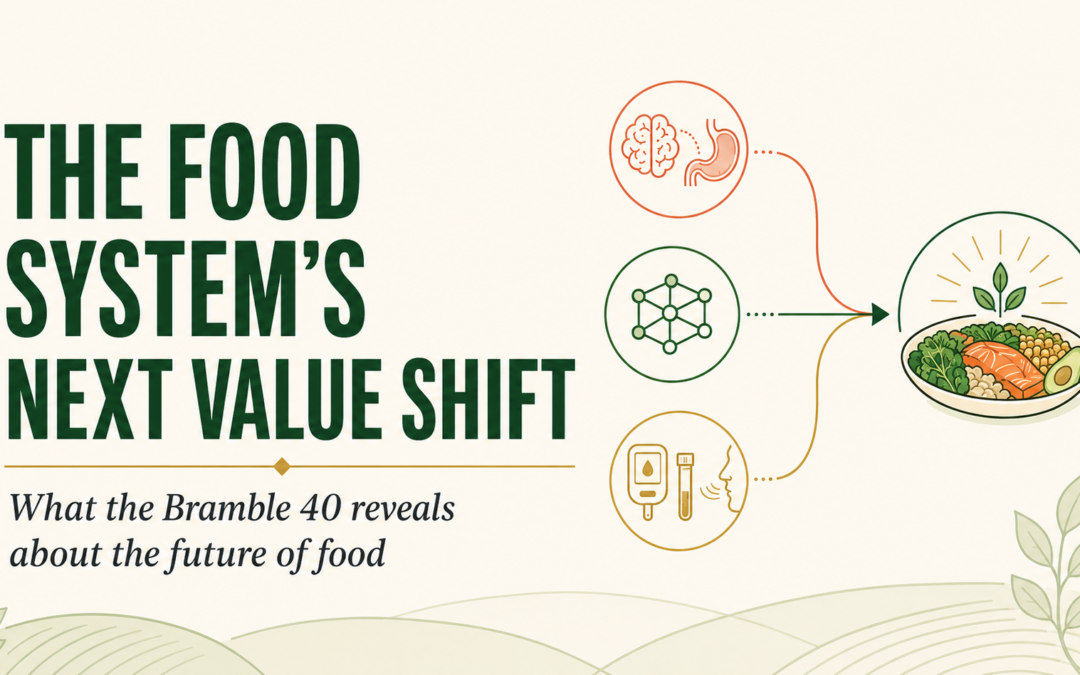
Tomorrow’s Appetites: What the Bramble 40 Tells Us About the Future of Food
The food industry is entering a period of structural change.
For decades, competitive advantage was largely built through scale, distribution, brand recognition, convenience, and price. These strengths remain important, but the newly released Bramble Intelligence 40 argues that the next major shift in food-system value will be shaped by something different: the growing ability of consumers to understand, influence, and measure how food affects their bodies.
The report identifies 40 companies—from emerging innovators to global technology platforms—that are positioning themselves for what Bramble Partners describes as the largest shift in food-industry profits since the rise of the supermarkets.
Its central premise is compelling: the future will belong increasingly to companies that make healthy eating easier, provide genuinely nourishing food, earn trust in their ingredients, and connect dietary choices with measurable health outcomes.
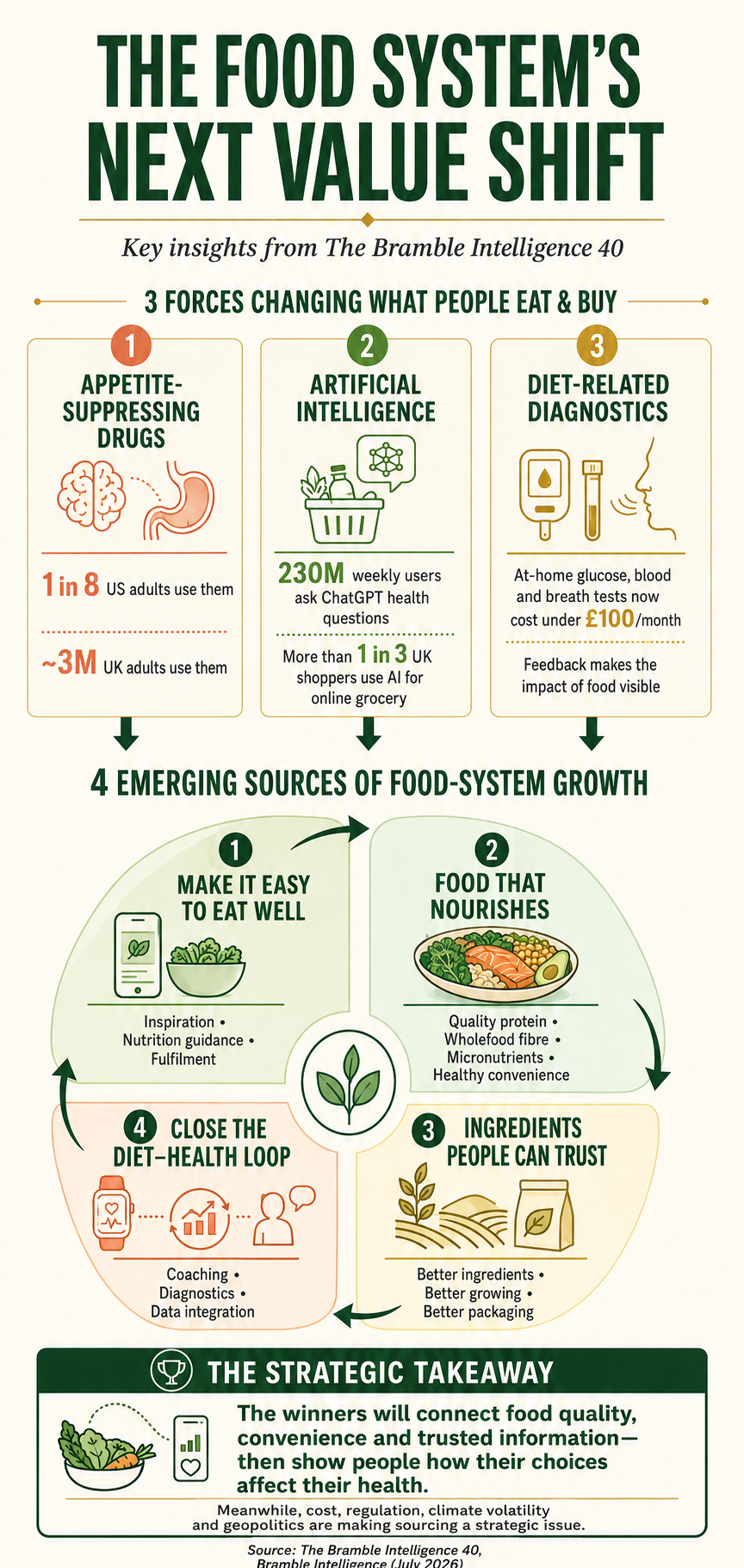
Three forces are changing what people eat
According to the report, three powerful forces from outside the traditional food industry are accelerating this transformation.
The first is the rapid adoption of appetite-suppressing medicines, particularly GLP-1 drugs. These treatments are changing appetite, portion size, food preference, and consumer expectations. They also reinforce an important scientific reality: obesity is not simply a failure of discipline or willpower. Appetite and energy regulation emerge from an interconnected biological system involving the gut, brain, hormones, metabolism, and reward circuitry.
The second force is artificial intelligence. Consumers are overwhelmed by conflicting nutritional advice from health professionals, traditional media, social platforms, influencers, podcasts, and commercial marketing. AI is rapidly becoming a new interpretive layer—helping people plan meals, evaluate products, compare alternatives, and eventually purchase food on their behalf.
The third force is the expansion of consumer diagnostics. Wearables, continuous glucose monitors, blood panels, breath tests, microbiome assessments, and other tools are beginning to show people how their bodies respond to diet.
This creates something nutrition has historically lacked: visible feedback.
When people can connect what they eat with changes in glucose, digestion, sleep, energy, appetite, or other health indicators, food stops being evaluated only through taste, price, packaging, and calories. Its biological effects become part of its perceived value.
Four emerging sources of value
The Bramble 40 organizes the resulting opportunities into four interconnected areas.
1. Making it easy to eat well
Knowledge alone rarely changes behaviour. People must also be able to act on that knowledge within the constraints of time, cost, access, culture, and everyday life.
The report highlights businesses using recipes, meal planning, nutrition guidance, product scoring, suggested swaps, healthier delivery options, and AI-supported shopping to remove friction from healthier choices.
The strategic prize may be the AI-enabled decision layer between the consumer and the food supply. If an AI assistant plans the meal, evaluates the products, fills the shopping basket, and learns from the consumer’s health data, it can influence millions of purchasing decisions.
But this influence brings considerable responsibility. Nutrition guidance must be scientifically credible, transparent, culturally appropriate, and protected from commercial manipulation. The system that recommends the food may ultimately become as influential as the company that makes it.
2. Food that genuinely nourishes
One of the report’s strongest observations is that healthier food cannot be defined only by removing undesirable nutrients.
Reducing sugar, salt, or certain additives may be valuable, but absence is not the same as nourishment. The emerging opportunity is food that provides greater nutritional and metabolic value per bite.
Bramble highlights four areas:
- High-quality protein from diverse sources
- Fibre-rich foods that support satiety and the gut microbiome
- Micronutrients delivered in natural, bioavailable forms
- Convenient foods that preserve nutritional quality
This represents a transition from conventional reformulation toward food-system redesign.
The question is no longer merely, “What can we remove from this product?” It is also, “What biological functions should this food support?”
That distinction is fundamental to the Metabolic Matrix. A product should not receive a nutritional halo simply because one negative component has been reduced or one positive nutrient has been added. Its ingredients, structure, processing, and overall physiological effects must be considered together.
3. Ingredients people can trust
Trust, the report argues, is becoming one of the most valuable assets across the food-system value chain.
Consumers increasingly want to know not only what is in their food, but where it came from, how it was grown, how it was processed, and whether the claims made about it can be independently verified.
This expands food innovation far beyond the finished product. It includes crop genetics, soil health, regenerative agriculture, precision breeding, nutrient-density testing, ingredient processing, preservation, packaging, and supply-chain transparency.
Some of the most consequential innovations may therefore remain largely invisible to consumers. A higher-fibre grain, a more nutrient-dense crop, gentler processing, or packaging that preserves food without additional chemical inputs can materially improve food quality before the product reaches the shelf.
The broader implication is that claims will increasingly need to become evidence. “Natural,” “healthy,” “sustainable,” and “nutritious” cannot remain vague marketing language. Trust will depend on transparent definitions, verified data, and credible methodologies.
4. Closing the loop between diet and health
The fourth shift is the creation of a continuous feedback loop connecting food purchases, dietary behaviour, biomarkers, wearables, and health outcomes.
In the traditional model, consumers receive general dietary advice and are expected to follow it without seeing an immediate result. In the emerging model, coaching and diagnostics can show whether a change is working, reinforce beneficial behaviour, and help refine future decisions.
This could transform nutrition from a largely static system of population-level recommendations into a more responsive and personalized process.
However, this is also the area requiring the greatest caution. The Bramble report appropriately acknowledges that parts of the diagnostic science remain emergent. Measurements may not always be accurate, reproducible, clinically meaningful, or capable of supporting the conclusions drawn from them.
More data does not automatically produce better nutrition. The quality of the interpretation—and the scientific model behind it—will matter enormously.
From nutrient scores to biological understanding
The Bramble 40 offers a valuable map of where innovation and investment are moving. The Metabolic Matrix helps answer the next question: what scientific framework should guide this transformation?
Simple nutritional scores may help people navigate complex choices, but they can also reduce food to a small number of compensatory calculations. A positive feature can cancel out a negative one, while processing, food structure, ingredient interactions, and metabolic consequences may receive insufficient attention.
The Metabolic Matrix takes a more integrated approach. Its 39 science-based criteria examine whether a food is designed to:
- Feed the gut
- Protect the liver
- Support the brain
These functions align closely with the biological systems being brought into focus by GLP-1 medicines, microbiome science, metabolic diagnostics, and personalized health technologies.
The opportunity is not merely to attach better advice to the existing food supply. It is to use better science to redesign the food supply itself.
The strategic message for food companies
The Bramble 40 should be read as more than a list of interesting businesses. It is an early signal of where value, influence, and consumer loyalty may be moving.
Food companies should be asking:
- Are we making healthier choices genuinely easier?
- Do our products deliver meaningful nourishment, rather than isolated nutritional claims?
- Can consumers trust our ingredients, processes, and evidence?
- Are we prepared for AI systems to evaluate and recommend—or reject—our products?
- Can we demonstrate how our products support metabolic health?
- Are we building the data and scientific capabilities required for this new environment?
Companies that continue to treat health as a marketing segment may find themselves increasingly vulnerable. Those that embed metabolic health into product development, ingredient sourcing, processing, validation, and consumer experience will be better positioned to lead.
The future described by the Bramble 40 is not simply one in which consumers eat less. It is one in which consumers, algorithms, retailers, healthcare systems, and investors become more discerning about what food actually does.
In that future, the winners will not necessarily be those that sell the most food.
They will be those that create the most trusted, accessible, and measurable nourishment.
Bramble Fund I is a £100m venture fund investing across the food system value chain – from soil to gut. The global food system is entering a decade of unprecedented structural change, and entirely new profit pools are emerging. We back the most ambitious food system innovators across the UK and Europe, at Series A to Growth stage, deploying £1.5–6.5m per investment.