
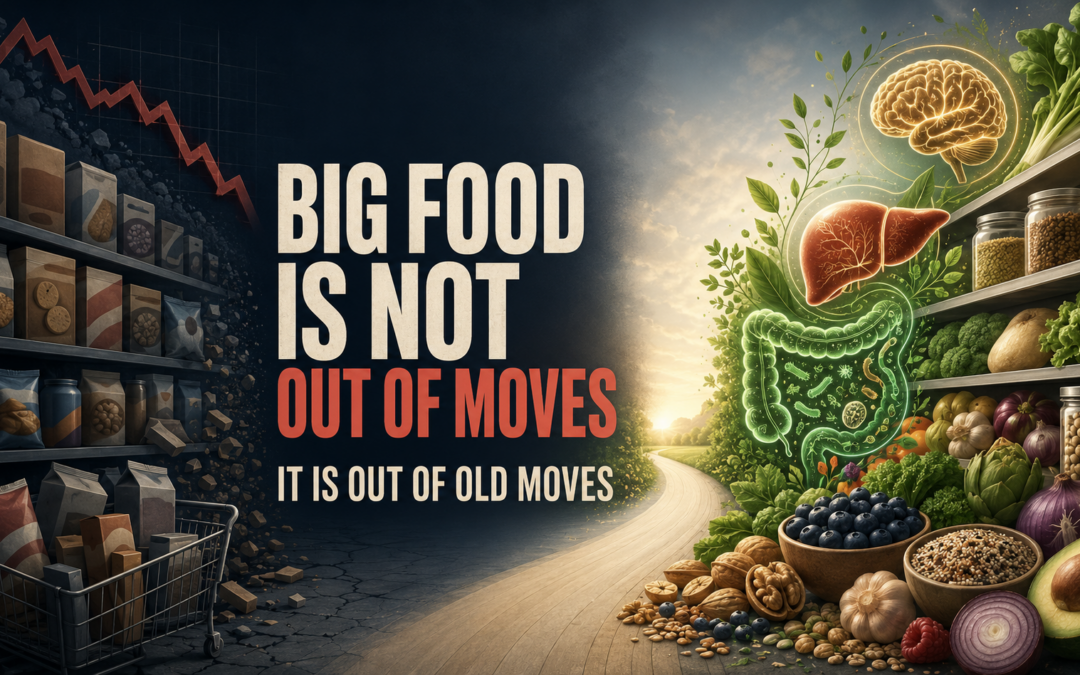
Big Food Is Not Running Out of Moves. It Is Running Out of Old Moves.
The food industry’s crisis cannot be solved by adding protein to yesterday’s products. It requires a fundamentally different approach to food design.
A recent Wall Street Journal analysis delivers a sobering diagnosis of the packaged food industry. Major companies have cut prices, increased advertising, acquired new brands and added protein to familiar products—yet sales continue to decline, profits are under pressure and investors remain unconvinced.
David Wainer’s article, “Big Food Is Running Out of Moves With Shoppers and Investors,” argues that the industry faces something deeper than another difficult economic cycle. Consumers are turning away from many legacy products, retailers are gaining power through private labels, production costs are rising and established food companies are struggling to demonstrate where future growth will come from.
The article is right about the scale of the problem. But Big Food is not necessarily running out of moves.
It is running out of old moves.
A structural problem disguised as a marketing problem
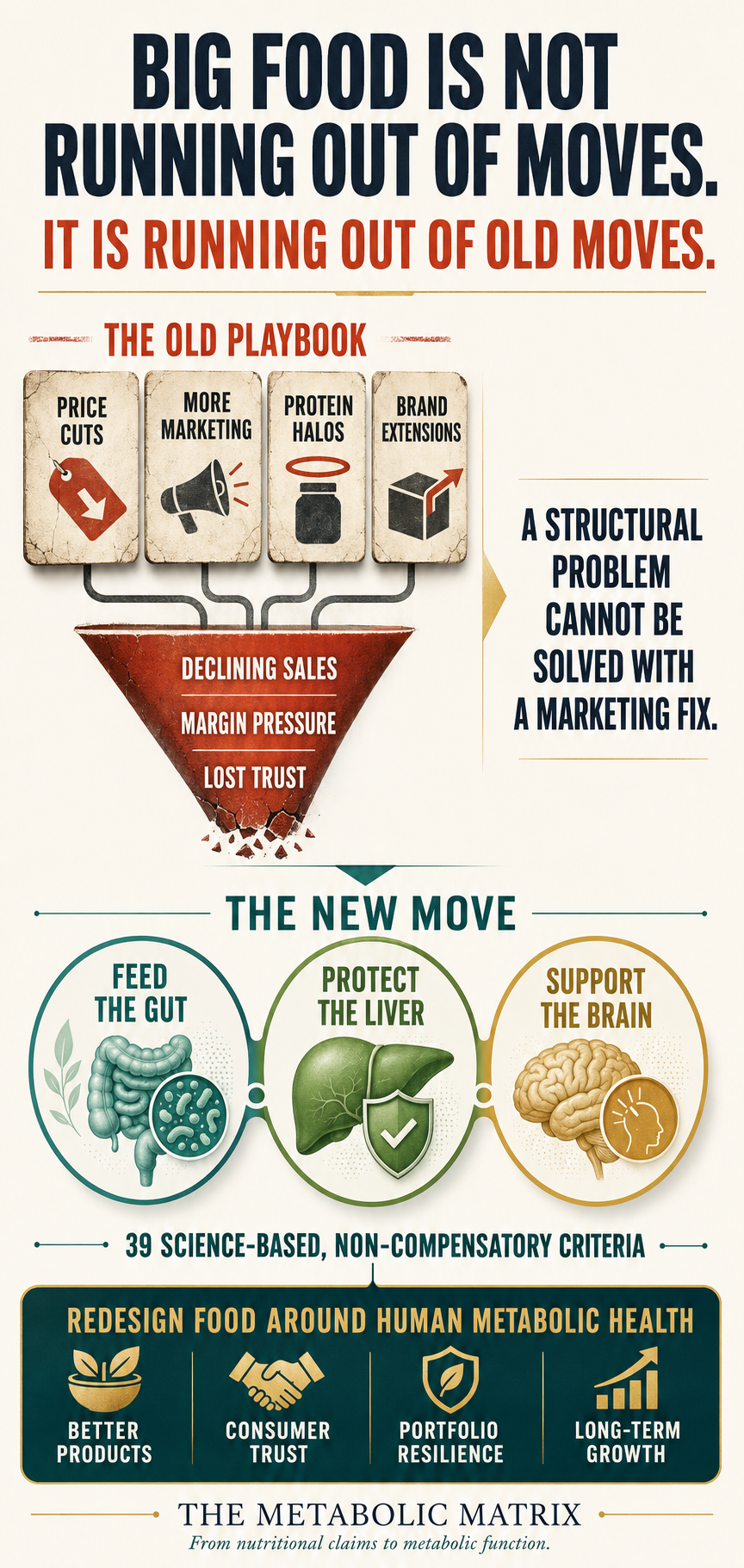
For decades, large food companies could respond to slowing growth through a familiar playbook: new flavors, new packaging, larger advertising budgets, modest reformulation, promotional pricing, acquisitions and extensions of established brands.
These tactics can still generate short-term results. But they do not address the structural change now occurring in the food market.
Consumers are reading ingredient lists more carefully. They are questioning ultra-processed products and increasingly connecting food with metabolic health. Some are trading up to smaller, premium or fresher brands. Others, under severe financial pressure, are trading down to private labels. Both movements weaken the traditional position of large branded food companies occupying the middle of the market.
GLP-1 medications are accelerating this disruption, but they did not create it. Their rapid adoption is one manifestation of a much larger metabolic health crisis—and of growing dissatisfaction with a food environment that has helped produce it.
The central question is no longer simply:
How can companies persuade consumers to buy more of the products they already make?
It is becoming:
How must food be redesigned to meet the biological, economic and social realities consumers now face?
That is a fundamentally different innovation challenge.
Protein is not a transformation strategy
The Wall Street Journal highlights the industry’s rush to add protein to legacy products. Protein can certainly be valuable, particularly when it addresses a genuine nutritional need. But adding a fashionable nutrient to an existing formulation does not necessarily make that product metabolically healthy.
A product may be high in protein while remaining high in added sugar, low in fiber, rapidly absorbed, heavily refined or dependent upon additives that contribute little to health. A prominent front-of-package claim can draw attention away from the overall product design.
The same limitation applies to many conventional reformulation strategies. “Low fat,” “low calorie,” “keto,” “natural,” “clean label” and “no added sugar” can each communicate something useful, but none independently establishes that a food supports metabolic health.
Health cannot be engineered through a single nutrient, claim or marketing halo. Food operates as a matrix. Its ingredients, structure, processing, bioavailability and physiological effects interact.
The challenge is therefore not to identify the next fashionable nutrient. It is to develop a disciplined methodology for designing better food.
From nutritional claims to metabolic function
The Metabolic Matrix was developed to help address this challenge. It evaluates food through three interconnected physiological objectives:
-
Feed the Gut: Does the food support the intestinal microbiome, digestive function and appropriate nutrient delivery?
-
Protect the Liver: Does it reduce unnecessary metabolic burden and help prevent the rapid delivery of substrates that can overwhelm normal liver function?
-
Support the Brain: Does it contribute to appropriate satiety, reward regulation and healthy patterns of consumption?
These three pillars are translated into 39 science-based criteria. Importantly, the criteria are non-compensatory. A positive attribute in one area should not automatically erase a serious weakness elsewhere. Adding protein, vitamins or fiber cannot simply cancel out excessive sugar, harmful processing or a formulation that encourages overconsumption.
This does not mean that every product must be perfect. Nor does it divide the food supply simplistically into “good” and “bad.” It provides a structured way to identify strengths, weaknesses and opportunities for meaningful product improvement.
That distinction matters because the industry does not merely need another scoring symbol. It needs a research, development and decision-making system capable of guiding portfolio transformation.
GLP-1s are a warning from human biology
The food industry could view GLP-1 medications primarily as a commercial threat: people taking the drugs often consume less food and may become less interested in certain calorie-dense products.
That interpretation is too narrow.
The extraordinary demand for these medications reveals the enormous unmet need created by obesity, diabetes and related metabolic diseases. Consumers are not simply following another wellness trend. Many are seeking powerful medical assistance to manage biological processes that their food environment has made increasingly difficult to regulate.
GLP-1s should therefore be understood as a strategic signal. They are demonstrating, at enormous scale, the importance of satiety, appetite regulation, glucose control and metabolic function.
The appropriate industry response is not to search for ways to sell more food to people eating less. It is to ask how food itself can better support satiety, metabolic resilience and long-term health—including for people using GLP-1 medications.
Food and medicine should not be placed in opposition. But neither should the food sector outsource the metabolic health crisis entirely to the pharmaceutical industry.
Real innovation requires more than reformulation
Transforming a food portfolio is difficult work. It may involve changes in ingredients, processing, product architecture, sensory performance, procurement, manufacturing, packaging, pricing and consumer communication.
It also requires collaboration across functions that companies often manage separately. Research, product development, manufacturing, quality, regulatory affairs, marketing, finance, procurement, sales and sustainability must work toward a shared definition of better food.
This is why genuine transformation cannot be reduced to a series of isolated reformulation projects. A company might launch several healthier products while the metabolic profile of its overall portfolio barely changes.
The more important questions are:
-
What proportion of sales is shifting toward metabolically supportive products?
-
Are the company’s largest legacy products improving?
-
Are research and capital being directed toward meaningful health outcomes?
-
Can progress be measured transparently?
-
Is the company building the internal capability to continue transforming?
Real innovation may indeed take years and require significant investment, as the Wall Street Journal observes. But delaying it does not make it less necessary. It only makes the eventual transition more difficult and expensive.
Metabolic health is also a business strategy
Improving food is sometimes treated as a social responsibility initiative sitting outside the commercial core of the company. That view is increasingly outdated.
Metabolic health is becoming a source of market relevance, consumer trust, regulatory resilience and long-term enterprise value. Companies capable of designing foods that are enjoyable, affordable, accessible and metabolically supportive will be better positioned for a market in which consumers, governments, healthcare systems and investors are asking harder questions.
The opportunity is not limited to affluent consumers buying premium health products. The greater challenge—and potentially the greater innovation opportunity—is to make better metabolic nutrition available at scale and at prices ordinary families can afford.
That requires more than replacing mainstream foods with expensive niche alternatives. It requires transforming mainstream food itself.
A new move is still available
The present crisis should not be interpreted as the end of the food industry. It may represent the end of an industrial model that too often treated marketing as innovation and nutrition as a collection of claims.
Big Food still possesses extraordinary capabilities: scientific expertise, manufacturing infrastructure, global distribution, trusted brands and the capacity to make nutritious food accessible to millions of people. These capabilities can become part of the solution—but only if they are directed toward genuine transformation.
The next era will not be won by adding fashionable ingredients to yesterday’s products. It will be won by companies willing to reconsider how food is formulated, processed, evaluated and brought to market.
Big Food is not out of moves.
But its next move must be more than another claim, campaign or acquisition. It must be a credible commitment to redesigning food around human metabolic health.
That is not merely the responsible path forward.
It may be the industry’s most important remaining growth strategy.