
One in Three People Cannot Afford a Healthy Diet. That Is a Food-System Failure.
The latest United Nations figures show modest progress against hunger—but also expose a deeper global inequity: billions of people remain unable to afford food that supports health.
The world has made some progress against hunger. But we should be careful not to mistake improvement for success.
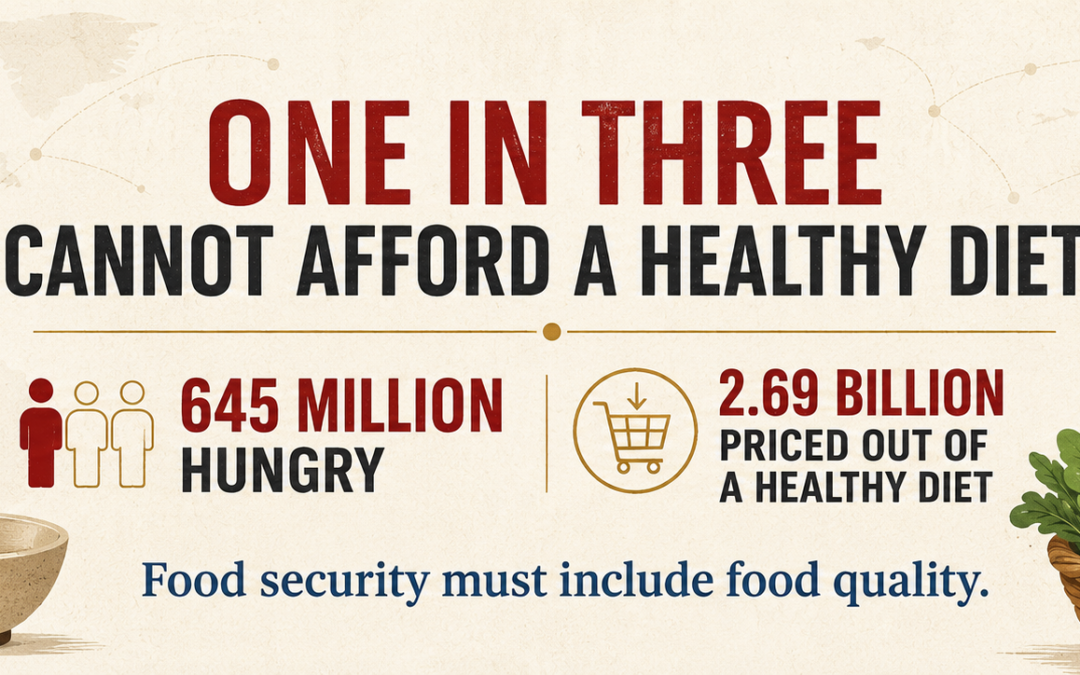
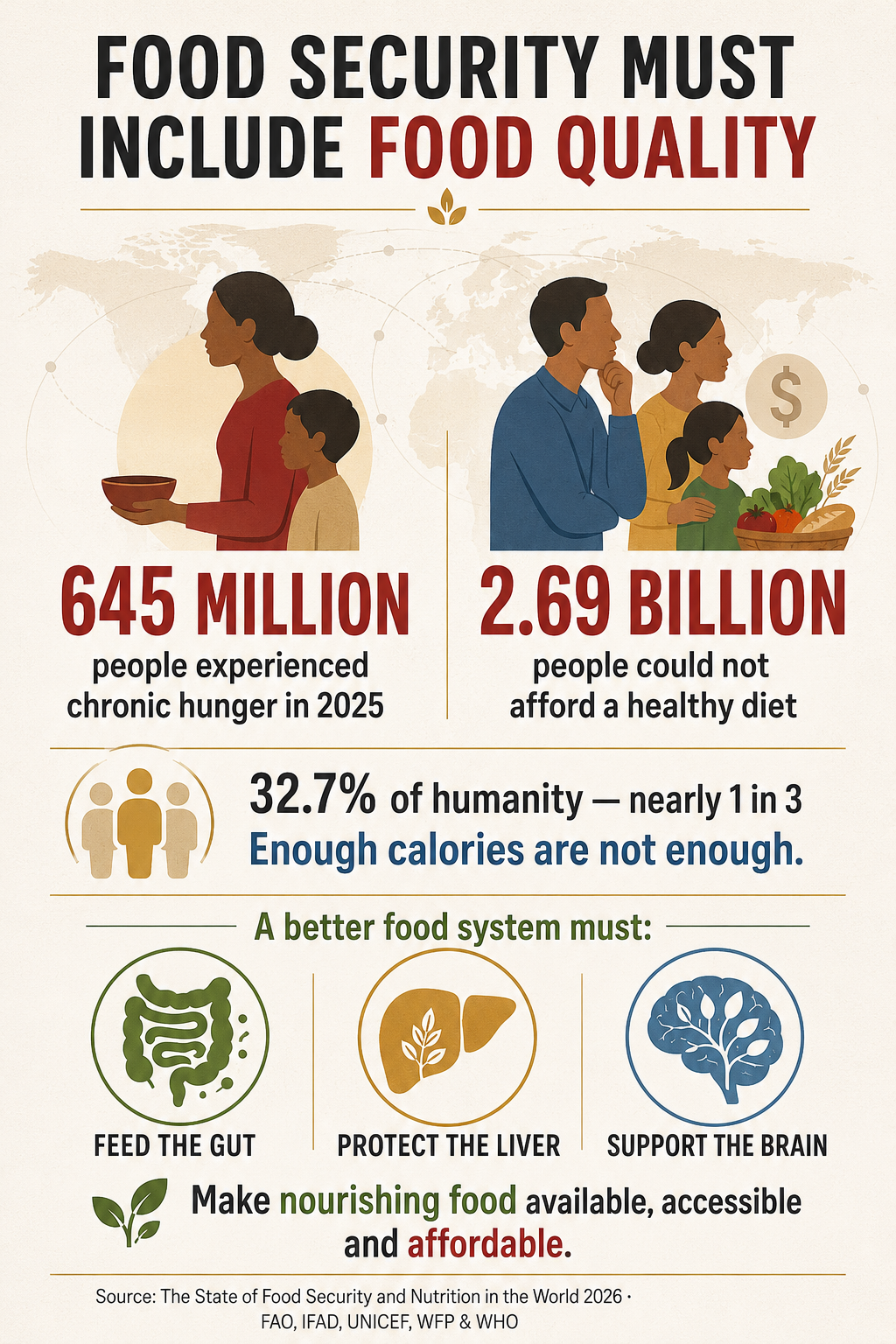
According to The State of Food Security and Nutrition in the World 2026, released on 21 July by five United Nations agencies, approximately 645 million people experienced chronic hunger in 2025. That represents a welcome decline, but the world remains far from achieving the goal of ending hunger by 2030.
An even broader statistic reveals the scale of the challenge:
One in three people worldwide cannot afford a healthy diet.
The precise estimate is 2.69 billion people—32.7% of the global population.
This means the global food crisis is not only about whether people have enough calories. It is also about whether they can obtain the kinds of foods required to nourish the body, prevent disease and support lifelong metabolic health.
Food security must include food quality
For too long, food security has been discussed primarily in terms of quantity: Are enough calories being produced? Can people obtain enough food to avoid hunger?
These questions remain essential. But they are no longer sufficient.
A person may consume enough calories while still lacking adequate protein, fibre, micronutrients and dietary diversity. In many communities, the cheapest and most accessible products are also the most heavily processed and least supportive of metabolic health.
This produces a cruel paradox: hunger, nutrient deficiency, obesity, diabetes and other diet-related diseases can coexist within the same country, community, household—or even the same person.
The distinction between undernutrition and metabolic disease is therefore increasingly artificial. Both can emerge from a food system that fails to provide equitable access to nourishing food.
Affordability shapes what people eat
People cannot choose foods that are unavailable or economically out of reach.
When nutritious foods cost more than household budgets can bear, families must make rational decisions under constrained circumstances. They often turn to foods that provide inexpensive calories, store well and reduce immediate hunger—even when those products may undermine long-term health.
That is not simply a failure of individual choice. It is a structural failure involving incomes, food prices, agricultural policy, supply chains, market incentives and the design of the food supply itself.
The 2026 UN report places the high cost of a healthy diet at the centre of the global nutrition challenge. That emphasis is important because affordability is not peripheral to health. It is one of its fundamental determinants.
From feeding people to nourishing people
The Metabolic Matrix begins with a simple proposition: food should be evaluated not only by what it contains, but by what it does within the human body.
Does it:
-
Feed the Gut?
-
Protect the Liver?
-
Support the Brain?
These three pillars offer a way to examine food beyond calories and isolated nutrient claims. They encourage us to consider dietary fibre, food structure, processing, metabolic response, satiety and the longer-term effects of food on human physiology.
But nutritional quality alone is not enough. A genuinely better food system must make metabolically supportive foods available, accessible and affordable.
A healthy product that remains beyond the reach of most people cannot transform population health. Innovation must therefore address cost and accessibility alongside formulation and scientific quality.
Progress must be judged by who benefits
The decline in global hunger demonstrates that improvement is possible. Yet progress is fragile and deeply uneven. The benefits have not been shared equally across regions or populations.
We should therefore ask harder questions:
-
Who can afford the foods that support good health?
-
Who bears the health consequences when nutritious food is inaccessible?
-
Are we designing food systems around human needs—or merely around the production and sale of calories?
-
Can food companies, governments and researchers make metabolic health an everyday possibility rather than a privilege?
These are questions of science, economics and policy. They are also questions of justice.
A more ambitious definition of success
The global community must continue working toward the eradication of hunger. No person should lack sufficient food.
But our ambition cannot stop there.
Success should mean that every person has access to food that is safe, nourishing, culturally appropriate and supportive of long-term health. It should mean transforming the food supply so that the affordable choice and the healthy choice increasingly become the same choice.
The latest UN figures give us two measures of the work ahead: 645 million people remain hungry, and 2.69 billion cannot afford a healthy diet.
Behind every number is a person whose health and potential are being constrained by the food system around them.
The challenge before us is not simply to produce more food. It is to redesign the system so that it nourishes everyone.
Source: The State of Food Security and Nutrition in the World 2026, jointly published by FAO, IFAD, UNICEF, WFP and WHO. See also the official UN report announcement.