Two Studies. Twenty-Two Years Apart. One Powerful Story About Fructose.
Why modern neuroscience is finally explaining what metabolic researchers first observed more than two decades ago.
For years, discussions about sugar have often been reduced to a simple equation:
A calorie is a calorie.
If fructose and glucose each provide approximately four calories per gram, shouldn’t they affect our bodies in essentially the same way?
Two landmark studies—published more than twenty years apart—suggest the answer is a clear no.
Although conducted in different eras, using different technologies, and even different species, these studies converge on an extraordinary conclusion:
The human body recognizes fructose and glucose as fundamentally different nutrients—not simply different sources of calories.
Together, they tell one of the most compelling scientific stories in modern nutrition.
The First Clue: Metabolism (2004)
In 2004, Dr. Kathleen Teff and colleagues published what has become a landmark paper in the Journal of Clinical Endocrinology & Metabolism.
Rather than asking whether fructose caused weight gain directly, they asked a more fundamental question:
Does the body respond differently after consuming fructose versus glucose?
The researchers provided healthy women with diets in which beverages were sweetened with either glucose or fructose while carefully measuring the body’s hormonal responses.
The findings were striking.
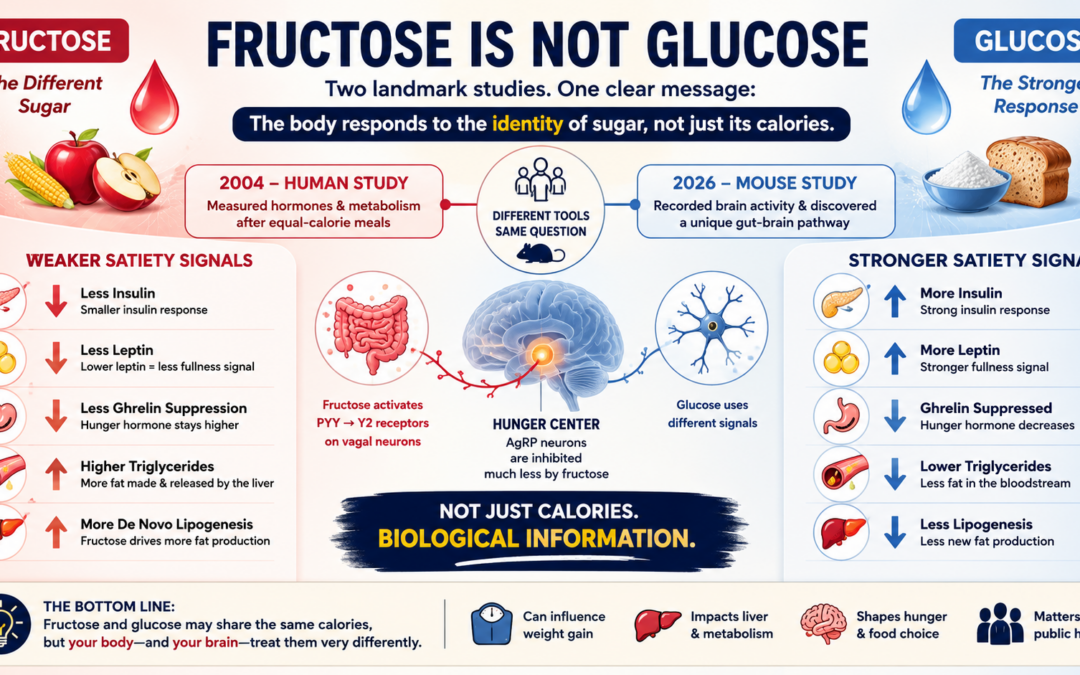
Compared with glucose, fructose produced:
-
substantially lower insulin secretion
-
reduced leptin concentrations
-
weaker suppression of the hunger hormone ghrelin
-
significantly higher post-meal triglycerides
This was the first strong demonstration that two sugars with identical caloric value could produce dramatically different endocrine responses.
The implication was profound.
The body was clearly doing much more than counting calories.
It was responding to what the calories were made of.
But Why?
For years, researchers understood what happened after fructose consumption.
What remained unclear was why.
How did the brain know whether the calories came from glucose or fructose?
What biological machinery distinguished one sugar from the other?
That question remained largely unanswered for more than twenty years.
The Missing Piece Arrives (2026)
In 2026, Aaron McKnight and colleagues published a remarkable paper in Neuron.
Instead of studying hormones circulating in the bloodstream, they looked directly at the brain.
Using advanced neural imaging, they monitored activity in hypothalamic AgRP neurons—the neurons widely recognized as one of the brain’s principal hunger centers.
The expectation, based on prevailing models, was straightforward.
If glucose and fructose provide the same calories, they should inhibit hunger neurons to roughly the same degree.
That is not what happened.
Instead, glucose produced robust inhibition of AgRP neurons.
Fructose produced only a modest response.
Despite identical caloric content, the brain reacted very differently.
This finding overturned the long-standing assumption that these neurons simply detect calories.
Instead, the study demonstrated that they detect nutrient identity.
Following the Signal
The study became even more fascinating.
Rather than stopping with the observation that fructose and glucose affect the brain differently, the investigators traced the pathway responsible.
They discovered that fructose follows an entirely distinct communication route:
Fructose
↓
PYY release from the intestine
↓
Y2 receptor activation
↓
Vagal sensory neurons
↓
Hypothalamic AgRP neurons
This dedicated gut-brain pathway had never been demonstrated before.
Meanwhile, glucose relies on an entirely different signaling mechanism.
In other words, the body doesn’t simply process fructose less efficiently.
It processes it differently.
Two Different Windows into the Same Biology
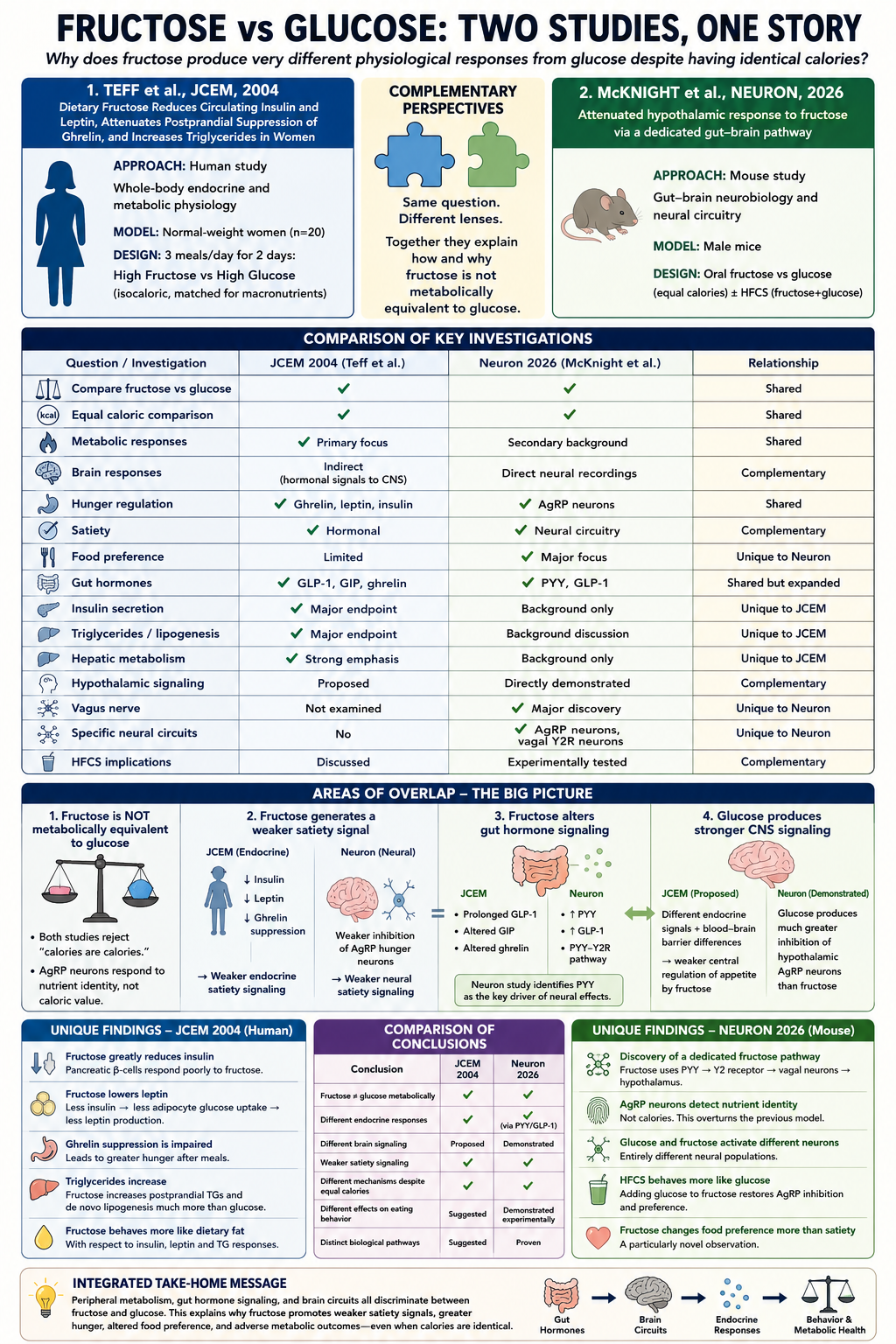
One of the remarkable aspects of these studies is how perfectly they complement one another.
The earlier study examined the body’s endocrine system.
The later study examined the nervous system.
Viewed together, they form two halves of the same story.
The 2004 study showed that fructose produces:
-
less insulin
-
less leptin
-
weaker ghrelin suppression
-
higher triglycerides
The 2026 study explains why the brain receives a fundamentally different physiological message:
-
weaker inhibition of hunger neurons
-
distinct gut hormone signaling
-
a dedicated vagal neural pathway
-
altered food preference learning
The second study doesn’t replace the first.
It explains it.
Calories Are Only Part of the Story
Perhaps the most important message emerging from these papers is philosophical as much as biological.
For decades, nutrition science has often emphasized energy balance.
Calories consumed.
Calories burned.
While energy balance unquestionably matters, these studies demonstrate that calories alone cannot explain how foods influence human physiology.
Two nutrients with identical energy content can produce entirely different hormonal responses.
Entirely different neural responses.
Entirely different metabolic consequences.
The body is reading information—not simply energy.
Implications for Metabolic Health
This distinction has enormous implications.
If fructose and glucose engage different biological systems from the moment they enter the intestine, then food quality becomes inseparable from food quantity.
The conversation shifts from:
“How many calories?”
to
“What biological signals does this food generate?”
That shift has implications for:
-
obesity
-
diabetes
-
fatty liver disease
-
appetite regulation
-
food formulation
-
public health policy
-
precision nutrition
It also reinforces an emerging principle in nutritional science:
Foods are biological signals long before they become calories.
The Bigger Picture
Taken together, these two studies support a unified model of fructose biology.
When fructose is consumed:
-
Peripheral metabolism diverges immediately, producing lower insulin and leptin responses, weaker ghrelin suppression, and greater hepatic triglyceride synthesis.
-
Gut hormone signaling diverges, with fructose preferentially engaging PYY-mediated pathways.
-
Brain signaling diverges, as hypothalamic hunger neurons respond much less strongly than they do to glucose.
-
Behavior changes, with glucose providing a stronger signal of immediate energy availability and exerting greater influence on food preference.
In many ways, the 2026 Neuron paper provides the mechanistic explanation for observations first made in the 2004 human metabolic study.
Twenty-two years later, two independent lines of research have converged on the same conclusion.
The body is not simply counting calories.
It is interpreting biological information.
And when it comes to fructose and glucose, those messages are anything but the same.
Take-Home Message
These landmark studies demonstrate that fructose and glucose are not metabolically interchangeable, despite providing identical calories. The earlier human study revealed striking differences in endocrine and metabolic responses, while the later neuroscience study uncovered the gut-brain circuitry that explains those differences. Together, they reinforce a central principle that is increasingly shaping modern nutrition science: nutrient identity matters. Understanding how different foods communicate with the body’s metabolic and neural systems may prove just as important as understanding how much energy they contain.
Postscript: Placing These Findings in the Context of Dr. Robert H. Lustig’s Research
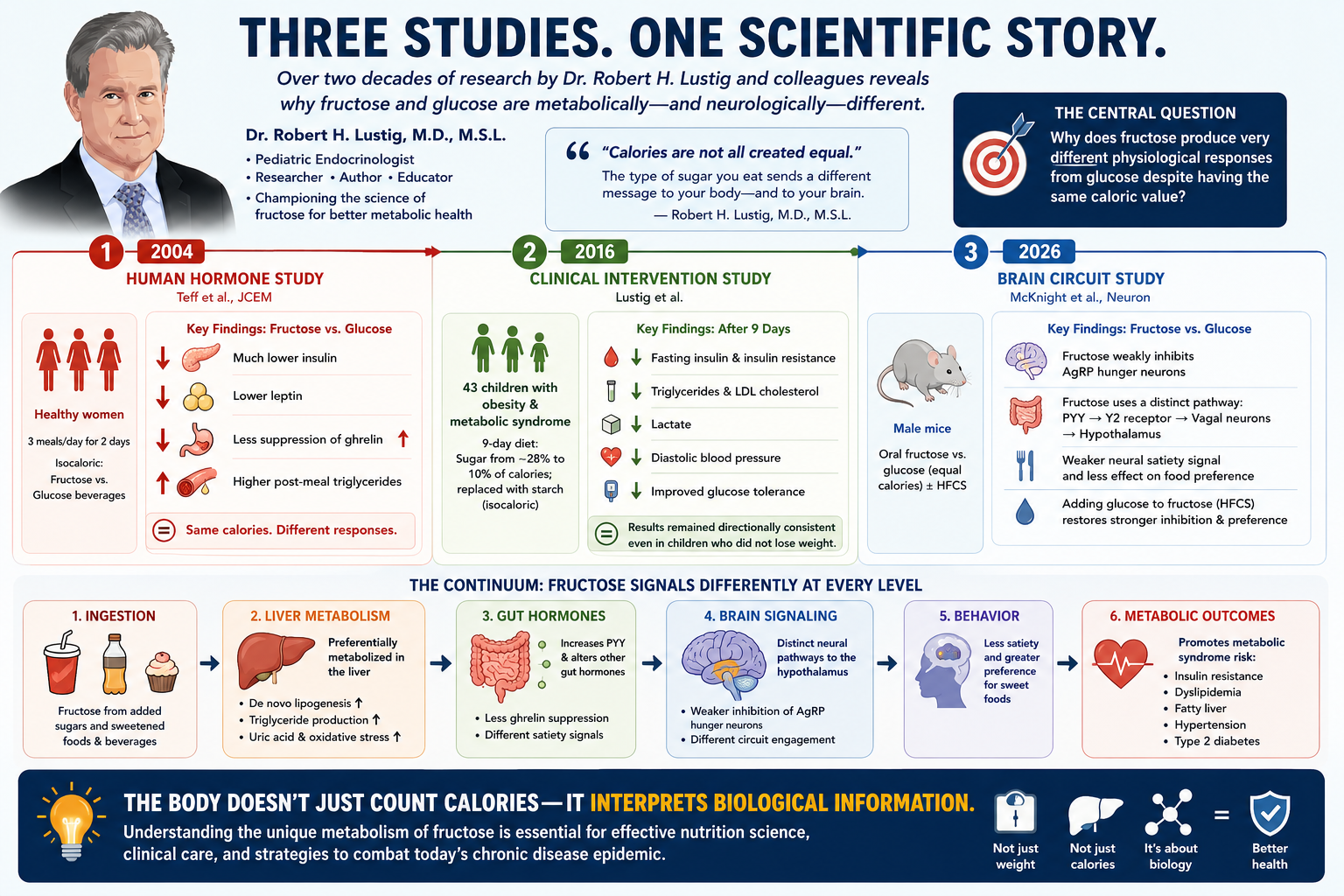
The two studies examined here fit squarely within the broader body of research led and advanced by Dr. Robert H. Lustig on the distinctive metabolic effects of fructose.
For many years, Dr. Lustig has argued that the health effects of sugar cannot be understood solely through caloric arithmetic. His work has emphasized that fructose is handled differently from glucose because of where it is metabolized, how it is regulated, and the downstream effects it can have on the liver, insulin sensitivity, lipid production, appetite signaling, and metabolic disease.
The 2004 study by Teff and colleagues helped establish the endocrine phenotype. Compared with glucose, fructose produced markedly lower insulin and leptin responses, less suppression of ghrelin, and higher triglycerides. In practical terms, the same number of calories generated a different hormonal and metabolic message.
The 2026 Neuron study extends this principle into the nervous system. It shows that fructose and glucose do not merely produce responses of different intensity; they engage different gut-brain pathways. Fructose was less effective than glucose at suppressing hypothalamic AgRP hunger neurons and depended on a distinct PYY–Y2 receptor–vagal pathway. This supports a central idea that has long appeared in Dr. Lustig’s work: the body responds not only to the energy contained in a nutrient, but also to its molecular identity and biological route.
Dr. Lustig’s own intervention research adds an important clinical dimension to this story. In a study of 43 children with obesity and metabolic syndrome, his team reduced dietary sugar from approximately 28% to 10% of calories and reduced fructose from about 12% to 4%, while replacing those calories largely with starch and attempting to maintain body weight. After only nine days, the children showed substantial improvements in fasting insulin, insulin resistance, triglycerides, glucose tolerance, lactate, LDL cholesterol, and diastolic blood pressure. The investigators adjusted the analyses for weight change and also found directionally similar improvements among the subgroup that did not lose weight.
That study is important because it addressed one of the most common objections in the fructose debate: perhaps sugar is harmful only because it adds calories and causes weight gain. Lustig and colleagues attempted to hold calories and overall macronutrient intake relatively constant while changing carbohydrate quality. Their conclusion was that the metabolic improvements could not be explained solely by weight loss or caloric restriction.
The three studies can therefore be viewed as different layers of the same biological argument:
Teff et al. identified the hormonal and lipid consequences.
Lustig et al. showed that reducing sugar and fructose exposure could rapidly improve metabolic dysfunction in children, even without meaningful fat loss.
McKnight et al. revealed a neural mechanism showing that the gut and brain distinguish fructose from glucose at the circuit level.
Together, they strengthen the case that fructose metabolism deserves to be understood on its own terms. This does not mean that every gram of fructose is inherently harmful, nor that fructose consumed within whole fruit should be treated as equivalent to large quantities of added sugar in beverages and processed foods. Dose, food structure, fiber, rate of absorption, overall diet, energy balance, and metabolic status all matter.
But it does mean that reducing the issue to “all sugars are the same” or “only calories matter” is biologically incomplete.
The larger contribution of Dr. Lustig’s research has been to insist on this distinction. His work places the liver at the center of the discussion and frames fructose not merely as a sweetener, but as a substrate capable of driving hepatic de novo lipogenesis, triglyceride production, insulin resistance, and metabolic stress when exposure is excessive and recurrent.
Seen in this context, the new neuroscience findings are not an isolated discovery. They are another piece of a much larger picture.
The evidence increasingly suggests that fructose and glucose differ at multiple levels:
-
intestinal sensing
-
hormonal signaling
-
neural communication
-
hepatic metabolism
-
lipid production
-
insulin action
-
appetite and food preference
The significance is therefore not simply academic. Understanding these differences is essential for nutrition science, clinical care, food formulation, and public health policy.
The most important question is no longer whether fructose and glucose contain the same number of calories.
It is whether those calories deliver the same biological information.
These studies strongly suggest that they do not.