
We keep treating chronic disease as if it were primarily a problem of individual behavior: eat less, exercise more, lose weight.
But what if we’ve been asking the wrong question?
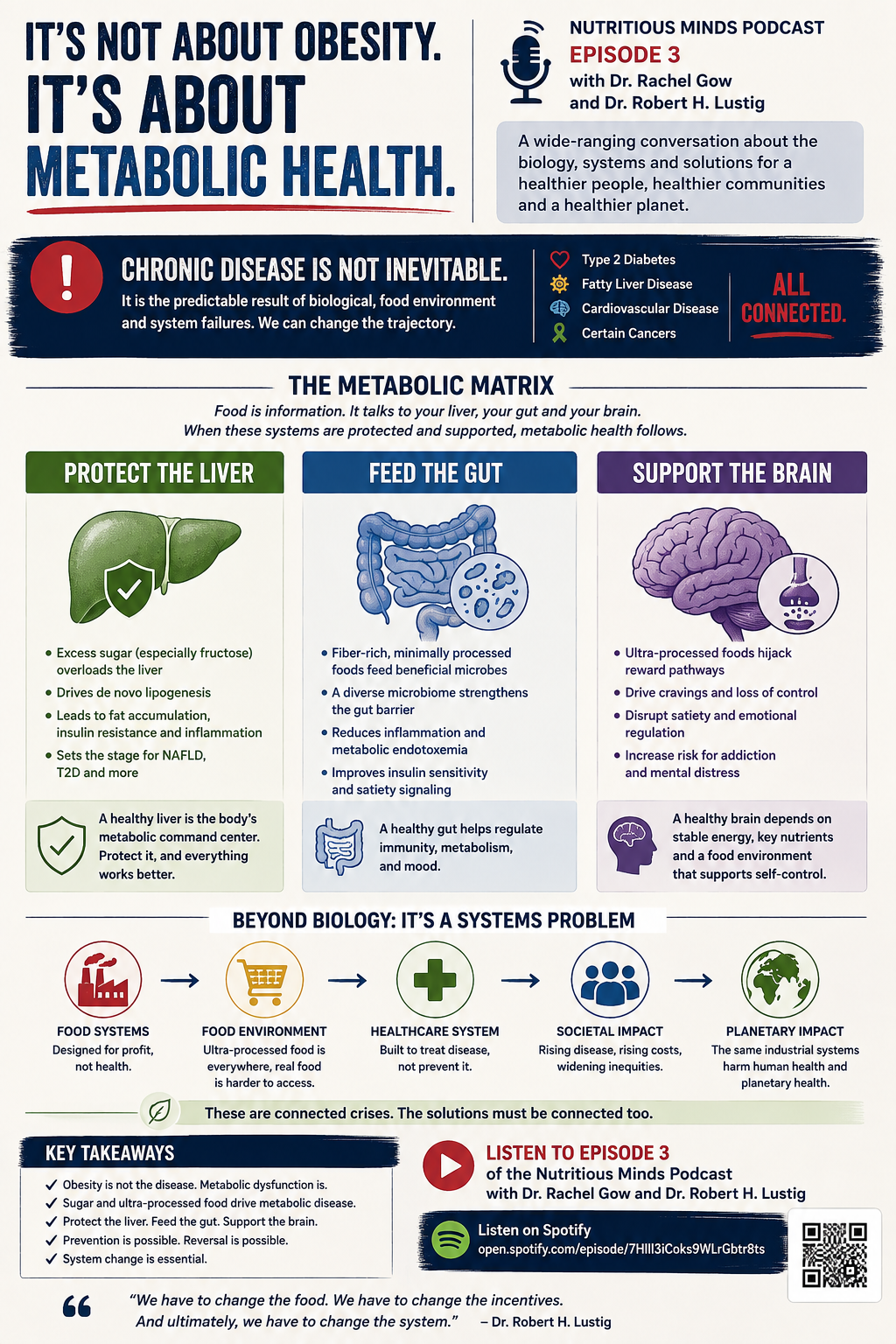
In an episode of the Nutritious Minds Podcast, Dr. Rachel Gow sits down with Dr. Robert H. Lustig for a wide-ranging conversation about what is actually driving the epidemic of chronic metabolic disease—and why solving it requires looking beyond calories, weight, and personal responsibility.
Recorded while Dr. Lustig was in London speaking at the IPM Congress, the conversation begins with the biology.
What happens to the liver? What happens to the gut? What happens to the brain?
Sugar and ultra-processed food don’t simply provide calories. They can alter metabolic function, disrupt satiety and reward pathways, promote insulin resistance, and contribute to the cascade of chronic diseases now consuming an ever-larger share of healthcare resources worldwide.
That distinction matters because obesity is not the disease. Metabolic dysfunction is the disease.
You can be thin and metabolically unhealthy. You can carry excess weight and remain metabolically healthy. If we continue using the bathroom scale as our primary measure of health, we will continue missing what is happening underneath it.
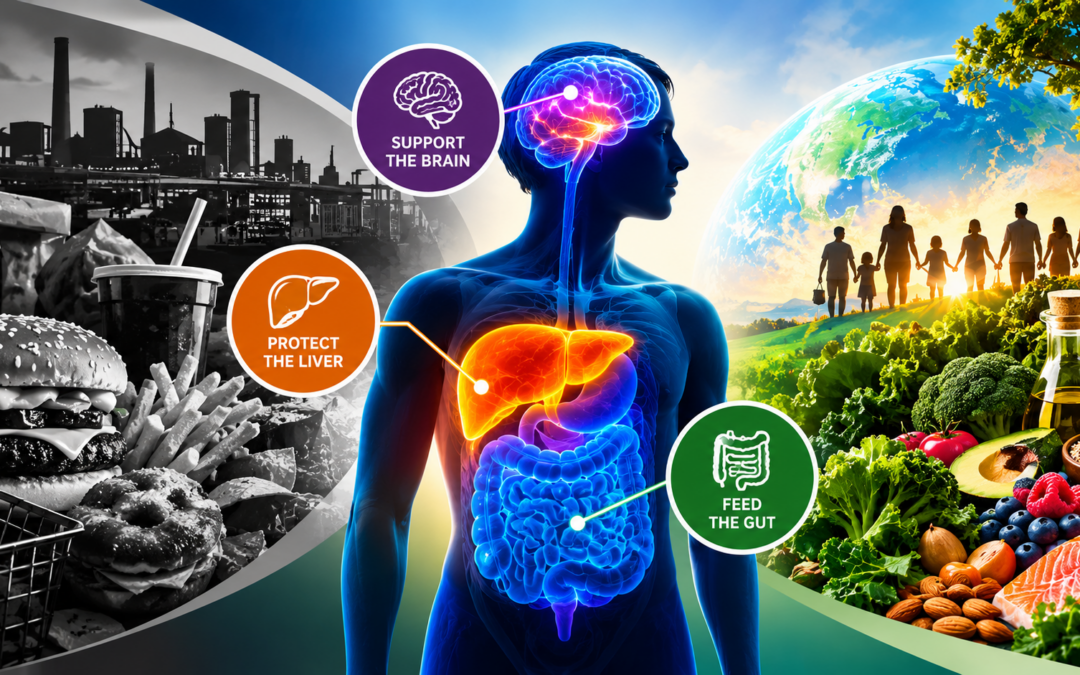
The conversation also returns to the Metabolic Matrix, developed through the work of Dr. Lustig, Dr. Rachel Gow and colleagues, and its three deceptively simple principles:
Protect the liver. Feed the gut. Support the brain.
These principles offer a different way of thinking about food—not simply in terms of calories, nutrients, or marketing claims, but in terms of what food actually does once it enters the human body.
And that leads to the bigger question.
If our food environment is helping drive metabolic disease, if our healthcare systems are largely designed to manage disease after it develops, and if the same industrial systems affecting human health are also placing enormous pressure on planetary health, then these are not separate problems.
They are connected.
The good news is that chronic metabolic disease is not necessarily destiny. Much of it is preventable. Some of it is reversible. But prevention requires more than telling people to make better choices inside an environment engineered to make those choices difficult.
We have to change the food.
We have to change the incentives.
And ultimately, we have to change the system.
This conversation is about how we begin.
Listen to Episode 3 of the Nutritious Minds Podcast with Dr. Rachel Gow and Dr. Robert Lustig.