The Externality Is the Opportunity
How the Metabolic Matrix can help turn the hidden costs of food into measurable health, innovation and economic value
For decades, the global food system has been optimized around what companies could most readily measure and monetize: agricultural yield, manufacturing efficiency, shelf life, price, distribution, sales volume and margin.
That system has achieved something extraordinary. It has made enormous quantities of convenient, affordable food available to billions of people.
But it has also left many of its largest consequences outside the conventional profit-and-loss statement.
The long-term effects of food on metabolic health have largely been treated as externalities—costs borne by individuals, families, employers, healthcare systems and governments rather than by the products and business models that contribute to them.
Those costs are no longer small enough to ignore.
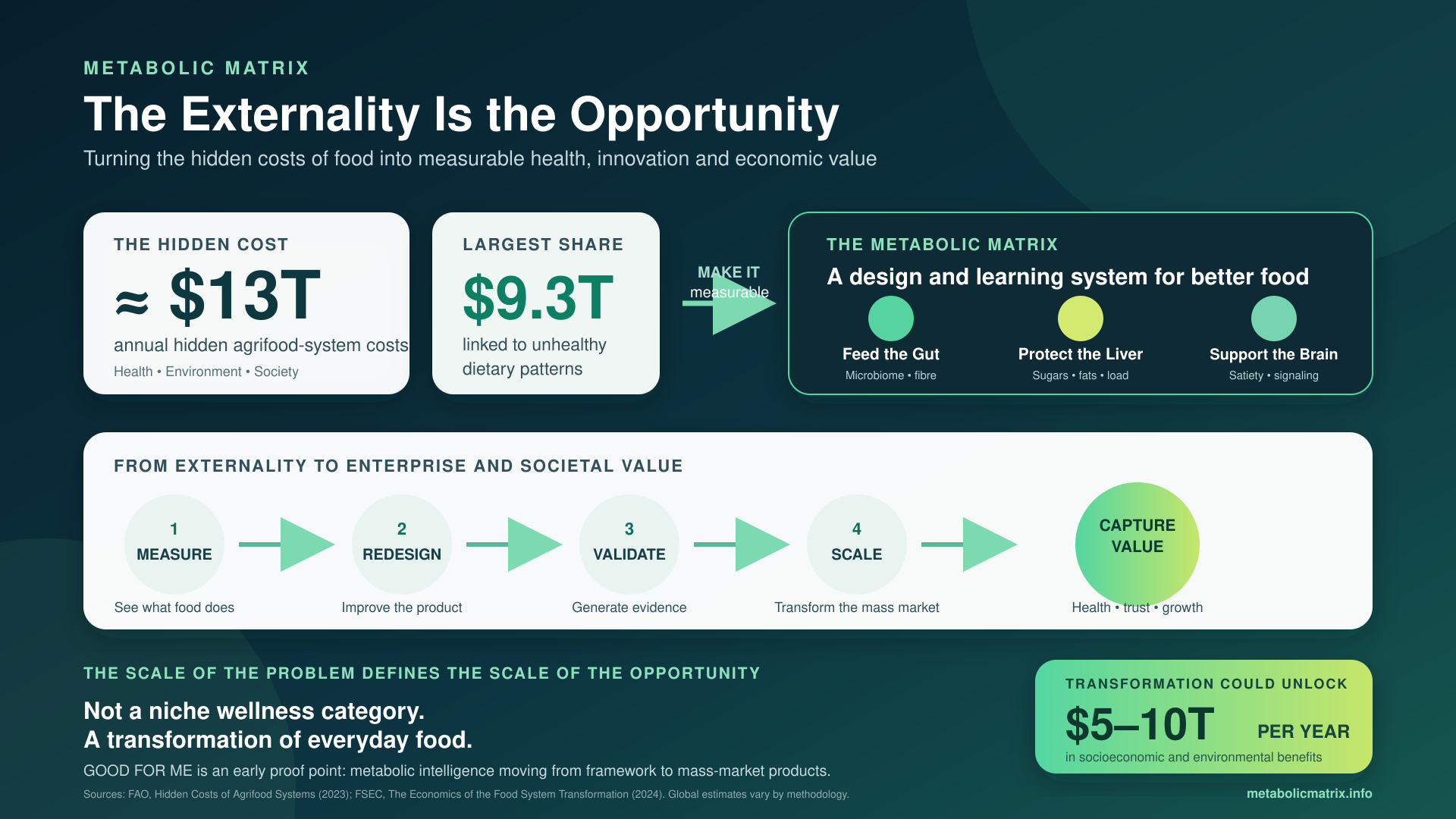
The United Nations Food and Agriculture Organization estimates that agrifood systems generate approximately $13 trillion in annual hidden health, environmental and social costs, expressed in 2020 purchasing-power-parity dollars. Approximately $9.3 trillion of this burden is associated with unhealthy dietary patterns.
Other true-cost assessments have compared approximately $9 trillion in annual food expenditure with total societal costs approaching $29 trillion. Although estimates differ according to methodology and should not be treated as a precise global balance sheet, the central message is remarkably consistent:
The current food system is destroying more value than it creates.
This is normally presented as a liability.
It may also represent one of the largest innovation opportunities in the global economy.
From hidden cost to addressable value
Investor Carter Williams recently offered a powerful reframing: externalities are becoming assets.
The idea is not that harm itself has value. It is that once an externality can be measured, influenced and connected to a decision, reducing it can create economic value.
The food system’s hidden costs point toward unmet needs on an extraordinary scale:
- healthier and more resilient populations;
- lower pressure on healthcare systems;
- foods that support rather than undermine metabolic function;
- stronger consumer trust;
- better agricultural and manufacturing practices;
- reduced regulatory and reputational exposure; and
- more resilient supply chains and businesses.
The Food System Economics Commission estimates that transforming the global food system could generate benefits of up to $10 trillion every year. The estimated cost of achieving that transformation—approximately 0.2% to 0.4% of global GDP annually—is small in comparison with the potential benefit.
This is not a niche opportunity.
If food-related harm is measured in trillions of dollars, then the response cannot be confined to a small assortment of premium wellness products. It requires transformation of the foods and beverages that billions of people consume every day.
The opportunity is not simply to build a healthier category at the margins of the existing system.
It is to redesign the mass market.
The missing measurement layer
Capital and industry can act most effectively when an opportunity can be measured.
Carbon markets emerged because greenhouse-gas emissions could increasingly be quantified, contracted around and assigned an economic value. Regenerative agriculture is attracting investment because changes in soil carbon, water retention, fertilizer requirements and yield resilience can increasingly be observed and evaluated.
Human metabolic health presents a comparable—but more complex—challenge.
Food is ordinarily assessed through a limited set of visible characteristics: calories, macronutrients, selected vitamins and minerals, ingredient declarations and a handful of regulated claims.
These measures are important, but they do not fully describe how a food interacts with human biology.
Two products with similar nutrient panels can affect the body differently because of their physical structure, degree and purpose of processing, fibre characteristics, sugars and sweeteners, fats and oils, additives, fermentation, ingredient interactions and the rate at which nutrients are delivered.
The question is therefore not only:
What nutrients are present in the food?
It is also:
What does the food do after it is eaten?
This is the gap the Metabolic Matrix was created to address.
Making metabolic effects more visible
The Metabolic Matrix is a science-based food-design and evaluation framework organized around three interconnected protective functions:
Feed the Gut
Does the food support the gut microbiome, intestinal barrier and healthy digestive function? Does it provide appropriate forms of fibre and food structure? Does processing preserve or diminish the substrate needed by the gut?
Protect the Liver
Does the food reduce unnecessary metabolic pressure on the liver? How does it address added sugars, refined carbohydrates, fats, additives, nutrient delivery and other characteristics associated with hepatic and metabolic stress?
Support the Brain
Does the food support satiety, cognition, mood and healthy signaling between the gut, liver and brain? Does it help consumers regulate intake, or has it been engineered in ways that encourage consumption beyond biological need?
These three pillars are translated into 39 criteria intended to help researchers, product developers and food companies examine foods more comprehensively.
The Metabolic Matrix does not reduce health to a single nutrient, ingredient or marketing claim. It looks at the product as a system.
It also recognizes that the three pillars are non-compensatory. A product should not be considered metabolically supportive simply because a beneficial ingredient has been added while other important aspects of its formulation remain unaddressed.
Adding fibre does not automatically neutralize excessive added sugar. Adding vitamins does not necessarily restore the properties removed through processing. A health claim on the front of the package does not, by itself, predict what the food will do inside the body.
The Matrix therefore shifts the conversation from health claims to product design.
Measurement creates a learning advantage
The Metabolic Matrix should not be viewed only as a scorecard that separates “good” food from “bad” food.
Its greater value may lie in its ability to create a structured learning system.
When metabolic-health criteria are incorporated into research, formulation and portfolio management, food producers can begin asking better questions:
- Which product characteristics are most important to improve?
- Where are the largest sources of avoidable metabolic pressure?
- Which changes can be made without compromising taste, affordability or accessibility?
- Which ingredients and processes generate several benefits simultaneously?
- How can existing products be progressively improved?
- What evidence is needed to determine whether an intervention produces a meaningful benefit?
- How can lessons from one product inform the next generation of products?
This creates a feedback loop:
Measure the food.
Identify the opportunity.
Redesign the product.
Generate evidence.
Learn from the results.
Apply the learning at greater scale.
The value lies not only in any one improved product. It lies in the capability to learn and improve faster across an entire portfolio.
The benefits can compound
Traditional business analysis often asks each health or sustainability intervention to justify itself independently.
Does adding fibre pay for itself?
Does reducing added sugar increase sales?
Does fermentation support a premium?
Does an improved ingredient justify its additional cost?
This approach can undervalue transformation because the benefits of better food frequently overlap and reinforce one another.
A metabolically improved product may create value through several pathways:
- greater and more meaningful consumer benefit;
- stronger trust and brand preference;
- increased relevance to people concerned about metabolic health;
- differentiation in a crowded category;
- readiness for future regulation;
- reduced dependence on potentially problematic ingredients;
- stronger scientific and healthcare partnerships;
- new data and intellectual property;
- improved employee or population-health programs; and
- access to new markets, customers and channels.
Not every benefit needs to materialize for the investment to succeed.
If one reformulation reduces regulatory risk while another creates stronger consumer preference, the portfolio still advances. If an intervention produces modest short-term sales but generates valuable scientific and formulation knowledge, it may still strengthen the organization’s long-term position.
The externality becomes an asset when reducing harm also improves the underlying product, knowledge base, brand or business system.
GLP-1 medicines reveal the size of the demand
“The GLP-1 franchises, Lilly’s tirzepatide and Novo’s semaglutide, did roughly $71 billion in combined 2025 revenue. The two flagship AI labs, OpenAI and Anthropic, did about $29 billion. Consumers trying to escape metabolic disease are already generating more than twice the revenue of the AI labs. Yet capital markets are committing roughly $600 billion this year to data centers, and almost nothing to the upstream food system that produces the disease in the first place.”
– Carter Williams, Externalities Are the Asset: How Capital Markets Can Securitize Resilience Before Everyone Else Figures Out What It Is Worth.
The rapid growth of GLP-1 medicines provides one of the clearest market signals of the scale of metabolic dysfunction.
Consumers, healthcare systems and insurers are demonstrating an extraordinary willingness to pay for interventions addressing obesity, diabetes and related metabolic conditions.
These medicines may provide substantial benefits for appropriate patients. But they also expose a deeper economic reality: society is already paying enormous amounts to manage the downstream consequences of metabolic disease.
Food operates further upstream.
It reaches people earlier, more frequently and at far greater population scale than any medicine. It can also play an important supporting role for people using medical therapies, whose nutritional needs do not disappear when treatment begins.
Food is not a replacement for medicine. Nor should food companies make pharmaceutical claims for ordinary products.
But the growth of the GLP-1 market confirms that metabolic health is not a marginal consumer concern. It is a major economic demand signal.
The question is whether the food system will respond only by creating products marketed to people already using these medicines—or whether it will undertake the more consequential work of improving the metabolic quality of everyday food.
Mass-market transformation, not niche wellness
A healthier food system cannot depend solely on expensive specialist products available to a small portion of the population.
The foods with the greatest potential impact may be familiar products consumed repeatedly:
- dairy and fermented foods;
- drinks and hydration products;
- breads and grain-based foods;
- snacks and convenience foods;
- culinary staples;
- products designed with appropriate fibres;
- foods that support microbial diversity; and
- reformulated versions of established mass-market products.
Taste, price, convenience, culture and accessibility remain essential. A product that performs well against a scientific framework but is unaffordable, undesirable or unavailable will not transform population health.
The design challenge is therefore not to choose between health and commercial viability.
It is to engineer both.
This is where the food industry’s existing capabilities—formulation, procurement, manufacturing, sensory science, branding, distribution and scale—can become powerful instruments of public-health improvement.
The industry that helped create the problem possesses many of the capabilities required to solve it.
From framework to food
The Metabolic Matrix is already beginning to move from theory into application.
KDD, the Kuwait-based food and beverage company that has led the development of the framework with scientific collaborators, is applying its principles through product research, reformulation and the development of its GOOD FOR ME portfolio.
GOOD FOR ME is intended to demonstrate that metabolically informed food does not have to remain confined to laboratories, academic publications or premium health-food channels. The ambition is to translate the Matrix into enjoyable, accessible products for everyday consumption.
KDD is one participant and an early leader, but the larger purpose of the Metabolic Matrix extends beyond any single company.
The framework offers a shared language through which scientists, food producers, healthcare leaders, governments, investors and consumers can examine how food is designed—and how it might be improved.
Its long-term relevance will depend on continued scientific scrutiny, transparent methods, independent validation and application across different products, cultures and food systems.
No single framework can transform food by itself.
But transformation becomes far more difficult without a framework capable of defining the direction of travel.
Buying the option to learn
Food companies do not need perfect certainty about the future before beginning this work.
They do not need to redesign every product at once or claim that every improvement will produce a measurable clinical outcome.
They need to acquire the ability to learn.
That means investing in product assessment, data, research partnerships, ingredient knowledge, reformulation capability and real-world evidence. It means testing where metabolic-health principles can improve products without sacrificing consumer acceptance. It means learning which interventions survive outside the laboratory and which disappear when exposed to the realities of cost, manufacturing and consumer behavior.
In investment terms, this is a real option.
A relatively focused investment today can create knowledge, relationships, data and capabilities that preserve the right to scale when the market, evidence and policy environment become clearer.
Uncertainty is not necessarily a reason to remain outside the transformation.
It is one reason the learning position is valuable.
Turning hidden harm into visible value
The old food system largely succeeded by producing more food, more efficiently, at lower apparent cost.
The next food system must retain the best of that achievement while confronting the costs that were previously left outside the calculation.
That does not mean attaching a health claim to the existing system.
It means building the capacity to understand food differently.
The Metabolic Matrix offers a pathway:
Make the metabolic effects of food more visible.
Translate that knowledge into better product design.
Test improvements against evidence and real-world constraints.
Validate evidence with peer reviewed science and research
Apply what works across the mass market.
Convert reduced harm into consumer, societal and economic value.
The scale of today’s externalities tells us something important about the scale of tomorrow’s opportunity.
Food-system transformation is not a charitable exercise at the edge of the economy. It may be one of the largest sources of unrealized value within it.
The externality is not the asset because harm is valuable.
The externality becomes an asset when we develop the knowledge, tools and products required to remove it.
That is the opportunity the Metabolic Matrix is designed to help unlock.
References and further reading
- Food and Agriculture Organization of the United Nations. The State of Food and Agriculture 2023: Revealing the True Cost of Food to Transform Agrifood Systems.
https://www.fao.org/agrifood-economics/publications/detail/en/c/1661488/ - Lord, S. Hidden Costs of Agrifood Systems and Recent Trends from 2016 to 2023. FAO Agricultural Development Economics Technical Study No. 31.
https://www.fao.org/agrifood-economics/publications/detail/en/c/1661522/ - Food System Economics Commission. The Economics of the Food System Transformation.
https://foodsystemeconomics.org/wp-content/uploads/FSEC-GlobalPolicyReport-February2024.pdf - University of Oxford. “Fixing the Broken Food System Would Unlock Trillions of Dollars in Benefits.”
https://www.ox.ac.uk/news/2024-01-29-fixing-broken-food-system-would-unlock-trillions-dollars-benefits-study-finds - Williams, Carter. “Externalities Are the Asset: How Capital Markets Can Securitize Resilience Before Everyone Else Figures Out What It Is Worth.” August 30, 2026.
https://foodishealth.substack.com/p/externalities-are-the-asset