
Metabolic Health and Nutrition
Connecting knowledge, food innovation, and a community working for change
Food connects our everyday lives to the workings of our bodies. What we eat, how food is made, and the choices available to us all belong in the conversation about health.
Metabolic health describes how well the body manages the processes that turn food into energy and support normal function. Nutrition concerns the foods and nutrients that sustain those processes. Together, metabolic health and nutrition help us consider how food supports the body over time. medlineplus.gov
This perspective raises a practical question: How can we make foods that support metabolic health more widely available?
Answering it requires scientific knowledge, changes in how food is developed, and people willing to share what they learn.
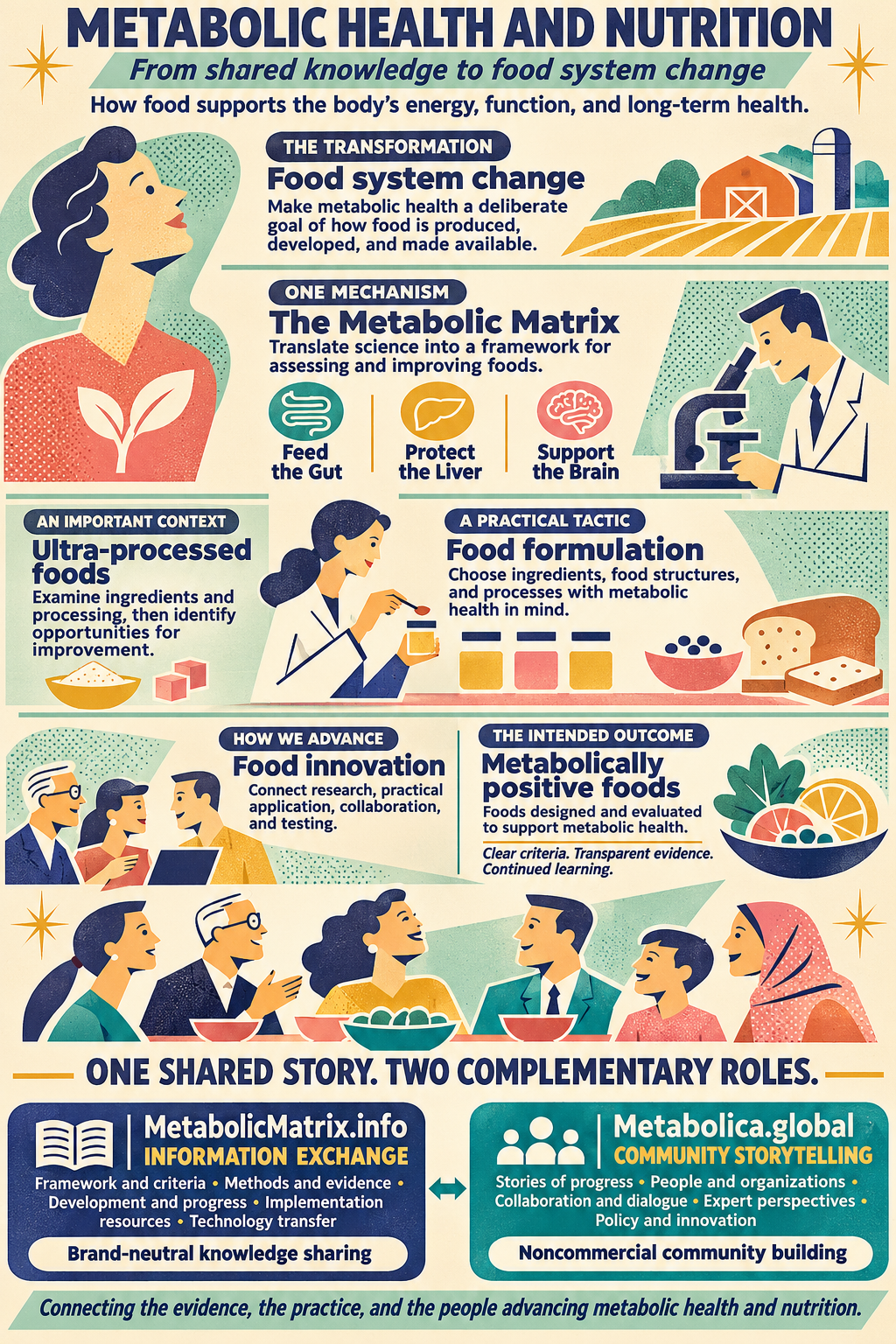
Food system change is the transformation
The foods available to us reflect decisions made across agriculture, research, manufacturing, retail, healthcare, and public policy. Improving those foods therefore requires action across the food system.
Food system change means bringing health into those decisions: what we grow, which ingredients we use, how we process and formulate products, what institutions serve, and which innovations receive support.
The ambition is to make nourishment a more deliberate outcome of the food system—and to make progress practical, accessible, and relevant to different communities.
The Metabolic Matrix is one mechanism
The Metabolic Matrix offers a structured approach to translating nutrition science into food assessment and development. Its methods paper describes a framework organized around three principles: Feed the Gut, Protect the Liver, and Support the Brain. These principles guide criteria for evaluating foods and identifying opportunities for improvement. frontiersin.org
The framework is one contribution to a wider field of work. Its value depends on scrutiny, application, learning, and continued development. Sharing its methods and evidence allows other organizations to examine the approach and consider how it might serve their own circumstances.
Food formulation is a practical tactic
Food formulation is where many decisions about a product become concrete: the ingredients selected, their proportions, the structure of the food, and the processes used to make it.
For existing products, reformulation creates an opportunity to reconsider those decisions. For new products, formulation allows metabolic health to be considered from the outset.
The task is to translate scientific principles into foods people can access, afford, and enjoy, while evaluating whether the intended improvements have been achieved.
Ultra-processed foods are an important context
Ultra-processed foods are a central subject in discussions about the relationship between industrial food production and health. They are also an important context for the development of the Metabolic Matrix, whose published methodology examines ingredients and processing as part of a broader approach to product improvement. frontiersin.org
This creates a practical agenda: investigate the features of foods that matter, examine the evidence, and identify changes worth making and testing. Classification can help frame the discussion; formulation and innovation provide opportunities to act.
Metabolically positive foods are the intended outcome
By metabolically positive foods, we mean foods designed and evaluated with the aim of supporting metabolic health.
The phrase expresses an outcome to work toward. It should be accompanied by clear criteria, transparent evidence, and an honest account of what has—and has not—been demonstrated. Improving a formulation is an important step; establishing its effects on human health may require further research.
The ambition is to make metabolic health a meaningful consideration in food quality and development.
Food innovation is how we move forward
Food innovation connects knowledge with practical change. It can involve ingredients, formulation, processing, assessment methods, or new ways of making better food accessible.
Progress also depends on collaboration. Researchers generate and test ideas. Manufacturers explore their application. Healthcare professionals and institutions identify needs. Policymakers shape the conditions for change. Communities contribute experience, expectations, and feedback.
Sharing this work helps others learn from it. A documented method can support another organization’s development process. A story of progress can introduce new collaborators. A clearly explained limitation can help the next project ask a better question.
Two websites share this story in different ways
MetabolicMatrix.info is an information exchange site devoted to the Metabolic Matrix. It brings together the framework and criteria, methods paper, scientific evidence, research references, development updates, implementation resources, technology transfer information, and guidance on framework versions.
Its purpose is brand-neutral knowledge sharing. Its deliberately straightforward presentation helps people find, examine, and use information. Organizations should be able to explore the framework on its merits and consider adopting it without treating that adoption as an endorsement of any commercial brand.
Metabolica.global is a community storytelling site for the broader movement in metabolic health and nutrition. It shares stories of progress and introduces the people, organizations, companies, and institutions advancing the field.
Its purpose is noncommercial community building: encouraging collaboration and dialogue, sharing expert perspectives, exploring food policy, and giving visibility to innovators and initiatives. The Metabolic Matrix is part of this story, alongside the work of others across the field.
Both sites acknowledge the contributions behind the work while serving a wider purpose than promoting an individual company. One makes knowledge available for examination and application. The other helps a community discover, discuss, and advance that work.
Together, they connect the evidence, the practice, and the people working toward food systems that better support metabolic health and nutrition.